
Penguin Press
We may receive an affiliate commission from anything you buy from this article.
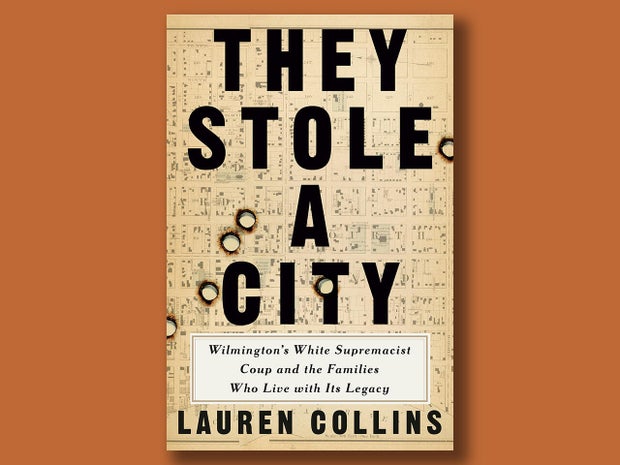
In “They Stole a City: Wilmington’s White Supremacist Coup and the Families Who Live With Its Legacy” (to be published July 14 by Penguin Press), The New Yorker writer Lauren Collins examines how, in 1898, white supremacists staged a coup against Wilmington, N.C.’s multi-racial government – a case study in the sabotage of American democracy.
Read an excerpt below, and don’t miss Lee Cowan’s interview with Lauren Collins on “CBS Sunday Morning” July 12!
Prefer to listen? Audible has a 30-day free trial available right now.
Most accounts of 1898 begin with Reconstruction or, more often, with 1894 and the creation of the racially diverse Fusion movement. They conclude in late 1898, with the McKinley administration’s refusal to send troops to Wilmington or to extend any other form of aid, emboldening white terrorists nationwide. At the outer limit, they continue to 1900. That year, the passage of voting restrictions, accompanied by a grandfather clause exempting anyone whose forebear could vote before 1867 from disenfranchisement— that is, almost all white men—achieved the white supremacists’ goal of evicting Black people from political life. It seemed to me that 1898 had been put into a historical container that couldn’t hold its copious antecedents, its complex consequences spilling into the coming centuries in messy, unpredictable streaks. The event begged to be examined in its longitudinal fullness. I stuck a note card to the shelf above my desk: “American coup—and then what?”
In addition to extending the timeline of 1898 into both the past and the future, I have enlarged the human scope of inquiry, focusing on families rather than individual players. Twenty thousand people lived in Wilmington in 1898. They passed their experiences down to their children, who transmitted them to their own, and so on: hundreds of thousands of lives, interrupted, consolidated, dispersed, concentrated, thwarted, redirected, punctuated, complicated, elevated, degraded, enriched, ruined, marked, transformed. Families are both the incubators and the life-support machines of memory. The North Carolina legislature’s recent efforts to disenfranchise Black voters through gerrymandering and voter identification laws are nothing if not the grandchildren of the grandfather clause. Tracing the intergenerational transmission of racial terror is critical because it allows us to see who made its instigators and survivors the people that they were, and to assess how their legacies shape the choices that their descendants make today.
Wilmington’s Black population declined moderately in the immediate wake of 1898, as did the number of Black-owned businesses. White supremacists thereafter dominated political life in Wilmington and much of North Carolina, which did not elect another Black person to national office until 1992, when I was twelve. Statistics are enlightening, but insufficient for understanding this heritage. The qualitative fallout of 1898 is no less important for being more difficult to measure. We know that Black people lost life in 1898. Did they lose love? Lose touch? Lose hope, or muster strength? What did white people tally in pride, confidence, entitlement, shame?
To answer these questions, I have chosen principally to follow four Wilmington families, the Bellamy/MacRaes, the Moores, the Howes, and the Halseys. The first two are white families who contributed to the violence and its afterlife. The latter two are Black families who came through it. Their trajectories have diverged and sometimes overlapped in the 125 years since their forebears moved through the same dusty streets on one November day. Each family has developed its own strategies for explaining and remembering their ancestors’ actions in 1898. Some of them have chosen to stay quiet for understandable reasons, but others have made courageous efforts over the course of many years to tell these stories. In collaboration with these living descendants, I have sought to create a more complete account of 1898 than that which can be understood solely from the archive.
1898 is often presented as “hidden history.” It is true that the story was long subject to powerful taboos, but in recent years, public awareness has increased due to the work of filmmakers, scholars, writers, and musicians, along with a surge of interest in the subject of racial violence after the murder of George Floyd and the January 6 Capitol attack. Even if many people remain ignorant of 1898 and its seminal role in undemocratizing American democracy, its legacy is closer to a cipher than a secret. There are so many people, after all, whose relatives murdered or were murdered; whose fortunes prospered or failed; who do know what happened, because of the antique gun that they keep in a closet, or the New York address on their birth certificate, because of deathbed unburdening they’ve never forgotten, or how the ramifications of 1898 factored into their parents’ 1960s divorce.
The historian Glenda Gilmore has written, “Murder’s best work is done after the fact, when terror lives on in memory.” This book argues that the damage of the Wilmington massacre and coup, already great, far exceeds the number of people murdered on November 10, 1898. It demonstrates that the white supremacists began their work long before 1898, and continued it long after with Jim Crow and the violently botched desegregation of schools in the 1950s and ’60s; the devastating closure of Williston Senior High School, Wilmington’s bastion of Black education, in 1968; and the wrongful convictions, in 1971, of the Wilmington Ten for arson and conspiracy. 1898 lives on in Wilmington today in persistently low rates of Black voter participation, homeownership, and business ownership. Among white people, intergenerational wealth, the monopolization of public memory, and an enduring sense of chauvinism—a locally tinctured strain of white nationalism—must be counted among the massacre and coup’s consequences. Only with a full, encompassing inventory of 1898’s harm can we seek appropriate repair.
1898 was a premeditated takeover that enabled the ongoing needs of white supremacy, not the spontaneous folly of a few local racists. Treating it as an idiosyncratic moment in an ever-distant past renders it spectacle to be wondered at from safe remove. In fact, as a case study in the sabotage of American democracy by revanchist politicians, aggrieved moguls, and a bullying right-wing media, it presents unignorable lessons for today. To avoid repeating 1898, we must acknowledge it for what it was: a successful effort by white supremacists to wrest power from Black people who had amassed significant amounts of it—murder’s worst work, the crime of 128 years and counting.
From “They Stole a City: Wilmington’s White Supremacist Coup and the Families Who Live With Its Legacy” by Lauren Collins, published by Penguin Press, an imprint of Penguin Publishing Group, a division of Penguin Random House LLC. Copyright © 2026 by Lauren Collins.
Get the book here:
“They Stole a City” by Lauren Collins
Buy locally from Bookshop.org
For more info:
- “They Stole a City: Wilmington’s White Supremacist Coup and the Families Who Live With Its Legacy” by Lauren Collins (Penguin Press), in Hardcover, eBook and Audio formats, available July 14
- Lauren Collins, The New Yorker
- Lauren Collins on Instagram
- Lauren Collins’ Lettre Recommandee (Substack)