Viking
We may receive an affiliate commission from anything you buy from this article.
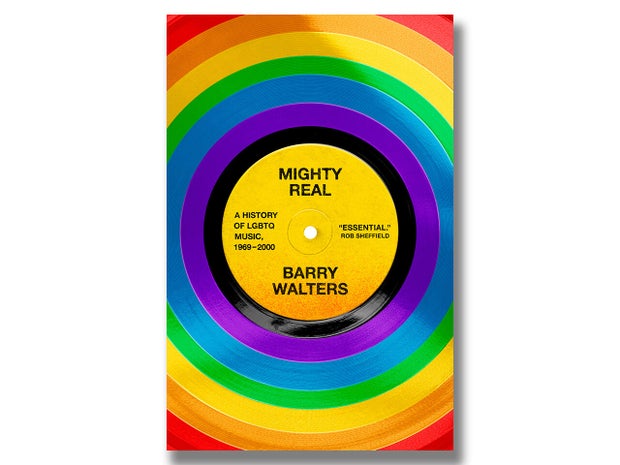
In his new book, “Mighty Real: A History of LGBTQ Music, 1969-2000” (published by Viking), Barry Walters, a writer for such publications as Rolling Stone and Spin, explores how LGBTQ songwriters, musicians, execs and fans reshaped pop culture in the late 20th century, as queer messages in music became less coded.
Read an excerpt below about the influence of singer-songwriter Elton John, and don’t miss Barry Walters on “CBS Sunday Morning” July 19!
Prefer to listen? Audible has a 30-day free trial available right now.
Chapter Nine
Elton John
“It’s a little bit funny, this feeling inside/I’m not one of those who can easily hide” goes the opening of Elton John’s introductory 1970 hit “Your Song,” but hide Sir Elton initially did. Forget for a moment everything you know about his trademark garishness and contemplate his first few album jackets. There’s lots of beige and denim—little gaiety. For much of his early ’70s catalog, the songs within were also earth‑toned, yet rarely autobiographical. Even when paying tribute to Americana in 1970’s conceptual country album Tumbleweed Connection, his sidekick lyricist and fellow Englishman Bernie Taupin imparts mythic, even gothic otherworldliness to the Old West and bygone South. Conjuring detailed imaginary worlds through compositionally rich and sumptuously symphonic talents rarely exceeded in pop, the piano man makes their reveries seem conversely real because he serves them with surreal levels of feeling. The bounty of Taupin’s wordy poesy and the fulsomeness of Gus Dudgeon’s production pull each album further into an extroversion rare for singer‑songwriters. As word spread of Elton’s showmanship, his presentation grew far larger than the personal life he avoided discussing.
Aside from “Razor Face” on 1971’s Madman Across the Water, which offers love to a grizzled and quite possibly gay elder gent who’s “looking for a place to lay down,” someone who “needs a young man to walk him around,” there isn’t much tangible queerness to Elton’s earliest records. Tentative steps to a pop‑art presentation are taken on 1972’s Honky Château, and its singles proved relatable to LGBTQ people. “Rocket Man” is sung by an astronaut removed from ordinary existence. When society kept most of us closeted, its axial line “I’m not the man that they think I am at home” voiced our secrets by proxy. “Honky Cat” tells the story of an outland lad who, like many of us, finds salvation in the big city’s bright lights. Don’t Shoot Me I’m Only the Piano Player furthered this evolution in 1973. Sung from one brother to another, “Daniel” was the closest we got to a ubiquitous ’70s same‑sex love song. It’s that same year’s subsequent Goodbye Yellow Brick Road that flicked the switch from sepia to Technicolor for good. Rather than merely paraphrasing old‑time boogie‑woogie, as he did on Don’t Shoot‘s kitschy “Crocodile Rock,” Elton becomes a genuine rocker here, yet simultaneously show tune‑y—a combo that would influence queer rock musicals like Hedwig and the Angry Inch, as well as theatrically inclined LGBTQ rockers like Scissor Sisters. For the first time, Elton consistently captures the exuberance of his piano-pounding, Little Richard–inspired concerts, which chafed against his early earnestness. Recorded with the working title “Silent Movies and Talking Pictures,” Goodbye serves as his musical coming out—a prelude to his personal one in Rolling Stone, first as bisexual in 1976, then as gay in 1988.
You can see that shift in Goodbye‘s artwork. Clad in a pink‑satin bomber jacket, Elton abandons the monochromatic drabness of ordinary existence and follows the bluebird of happiness into the dawning of a far‑brighter, Hollywood‑inspired reverie over the rainbow. He’s not forgoing The Wizard of Oz‘s yellow brick road, as the title suggests, but stepping right onto it in glittery, crimson platform shoes—the ’70s male equivalent of Dorothy’s ruby-red slippers. Its symbolism couldn’t be clearer: The musician flees the drab reality he was born into as Reg Dwight, his birth name, and trades it for the emerging LGBTQ dream of a multicolor utopia he could only reach as Elton John. He’s even wearing rose‑colored glasses.
You can hear this transition in the music, too, right in the opening medley. A dirgelike overture, “Funeral for a Friend” can be heard as a eulogy for Elton’s former closeted self, summing up the seriousness of his previous albums before slamming into “Love Lies Bleeding.” This stately swell of rock ‘n’ roll shifts Elton away from a softy singer‑songwriter into a genre‑crossing genuine rocker.
The third of six consecutive chart‑topping albums, Goodbye marks when Elton attained the cultural centrality of the Rolling Stones, whose muck he mimics on “Dirty Little Girl.” More unexpected is the specter of Slade—glam’s butchest best‑selling louts—on the double LP’s shout‑along lead single, “Saturday Night’s Alright for Fighting,” and even Alice Cooper on “All the Girls Love Alice,” which eulogizes a well‑bred but licentious sixteen‑year‑old lesbian.
The latter song’s illustration in Goodbye‘s triple‑gatefold sleeve further draws from The Killing of Sister George, a 1968 film that also features a queer Alice. Like Elton’s 1974 hit “The Bitch Is Back,” which set a precedent for the b‑word’s popularity in pop but bypasses its usual misogyny (because the singer calls himself a bitch and owns it), Sister George isn’t remotely PC. Its lesbians live cruel, mutually destructive lives, and the song goes even further to suggest—as did many other LGBTQ movies of the era—that if you act on queer passions, you’ll wind up dead. Still, a catchy, hard‑rocking, lesbian-themed tune on a number one album was a breakthrough that spoke to LGBTQ listeners hungry for any likeness of our lives. Although Taupin’s lyric shows little understanding of gay experience, Elton’s music feels firsthand. Punctuated by pregnant pauses and peaking in a vortex of stabbing guitars, pounding piano, zip‑zapping synths, and ricocheting sound effects, it’s Elton’s sexiest song. “If I give you my number, will you promise to call me?/Wait till my husband’s away,” he pleads from the perspective of Alice’s female admirers. Here was a likely gay superstar singing about same‑sex relations with first‑person pronouns—and it’s hot. When lesbians had no mainstream voice, this spoke volumes. I played this track obsessively at age twelve while reading the lyrics and studying the illustration to figure out what they could mean—about Elton, and me.
Goodbye set the musician’s compositional identity. Even in its most contrasting moments, Elton sounds more like himself here than on any other album. His choice of chords and the notes he accentuates are as intrinsic to his sonic stamp as the jumps in his voice from baritone to falsetto, especially on the ascending title track. He fought against the single release of his most Elton‑y song ever, “Bennie and the Jets,” because he didn’t believe it would be successful. Instead, it became, for decades, his biggest US hit. His exaltation of an electric‑booted, mohair‑suited singer who empowers fans to fight their parents’ outdated morality couldn’t be more glam. Given the masculine moniker and female pronouns, Bennie—spelled “Benny” on the UK single—might even be a guy Elton calls “she” in the arch gay way before vamping girlishly. Its slow and funky groove made “Bennie” an R&B radio hit, set a precedent for 1975’s Philly soul tribute “Philadelphia Freedom,” and helped land Elton on Soul Train.
Aretha gave her approval even earlier: Her 1970 gospel rendition of Elton’s “Border Song” charted higher than his own. But Elton’s connection to outsiders goes deeper than his R&B skills. Goodbye pays tribute to Hollywood through Marilyn Monroe in Goodbye‘s original “Candle in the Wind.” He rerecorded the song in 1997 as a tribute to Diana, Princess of Wales, and it became the second‑best‑selling single of all time. Giving Taupin’s archetypes troubled souls, Elton situates both heroines in a lonely place beyond the status quo that’s akin to ours. In his rarely straightforward music, you can hear the allied rhythms of their challenging lives.
Identifying with the glamorous and gutsy extremes of Goodbye, Elton broke from the middle‑of‑the‑road crooner he was initially perceived to be. Although his queerness wasn’t quite explicit yet, it was now thoroughly implicit. Even with Taupin’s speaking for him lyrically, there’s hardly a moment when this superstar seems straight in any sense of the word. Goodbye is where he truly transcends reality—the ultimate, if unspoken, goal of all minorities, and women as well. The dreams Elton John dared to dream really did come true.
From “Mighty Real” by Barry Walters, published by Viking, an imprint of Penguin Publishing Group, a division of Penguin Random House, LLC. Copyright © 2026 by Barry Walters.
Get the book here:
“Mighty Real” by Barry Walters
Buy locally from Bookshop.org
For more info:
- “Mighty Real: A History of LGBTQ Music, 1969-2000” by Barry Walters (Viking), in Hardcover, eBook and Audio formats
- barrywalterswriter.com