
At least 12 dead, 23 missing amid fast-moving wildfire in southern Spain

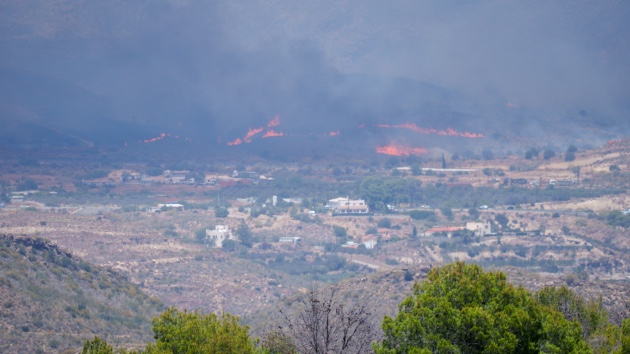
Image of the wildfire that broke out in the Los Gallardos area (Almeria) on 10 July 2026, in Los Gallardos, Almeria, Andalusia, Spain. (Photo By Francisco J. Olmo/Europa Press via Getty Images)

(LOS GALLARDOS, Spain) — At least 12 people have died and 23 others are unaccounted for as firefighters in southern Spain battle a rapidly spreading wildfire, officials said.

Emergency services in Andalusia said the death toll rose overnight amid the devastating blaze.

Andalusian regional leader Juanma Moreno said in a post on X that eight people had also been injured, including four who were in serious condition.

In an interview Friday morning on Spanish radio, Moreno said four of those killed were believed to be British nationals who became trapped in a car while trying to escape the flames.

The majority of the victims were from outside Spain, particularly British and Belgian nationals, Moreno said later Friday, but added that authorities are still working to identify the deceased.

The wildfire, burning in the municipality of Los Gallardos in Spain’s southeastern Almeria province, continued to spread rapidly, with Moreno warning that weather conditions remained unfavorable for firefighters.

“The consequences are devastating,” Moreno said in his post on X.

Speaking to reporters Friday evening in Turre, a couple of miles from the wildfire in Los Gallardos, Moreno called the blaze a “major tragedy” and warned Spain is facing a challenging summer due to heavy winter rainfall that fueled a surge in spring undergrowth which has now dried out with the heatwaves.

Emergency crews on Friday were continuing search-and-rescue operations as they worked to locate the people still reported missing.

Moreno told reporters that firefighters were battling to control one of the fastest and most complex wildfires in the Andalusia region in years.

Spanish officials cautioned that the full scale of the disaster is still emerging as rescue efforts continue and officials work to identify victims.

Earlier Friday, a regional government official said in an interview that the fire was likely caused by an electric poll which had fallen.

The regional minister for emergencies in Andalusia, Antonio Sanz Cabello, said on Friday that last night was “a truly tragic night” with “terrible consequences.”

He said fighting the fire has been made more complicated by the remote terrain and the lack of access for heavy machinery. Sixteen aircraft are being used to fight the wildfire.

Cabello urged people to take maximum care and said teams are still fighting the wildfire in Los Gallardos “with all their strength.”

Andalusia’s government has urged people to be careful and follow all evacuation instructions from officials.

ABC News’ Claire Bower contributed to this report.

Copyright © 2026, ABC Audio. All rights reserved.
Liberia once offered Black Americans a new home. Decades on, it is receiving migrants the US wants out

(CNN) — Is Liberia an American dumping ground — or a place where a new generation of arrivals can build a new life?That’s the question Liberians are asking themselves after the first people to be deported to the West African country from the United States arrived in the capital, Monrovia.The 20 people on the flight from Louisiana were the first to be sent under an agreement that could see up to 1,200 people transferred to Liberia, a country of less than 6 million people, many of them descendants of formerly enslaved Black Americans.Liberian officials said the new arrivals were from “African and western hemisphere countries.”Liberia is one of several countries that have agreed to take migrants being deported from the US under the Trump administration’s anti-immigration crackdown. The arrivals are coming to a nation whose history is deeply tied to migration from the US.Nearly two centuries ago, free and formerly enslaved Black Americans crossed the Atlantic to settle in what would become Liberia – a name that translates as “land of the free.”Now, a country shaped in part by that migration is accepting people the US wants to remove.For Liberians, that has thrown up a mix of feelings in a country still recovering from a long and bloody civil war.“This country is going through a lot, and having more people come in — can we handle all of this?” said Pheta Morris, 48, a descendant of the Black Americans who settled in Liberia.But she said she sees the new arrivals through the lens of Liberia’s history and is struck by the contrast.“I think about the Americo-Liberians — people who were rejected where they were and needed somewhere to go, and Liberia opened its arms to them,” she said.“Back then, people needed somewhere they could be free, accepted and welcomed. Now, people are being rejected from the US, and Liberia is opening its doors to them.”The first transfer has already faced complications.Reuters reported that five migrants who refused to disembark after arriving in Monrovia were flown instead to Equatorial Guinea in Central Africa, where they are held with more than 30 other migrants previously sent there by the US.A US State Department spokesperson said implementing the Trump administration’s immigration policies was a “top priority,” adding that the department generally does not comment on private diplomatic communications with other governments.CNN has contacted Liberia’s information ministry for more details about the agreement and its terms.A country shaped by AmericaThe first group of free Black Americans arrived in Liberia in the early 1820s.Over the following decades, thousands more made the journey, with the American Colonization Society helping to establish settlements along the West African coast. The US State Department says about 16,000 Black Americans migrated to Liberia during the 19th century.The migration was complicated. Some Black Americans saw Liberia as a chance to escape racism and build a new life, while others opposed the colonization movement and rejected the idea that free Black people should leave the US.Africans rescued from slave ships by the US Navy were also brought to Liberia. The settlements eventually formed the Republic of Liberia, which declared independence in 1847.The American influence remains visible today. Liberia’s flag resembles that of the US; its capital was named Monrovia after America’s fifth President James Monroe, and its early institutions were heavily influenced by Washington.Conmany Wesseh, a former Liberian lawmaker and member of the ruling Unity Party who was nominated as Liberia’s ambassador to the United Nations and later the European Union under former president Ellen Johnson Sirleaf, said that history continues to shape how Liberians view the US.For Wesseh though, the arrival of the deportees raises a more immediate question: Can Liberia, a country still struggling with basic infrastructure and services, accommodate more people?The cost of taking them inLiberia began rebuilding after a 14-year civil war ended in 2003, but Wesseh said the country still needs major investment. Poverty levels remain high and youth unemployment stands at 40%, according to African Development Bank data.“Our country needs a great deal of support,” he said. “We are short on medical facilities, and we have problems with education.”He questioned how the country would manage an influx of people from abroad.“They will have to go to the same hospitals. You won’t create a new hospital for them,” he said. “There’s no spare housing. We don’t have existing housing to put new people in.”Wesseh said Liberia’s development needs may have influenced the government’s decision, with officials hoping the agreement would bring support from Washington.Liberian authorities described the arrangement as humanitarian and said the deportees will be treated as guests who can seek asylum or leave the country.Asked whether he viewed the deal as humanitarian assistance, a diplomatic arrangement or the US outsourcing its immigration enforcement, Wesseh chose the latter.“I think (the administration of US President Donald Trump) just sees this as a place to dump people,” he said. “They want to take them off their hands and dump them in this country.”A chance for a new startFrancis Dennis had long known that his family had roots in the migration of Black Americans to Liberia in the 19th century. But just a few weeks ago, he became curious about his family’s past and began using AI genealogy tools to dig deeper into that history.The 71-year-old former president of the Liberia Chamber of Commerce told CNN he traced his great-great-great-grandfather to Snow Hill, a town on Maryland’s Eastern Shore in the US, using the technology and notes left by his father.He said the research also pointed him to the name of the vessel that carried his ancestor across the Atlantic to Liberia, along with a list of its passengers.Generations later, Dennis is watching another group arrive in Liberia from the US. But he does not believe their circumstances have to define what comes next.“People may have their apprehension about a new life, but it’s also an opportunity,” he said. “Some may be happy, some may resent it, but it opens a new window, a new opportunity.”His own ancestor crossed the Atlantic generations ago and became part of the community that helped shape modern Liberia.Now, he hopes those arriving under very different circumstances will also see the country as a chance for a fresh start.“The ball will be in their court,” Dennis said. “Are they going to seize it as an opportunity for a new start, a fresh start, a new life? Or will they be thinking about the past?”The-CNN-Wire™ & © 2026 Cable News Network, Inc., a Warner Bros. Discovery Company. All rights reserved.
Read Next Story