
Astronomer’s name deciphered from ancient Mayan ruins for first time

▶ Watch Video: Scientists use laser technology to uncover more Mayan ruins

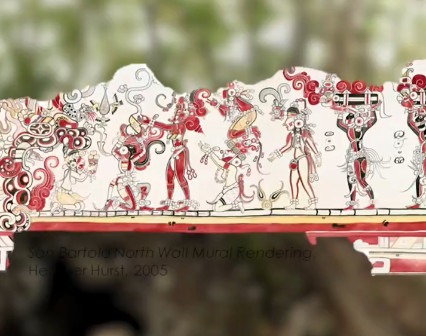
Archaeologists have transcribed mural symbols from Mayan ruins to learn the name of an astronomer and mathematician from the ancient civilization for the first time, Guatemala’s Ministry of Culture said Monday.

The name “White-chested Fox” was found in drawings dating from 400 BC to 900 AD at the San Bartolo-Xultun archaeological site on the Mexican border.

Culture minister Luis Mendez told reporters researchers at Xultun unearthed a “complete mathematical and astronomical formula” authored by Sak Tahn Waax, which translates to White-chested Fox.

Mendez said it’s the only work of its kind attributed to a mathematician from the Maya Classic period, considered the peak of the Mesoamerican civilization.

The discovery was “made possible by the epigraphic analysis of more than 50 mathematical and astronomical microtexts written on the wall,” the ministry said in a statement.
ruins-screenshot-2026-07-14-071118.png
Archaeologists have transcribed mural symbols from Mayan ruins to learn the name of an astronomer and mathematician from the ancient civilization for the first time, Guatemala’s Ministry of Culture said Monday.

Guatemala’s Ministry of Culture

In addition to determining the astronomer’s name, researchers identified calculations and tables that employ astronomical and calendrical units of time.

Researchers used drawings, photographs and scans of the inscriptions, which were later digitally enhanced, revealing 11 hieroglyphs that could finally be deciphered, the ministry said.

The glyphs appeared in “a context where art was intertwined with science, mathematics, astronomy and everyday life,” Mendez said.

The Maya civilization went into decline around 900 AD, until its collapse with the arrival of Spanish conquistadors at the turn of the 16th century.

Last year, the culture ministry announced archaeologists unearthed the remains of a Mayan city nearly 3,000 years old in northern Guatemala, with pyramids and monuments.

In 2024, an American doctoral student discovered a sprawling Maya city within a dense jungle in Mexico. Scientists and archaeologists have discovered ancient Mayan ruins by shooting lasers down from a plane to penetrate the dense jungle.

Senate approves bill to fund government into December

Washington — The Senate approved a continuing resolution on Saturday to keep the government funded through Dec. 11, sending the bill to the House as Congress looks to avoid a government shutdown ahead of the midterm elections this fall. In a 90 to 6 vote, the Senate approved the measure, which would keep the government funded at current levels with some exceptions for six weeks beyond the Sept. 30 end of the fiscal year. It now goes to the House, where lawmakers have pursued a different approach. Before leaving town for its August recess, the House approved a separate continuing resolution that would also fund the government into December. But the GOP-led bill was passed with widespread opposition from Democrats. In the Senate, which has a 60-vote threshold to advance most legislation, GOP leaders pursued a bipartisan approach to the funding extension — acknowledging the need for support across the aisle. Top Republican and Democratic appropriators in the Senate announced on Sunday an agreement on a stopgap funding bill. Democrats touted, among other wins, a provision in the bill closing a loophole preventing the administration from transferring funds to Border Patrol, after they refused to fund immigration enforcement agencies earlier this year. GOP Sen. Susan Collins of Maine, the chair of the Senate Appropriations Committee, praised the stopgap funding measure for avoiding "any poison pills." Democrats had sought additional provisions that could have imperiled its passage. But one provision could still pose hurdles in the House, should it take up the bill when it returns from recess later this month. The bill includes language to temporarily prevent political appointees in the administration from implementing a proposed rule about federal grants. Democrats have warned that the rule will allow the administration to cancel grants and "take even more federal funding hostage," and have sought to permanently ban the rule. But even the temporary ban could cause the measure to lose support among Republicans. If House Speaker Mike Johnson moves forward with the Senate bill, it could pick up support from Democrats to propel it to passage. But whether pressure from members of his own conference pushes him to pursue a different course remains to be seen.The Senate approved the measure as it churned through a number of priorities while preparing to depart for a five-week August recess. The House is set to return from its recess on Aug. 31, at which point the lower chamber will have a matter of weeks to coalesce behind a plan to keep the government funded. For the bulk of lawmakers, following two record breaking government shutdowns within the last 12 months, the appetite for another funding lapse appears low. And with the midterm elections quickly approaching, both sides of the aisle appear inclined to push off the fight for now. 
Read Next Story