
Astronomer’s name deciphered from ancient Mayan ruins for first time

▶ Watch Video: Scientists use laser technology to uncover more Mayan ruins

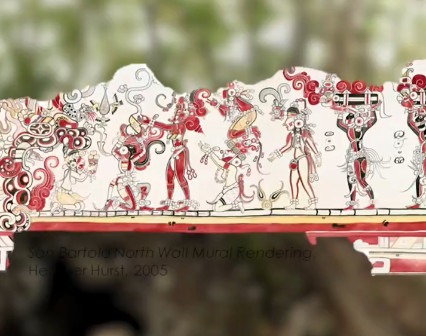
Archaeologists have transcribed mural symbols from Mayan ruins to learn the name of an astronomer and mathematician from the ancient civilization for the first time, Guatemala’s Ministry of Culture said Monday.

The name “White-chested Fox” was found in drawings dating from 400 BC to 900 AD at the San Bartolo-Xultun archaeological site on the Mexican border.

Culture minister Luis Mendez told reporters researchers at Xultun unearthed a “complete mathematical and astronomical formula” authored by Sak Tahn Waax, which translates to White-chested Fox.

Mendez said it’s the only work of its kind attributed to a mathematician from the Maya Classic period, considered the peak of the Mesoamerican civilization.

The discovery was “made possible by the epigraphic analysis of more than 50 mathematical and astronomical microtexts written on the wall,” the ministry said in a statement.
ruins-screenshot-2026-07-14-071118.png
Archaeologists have transcribed mural symbols from Mayan ruins to learn the name of an astronomer and mathematician from the ancient civilization for the first time, Guatemala’s Ministry of Culture said Monday.

Guatemala’s Ministry of Culture

In addition to determining the astronomer’s name, researchers identified calculations and tables that employ astronomical and calendrical units of time.

Researchers used drawings, photographs and scans of the inscriptions, which were later digitally enhanced, revealing 11 hieroglyphs that could finally be deciphered, the ministry said.

The glyphs appeared in “a context where art was intertwined with science, mathematics, astronomy and everyday life,” Mendez said.

The Maya civilization went into decline around 900 AD, until its collapse with the arrival of Spanish conquistadors at the turn of the 16th century.

Last year, the culture ministry announced archaeologists unearthed the remains of a Mayan city nearly 3,000 years old in northern Guatemala, with pyramids and monuments.

In 2024, an American doctoral student discovered a sprawling Maya city within a dense jungle in Mexico. Scientists and archaeologists have discovered ancient Mayan ruins by shooting lasers down from a plane to penetrate the dense jungle.

He spied for the U.S. in the war on terror. Now ICE wants to deport him.

The Trump administration is trying to deport a self-described CIA spy who infiltrated al Qaeda after 9/11 and won his permission to live in the U.S. by helping convict terrorists.Immigration and Customs Enforcement agents arrested Blerim Skoro, a Kosovo-born father of three, outside an immigration office in New Jersey where he was renewing his paperwork earlier this month.His lawyers have filed in federal court to halt his deportation, saying Skoro, 55, was promised residency after years of significant work as a "CIA agent."Skoro, a Staten Island, New York, cab driver who has an American wife and children, was granted a deferral of removal in 2022 due to the risk of his capture and torture by terrorists if he were deported.The ruling was due in part to Skoro's help securing the arrests of al Qaeda, al Shabaab and Hezbollah members, his lawyers claim.Now he fears that the government, for which he claims to have put his life on the line, is going to send him back to Kosovo — he says into the hands of those who want him dead.Blerim Skoro, in a recent video call from ICE detention. Susan Skoro "I never thought they were going to betray me like this," he told CBS News in a phone interview from Elizabeth Detention Center, in New Jersey. "Please, if I die, I should die in this country so my kids can bury me."Skoro's relationship with U.S. intelligence officials began when he was jailed for trafficking drugs in 2000, FBI documents show.He says he was struggling to make ends meet supporting his children and refugee parents after the family fled the Kosovo conflict in the 1990s. He got caught transporting heroin overseas for an Albanian criminal gang.Raised a Muslim, he was welcomed by a group of Islamic radicals in a Manhattan prison where he began serving his drug trafficking sentence, FBI files that list him as a confidential informant show. After 9/11, he says the CIA approached him to exploit the connection.While incarcerated at FCI Allenwood, a federal prison in Pennsylvania, between 2002 and 2006, Skoro says he gleaned intelligence for the FBI on terrorists including Faysal Galab of the Lackawanna Six, which federal agents described as America's first homegrown terrorist sleeper cell; Randall "Ismail" Royer of the Virginia jihad network, convicted of organizing violence against U.S. troops overseas; and Hezbollah member Junuz Fuaz.Blerim Skoro, center, with fellow inmates in prison in the early 2000s. He says he gleaned intelligence for the FBI on several who were later convicted in terrorism-related cases.
Read Next Story