
Appeals court gives Trump temporary win in mail-in voting fight

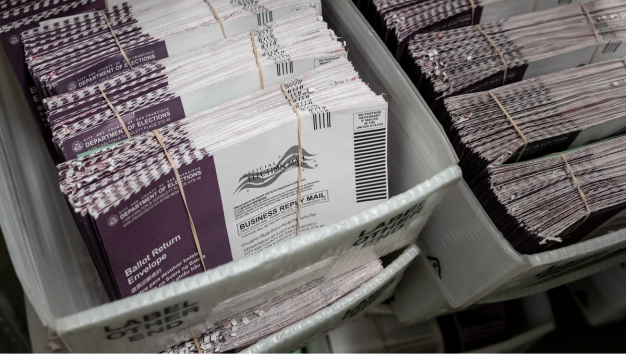
Mail-in ballots following a primary election at San Francisco County’s election operations facility at City Hall in San Francisco, California, US, on Tuesday, June 9, 2026. (David Paul Morris/Bloomberg via Getty Images)

(NEW YORK) — A federal appeals court in Washington, D.C., handed the Trump administration a temporary win on Friday in its attempt to increase federal oversight of elections.

In a unanimous ruling, a three-judge panel of the D.C. Circuit Court of Appeals put on hold a lower court ruling, which had blocked the U.S. Postal Service from attempting to restrict mail-in voting.

However, the Trump administration does not yet have a green light to move forward with the proposed rule. A separate judge in Massachusetts blocked the policy last month, and that injunction still stands. 

The cases center on a proposed rule from the U.S. Postal Service that sought to compel states to create lists of approved voters, as well as impose stricter regulations on mail-in ballots.

Last month, Postmaster General David Steiner told the Senate Homeland Security and Governmental Affairs Committee that under the proposed rule, the Postal Service would refuse to deliver mail-in ballots in states that do not turn over their voter lists.

“Yes or no — if a state refuses to turn their absentee voter list over to the federal government, will the Postal Service still mail their ballots under this proposed rule?” asked Sen. Gary Peters, D-Mich.

“Under our proposed regulation, no. We would tell the state that we need the manifest,” Steiner said. 

The NAACP, which brought the lawsuit, had previously sued the Postal Service in 2020, seeking to challenge delays in delivering mail-in ballots heading into that year’s presidential election. The two sides settled in 2021, with the Postal Service agreeing to “prioritiz[e] . . . the timely delivery of Election Mail” for every national election through 2028.

In Friday’s ruling, the appeals court said the Trump administration is likely to succeed because the lawsuit is premature — since the rule itself is not yet finalized — and not covered by a 2021 settlement between the NAACP and Postal Service. 

The appeals court also said the Trump administration demonstrated they would be irreparably harmed if the Postal Service can’t finalize and implement the rule in time for the midterms. 

“In this context, ‘there can be no do over’ once the election occurs,” the ruling said.

While the Trump administration cannot yet move forward with the new rule, the D.C. Circuit’s ruling signals that the Trump administration may be able convince other appeals courts to let them implement the policy while the lawsuits move through the courts — potentially past the November elections. 

Copyright © 2026, ABC Audio. All rights reserved.

He spied for the U.S. in the war on terror. Now ICE wants to deport him.

The Trump administration is trying to deport a self-described CIA spy who infiltrated al Qaeda after 9/11 and won his permission to live in the U.S. by helping convict terrorists.Immigration and Customs Enforcement agents arrested Blerim Skoro, a Kosovo-born father of three, outside an immigration office in New Jersey where he was renewing his paperwork earlier this month.His lawyers have filed in federal court to halt his deportation, saying Skoro, 55, was promised residency after years of significant work as a "CIA agent."Skoro, a Staten Island, New York, cab driver who has an American wife and children, was granted a deferral of removal in 2022 due to the risk of his capture and torture by terrorists if he were deported.The ruling was due in part to Skoro's help securing the arrests of al Qaeda, al Shabaab and Hezbollah members, his lawyers claim.Now he fears that the government, for which he claims to have put his life on the line, is going to send him back to Kosovo — he says into the hands of those who want him dead.Blerim Skoro, in a recent video call from ICE detention. Susan Skoro "I never thought they were going to betray me like this," he told CBS News in a phone interview from Elizabeth Detention Center, in New Jersey. "Please, if I die, I should die in this country so my kids can bury me."Skoro's relationship with U.S. intelligence officials began when he was jailed for trafficking drugs in 2000, FBI documents show.He says he was struggling to make ends meet supporting his children and refugee parents after the family fled the Kosovo conflict in the 1990s. He got caught transporting heroin overseas for an Albanian criminal gang.Raised a Muslim, he was welcomed by a group of Islamic radicals in a Manhattan prison where he began serving his drug trafficking sentence, FBI files that list him as a confidential informant show. After 9/11, he says the CIA approached him to exploit the connection.While incarcerated at FCI Allenwood, a federal prison in Pennsylvania, between 2002 and 2006, Skoro says he gleaned intelligence for the FBI on terrorists including Faysal Galab of the Lackawanna Six, which federal agents described as America's first homegrown terrorist sleeper cell; Randall "Ismail" Royer of the Virginia jihad network, convicted of organizing violence against U.S. troops overseas; and Hezbollah member Junuz Fuaz.Blerim Skoro, center, with fellow inmates in prison in the early 2000s. He says he gleaned intelligence for the FBI on several who were later convicted in terrorism-related cases.
Read Next Story