
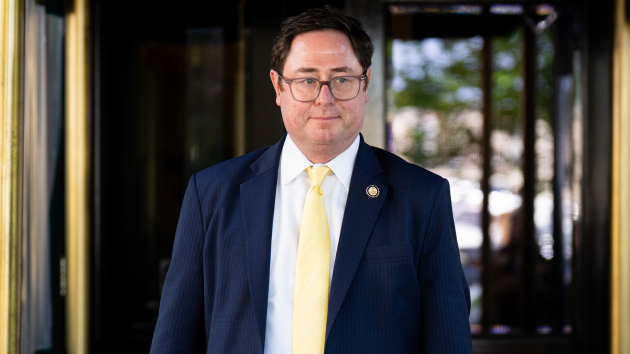
Angry crowd confronts Republican Rep. Mike Flood at Nebraska town hall over Trump policies

Rep. Mike Flood, R-Neb., leaves the House Republican Conference caucus meeting at the Capitol Hill Club in Washington on Wednesday, May 13, 2026. (Bill Clark/CQ-Roll Call, Inc via Getty Images)

(BELLUVUE, Neb.) — While Congress is out of session this week, a House Republican encountered a hostile crowd at a heated town hall meeting in Bellevue, Nebraska, Tuesday night – a sour reception that may preview the tenor other lawmakers could face heading into the midterm elections.  

Rep. Mike Flood faced repeated boos and shouts from audience members as they pressed him on the SAVE America Act, Israel, NATO, the bipartisan housing bill, the Trump administration’s policies and more, as seen on video of the town hall recorded by ABC affiliate KETV in Omaha.

While it’s uncertain how many in the audience were constituents, Tuesday’s contentious event wasn’t the first time Flood has found himself before angry crowds at town halls. Flood was shouted down and booed in Seward, Nebraska, where hundreds of people attended his town hall May 28 of last year, while defending the then-proposed One Big Beautiful Bill Act.

The month after Trump signed the bill into law, Flood faced a hostile crowd once more during an August town hall in Lincoln as the audience questioned its impact on Medicaid.

“F—— liar!” one attendee shouted at Flood Tuesday while he was discussing violent crime rates declining and the Trump administration’s ongoing deportation efforts.

“Listen, violent crime is down – ask the people of Washington, D.C., how much safer Washington is today compared to a year ago,” Flood said as the audience jeered.

“Violent crime is down in American cities. Violent crime is down in New York City. A lot of people that came here that were committing crimes have either been incarcerated or deported. The numbers speak for themselves,” Flood said.

Flood also was drowned out by the audience as he voiced his support for the proposed SAVE America Act and voter ID laws – key issues that are part of President Donald Trump’s policy agenda.

“What I can’t stand is what is so objectionable about having to show a driver’s license, a passport, or a birth certificate at your place where you vote,” Flood said, as the attendees booed. 

The congressman further said that while Nebraska in his “opinion” deals with “little” election fraud, he added, “when people believe that our elections are secure, it breeds respect for the law, our democracy, our country, our election leaders. There are so many benefits.”

A man in the audience demanded the congressman explain the evidence he has to back up claims of election fraud, which Trump continues to promote without evidence to support his claims. Flood pushed back, saying he believes Joe Biden was duly elected president in the 2020 election. 

”I have never argued that there was an inaccurate result, and I always recognized Joe Biden was our president, so I am not a congressman that has ever made that claim,” Flood responded.

Constituents further heckled Flood when the congressman said, “I want to be very clear: We have no greater ally in the Middle East than Israel,” prompting loud boos from the audience.

“What happened in Israel was horrific,” Flood said, referring to the Oct. 7, 2023, attack on Israel by Hamas. “If that had happened on our soil, we as Americans would rise up and eliminate that threat.”

As the conversation continued to scrutinize the Trump administration’s foreign policy, Flood also appeared to defend the administration’s actions in Iran

“We need to finish the job. We cannot put up with a regime that in the last 12 months has killed 45,000 of their own people. That is wrong. We have to have moral clarity here,” he said. “I support Israel.” 

While Trump attends the NATO Summit in Turkey, Flood said he fully supports the alliance, declaring it “has contributed greatly to the security of the world. I think they’re an important part of us.”

Flood received a more positive response regarding other topics, such as when he called Russian President Vladimir Putin “a thug” and voiced his support for Ukraine. He also earned some applause when he expressed confidence that the bipartisan housing bill currently on Trump’s desk will become law. 

“If [Trump] doesn’t sign it, it becomes law, and the good news about this is next week it’s likely to be a public law,” he said. “That’s what I’m focusing on – bipartisan common-sense results.”

However, when Flood brought up the One Big Beautiful Bill Act, which includes massive cuts to government benefits such as Medicaid and SNAP food assistance, the audience loudly booed. Several constituents raised concerns about losing SNAP benefits under the new law. 

“I want people that are food insecure to get resources. I also want people that are able-bodied and can work to work. If you don’t work, you shouldn’t expect free healthcare,” Flood said.

Flood’s comments about Medicaid prompted one audience member to shout “tax the rich” in response.

Copyright © 2026, ABC Audio. All rights reserved.

‘There is freedom’: Why Asian women are leaving their husbands in their 50s and 60s

(CNN) — Eiko Toyama had waited 32 years to leave her husband.Throughout their marriage, she said, she did all the housework and childcare in their Japan home, as well as supporting the family financially. Her husband “wanted to control everything,” from her social life to professional ambitions, leaving her feeling trapped and miserable. Still, she stuck it out for their two children.That finally changed when she turned 60. Her adult sons no longer needed her, and her husband was healthy – not yet so old that he needed a caretaker. It was a precious window of opportunity, and she took it.“I was nothing but happy (after the divorce). That was my only emotion,” she said. “I was so happy I wanted to run around all over the place.”Stories like hers are increasingly common around the world as the number of “gray divorces” – splits among couples aged 50 and older – rises each year. The trend has been seen in countries like the United States and elsewhere, but takes on particular significance in Asia, where people generally live longer.Many places like South Korea, Japan, Hong Kong, Taiwan and mainland China are battling demographic crises as birth rates fall and elderly populations swell.The surge in gray divorces is also often driven by women – who have long faced restrictive gender norms in conservative Asian societies, as well as legal, financial, and social barriers to seeking divorce. That’s now changing; in Japan, for instance, among couples splitting after decades of marriage, twice as many women as men filed for divorce in 2024.This could reshape what Asia’s elderly population looks like in the coming decade: more people living alone and requiring more welfare support, as experts have predicted — but also perhaps more empowered to step out on their own.For women like Toyama, growing up in the 1960s and ‘70s, divorce was uncommon – and often met with judgment and shame.Back then, if you were a woman, “getting divorced was kind of like the end of life,” said Sangyoub Park, an associate professor of sociology at Washburn University in Kansas, who wrote a 2023 paper on late-life divorces in South Korea.That began changing in the second half of the 20th century as more women joined the workforce and pursued higher education. Gray divorces have risen steadily – particularly as Gen X began entering its 50s in the past decade, Park said.That’s an important demographic: born between 1965 and 1980, Gen X was the first generation to grow up in a globalizing Asia, watching American TV and movies. Through pop culture, they also absorbed American values such as prioritizing “personal choices rather than family obligation,” which – alongside those broader economic factors – helped gradually shift attitudes toward divorce, Park said.That’s reflected in data around the region. In South Korea last year, the number of divorces among couples who had been married at least 30 years surpassed divorces among younger couples who were married less than five years – for the first time ever.Taiwan has also seen divorces increase among long-married couples, according to government data. In Hong Kong, multiple law firms have described a surge in gray divorces, and in mainland China, the number of elderly divorces has doubled in the past 30 years.Part of this may be demographic: an aging society has a bigger pool of older people, so it’ll have more older divorces too. Young people are getting married less these days, so their divorces are also fewer.But legal reforms have also made a huge difference, creating safety nets for women who previously had to depend on their husbands’ livelihoods.For instance, South Korea ruled in 2014 that future pensions and severance pay could be included in the division of assets. That means if a housewife handled all the housework and childcare during their marriage, thus allowing her husband to work, she’s entitled to part of his elderly pension after getting divorced. Japan introduced a similar reform in 2007.These measures are especially critical given the high rate of elderly poverty in Asia. Among OECD nations, South Korea has the highest poverty rate for people over 65; Hong Kong (not an OECD member) is similarly high. While Japan ranks slightly lower, it’s still above the global average.And deep gender inequality still persists, despite these reforms.“For women in particular, the main reason they can’t get a divorce is the inability to be financially independent,” said Toyama, pointing to lower wages for women in Japan. “Once a woman becomes a full-time homemaker, it’s very hard to leave her husband and become independent.”“My two children are boys, but if I had a daughter, I would constantly tell her, ‘No matter what happens, never quit your job,’” she added.The biggest common factor across Asia is longevity, Park said – and how people are thinking differently about the final part of their lives.“Having an extra 20, 30 years creates new expectations,” with people more “willing to walk away from an unhappy, unfulfilled marriage,” he said. Divorce “is not a failure anymore – rather, it’s something new. It’s the beginning of a new chapter.”Iman Lau, 50, experienced this rebirth firsthand. Growing up in Hong Kong, her expectations for marriage were less than inspiring: spouses eat together, do activities together, and share blandly peaceful lives, she thought. “This is just how marriage is.”That mentality stayed even through years of infidelity by her husband. She would wonder: had she done something wrong, was she not good enough? He was ultimately the one to initiate the divorce despite her pleas to stay together; he even compared her to a bird who refused to fly out of an open cage.“I’m a pretty traditional woman,” she said. “In my whole life, I never thought I would get divorced.”It was a shock, as if she’d lost a limb or an organ. But it also made her realize that somewhere in that 14-year marriage, she’d lost her sense of self, neglecting her friends and interests to simply “orbit around him,” she said.She vowed to change that this year after finalizing the divorce, and threw herself into the world with determined vigor. She joined online meetup groups and made new friends. She discovered a love for the outdoors, going hiking, swimming, kayaking and snorkeling. She’s learning to play the piano and loves jazz.After traveling across Europe, she printed and hung up holiday photos in her apartment; it’s her “happy wall,” to remind her of the joy she found trekking across Sicily and camping in Georgia.“I didn’t know that life by yourself could be so spectacular,” she said.Toyama has embarked on a similar journey, describing herself as “full of life” at 63.She began livestreaming on TikTok, and created an account on a messaging app to dole out advice to people who call and text each week. She’s working to launch new business ventures including a marriage agency and a live events company.“For 32 years, I couldn’t do anything, but now I’m finally in my third year of being able to do whatever I want,” she said. The process wasn’t easy, but any challenges now are still “much better than the anxiety of being with my ex-husband,” she said. “Above all, there is freedom.”Both women described noticing an evolution in people’s attitudes when they shared news of their divorce. For Toyama, the reactions were overwhelmingly positive, with some even expressing envy. For Lau, they were more split – and in revealing ways.“Friends around my age treat it like a taboo, like you’ve had a death in the family – they don’t dare to ask about it, they’ll just say, ‘I’m so sorry,’” she said. “But with young Gen Z people, everybody congratulates me.”The increase in gray divorces might start to plateau when millennials – who got married under very different circumstances and social attitudes than their predecessors – start aging into retirement, said Park. But that’s not for another decade or so, and separations will likely continue rising until then.For those future divorcees, Lau has some encouragement from the other side. “Actually, this world is extraordinary,” she said.“Asians in particular often think divorce is like a stain or taboo in your life, like a label of failure. But that’s not true,” she added. “Just think of it as giving yourself the chance to see that you can have an even more vibrant life – as long as you’re willing to take that step.”The-CNN-Wire™ & © 2026 Cable News Network, Inc., a Warner Bros. Discovery Company. All rights reserved.
Read Next Story