
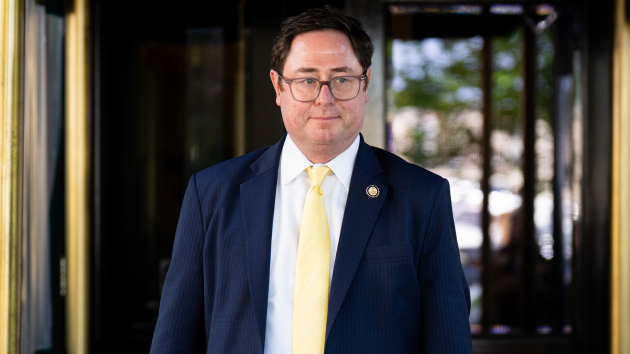
Angry crowd confronts Republican Rep. Mike Flood at Nebraska town hall over Trump policies

Rep. Mike Flood, R-Neb., leaves the House Republican Conference caucus meeting at the Capitol Hill Club in Washington on Wednesday, May 13, 2026. (Bill Clark/CQ-Roll Call, Inc via Getty Images)

(BELLUVUE, Neb.) — While Congress is out of session this week, a House Republican encountered a hostile crowd at a heated town hall meeting in Bellevue, Nebraska, Tuesday night – a sour reception that may preview the tenor other lawmakers could face heading into the midterm elections.  

Rep. Mike Flood faced repeated boos and shouts from audience members as they pressed him on the SAVE America Act, Israel, NATO, the bipartisan housing bill, the Trump administration’s policies and more, as seen on video of the town hall recorded by ABC affiliate KETV in Omaha.

While it’s uncertain how many in the audience were constituents, Tuesday’s contentious event wasn’t the first time Flood has found himself before angry crowds at town halls. Flood was shouted down and booed in Seward, Nebraska, where hundreds of people attended his town hall May 28 of last year, while defending the then-proposed One Big Beautiful Bill Act.

The month after Trump signed the bill into law, Flood faced a hostile crowd once more during an August town hall in Lincoln as the audience questioned its impact on Medicaid.

“F—— liar!” one attendee shouted at Flood Tuesday while he was discussing violent crime rates declining and the Trump administration’s ongoing deportation efforts.

“Listen, violent crime is down – ask the people of Washington, D.C., how much safer Washington is today compared to a year ago,” Flood said as the audience jeered.

“Violent crime is down in American cities. Violent crime is down in New York City. A lot of people that came here that were committing crimes have either been incarcerated or deported. The numbers speak for themselves,” Flood said.

Flood also was drowned out by the audience as he voiced his support for the proposed SAVE America Act and voter ID laws – key issues that are part of President Donald Trump’s policy agenda.

“What I can’t stand is what is so objectionable about having to show a driver’s license, a passport, or a birth certificate at your place where you vote,” Flood said, as the attendees booed. 

The congressman further said that while Nebraska in his “opinion” deals with “little” election fraud, he added, “when people believe that our elections are secure, it breeds respect for the law, our democracy, our country, our election leaders. There are so many benefits.”

A man in the audience demanded the congressman explain the evidence he has to back up claims of election fraud, which Trump continues to promote without evidence to support his claims. Flood pushed back, saying he believes Joe Biden was duly elected president in the 2020 election. 

”I have never argued that there was an inaccurate result, and I always recognized Joe Biden was our president, so I am not a congressman that has ever made that claim,” Flood responded.

Constituents further heckled Flood when the congressman said, “I want to be very clear: We have no greater ally in the Middle East than Israel,” prompting loud boos from the audience.

“What happened in Israel was horrific,” Flood said, referring to the Oct. 7, 2023, attack on Israel by Hamas. “If that had happened on our soil, we as Americans would rise up and eliminate that threat.”

As the conversation continued to scrutinize the Trump administration’s foreign policy, Flood also appeared to defend the administration’s actions in Iran

“We need to finish the job. We cannot put up with a regime that in the last 12 months has killed 45,000 of their own people. That is wrong. We have to have moral clarity here,” he said. “I support Israel.” 

While Trump attends the NATO Summit in Turkey, Flood said he fully supports the alliance, declaring it “has contributed greatly to the security of the world. I think they’re an important part of us.”

Flood received a more positive response regarding other topics, such as when he called Russian President Vladimir Putin “a thug” and voiced his support for Ukraine. He also earned some applause when he expressed confidence that the bipartisan housing bill currently on Trump’s desk will become law. 

“If [Trump] doesn’t sign it, it becomes law, and the good news about this is next week it’s likely to be a public law,” he said. “That’s what I’m focusing on – bipartisan common-sense results.”

However, when Flood brought up the One Big Beautiful Bill Act, which includes massive cuts to government benefits such as Medicaid and SNAP food assistance, the audience loudly booed. Several constituents raised concerns about losing SNAP benefits under the new law. 

“I want people that are food insecure to get resources. I also want people that are able-bodied and can work to work. If you don’t work, you shouldn’t expect free healthcare,” Flood said.

Flood’s comments about Medicaid prompted one audience member to shout “tax the rich” in response.

Copyright © 2026, ABC Audio. All rights reserved.

Luigi Mangione pleads guilty in federal case, admits shooting Brian Thompson

▶ Watch Video: CBS News New York Luigi Mangione entered a guilty plea in his federal case at a court appearance in Manhattan Friday morning, admitting to the judge that he shot and killed UnitedHealthcare CEO Brian Thompson outside a Midtown hotel in 2024.Mangione, 28, faced both federal and state trials in New York for the deadly shooting. He had previously pleaded not guilty in both cases.Sentencing in the federal case will take place on Dec. 18, with Mangione facing a maximum possible sentence of life in prison.His state trial is currently set to begin in September. What happened in courtThompson's family arrived in the courtroom at around 10:50 a.m. The hearing, which had been set to start at 11 a.m., got started a bit late. The courtroom had filled press personnel as well as about two rows of members of the public. Mangione entered the court at around 11:10 a.m. with his feet shackled and his hands behind his back. He was wearing tan prison clothing with a white T-shirt underneath. Just before 11:15 a.m., Mangione's defense team told the judge Mangione "is prepared to plead guilty to the indictment at this time." The judge asked Mangione if that was correct. "Yes," Mangione told the judge. The judge then asked Mangione a series of questions about his background and use of medications and drugs. The judge then found Mangione to be fully competent to enter the plea. The judge told Mangione that the maximum possible sentence is life in prison followed by supervised release. The judge added that there's no parole in the federal system, although good behavior and other programs can impact how long he will spend in prison. He will be required to serve 85% of the sentence, the judge said. The judge pointed out that there's no plea agreement between the defense and prosecution, and Mangione's defense attorney said that's correct. Mangione's admission in courtMangione then told the court in his own words what he did. He told the court that he had for years endured severe pain for a boken back and had navigated the health insurance system. He told the court he learned about the UnitedHealthcare annual investor conference in New York even though it wasn't publicized, and traveled to it. He told the court he posed as an investor to find out more information about the conference. He told the court he used a 3D printer to make parts of the gun, and traveled to New York with the gun, silencer, and magazine with "the intent to shoot Brian Thompson." He said he shot Thompson in Manhattan knowing it would place him in fear of death or serious bodily injury. Prosecutors then spoke in court, reviewing the evidence against Mangione. They pointed to video capturing the shooting, as well as Mangione fleeing the scene on the bicycle, his arrest in Altoona, Pennsylvania, the recovered pistol and shell casings, as well as DNA found at the crime scene. Prosecutors said entries in Mangione's notebook expressed his desire to kill a health care executive. "Mr. Mangione, how do you now plead to counts one and two of the indictment," the judge asked. "Guilty," Mangione said. "I will accept your guilty plea," the judge said. About the chargesMangione initially faced four federal charges in Thompson's killing. Two of those charges against him, one of which brought the possibility of the death penalty — murder through use of a firearm and an additional firearms charge — were dismissed earlier this year, and federal prosecutors said they would not appeal that decision.That left federal stalking charges against him, which brought the possibility of life in prison without the possibility of parole.Jury selection in the federal case had been set to begin in January. Speculation about a possible plea deal had been rampant since Tuesday, when prosecutors and Mangione's defense team sent a letter to the court requesting a Friday conference regarding the federal case.What the federal plea deal means for Luigi Mangione's state trialThe plea deal will put an end to the federal trial and raises questions about Mangione's state trial, which is set to begin in September.The state case, in which he faces second-degree murder charges, among others, also carries with it the possibility of life in prison.The plea deal, however, may revive a double jeopardy argument, CBS News legal contributor Caroline Polisi said on "CBS Mornings" Thursday.Double jeopardy refers to a law stating "a person may not be twice prosecuted for the same offense," although there are a number of exceptions. "Luigi Mangione's defense team had made that argument in the state case prior, and this could revive it, because if you actually have a conviction on the federal case, it's a more robust double jeopardy protection in the New York state case. So we could see a motion there that could kick this state case back," Polisi said.Legal expert Rich Schoenstein, however, said he thinks the double jeopardy argument is "open and complicated and subject to debate." Schoenstein said that's because the federal charges Mangione is pleading guilty to are related to interstate matters and stalking, which are quite different than the second-degree murder, weapons and forged instrument charges he's facing on a state level. "So the weapons and forged instrument charges would not be resolved by the federal plea, and arguably the intentional killing charge would not be resolved. I do think there's a serious question as to whether this would be double jeopardy," Schoenstein said.The plea deal, however, may "put some pressure" on New York prosecutors to reach a deal too, "and therefore it could resolve the case on a negotiated level." Evidence in the Luigi Mangione caseKey evidence seized during Mangione's Pennsylvania arrest had been expected to be admitted in the federal trial, including a 3D-printed handgun, loaded magazine, a notebook and more.Thompson, 50, was killed on Dec. 4, 2024, as he arrived at a hotel for UnitedHealth Group's annual investor conference. The killing  of the husband and father of two was caught on surveillance video, which showed Thompson being shot in the back as he walked down the street. Police say the words "delay," "deny" and "depose" were written on the ammunition, echoing a phrase used to describe how insurers avoid paying claims.Thompson's killing set off a frantic multistate manhunt that ended with Mangione's arrest at a McDonald's in Altoona, Pennsylvania, five days later.This is a developing story. Check back soon for more information. 
Read Next Story