(LONDON) — Andy Burnham officially became British prime minister on Monday — the country’s seventh leader in 10 years — having already been elected as the leader of the country’s Labour Party last week.
Burnham, who until recently was serving as the mayor of Greater Manchester, succeeded outgoing Prime Minister Keir Starmer.
Speaking outside the prime minister’s official residence — 10 Downing Street — on Monday morning, Starmer said, “Today I am here to offer my resignation and close the book on my time as prime minister. My work is done.”
“I thank the British people for the opportunity to serve. I go with good grace, I go with a smile, and I go proud of everything that we have achieved. Thank you very much,” Starmer added.
Of his successor, the outgoing prime minister said, “I now pass the baton to Andy Burnham, I wish him every success. He has my full support.”
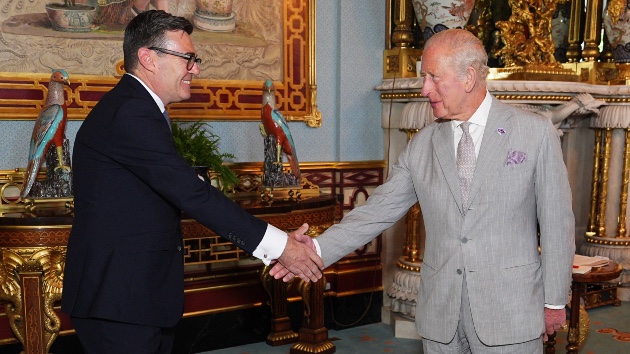
After his address, Starmer traveled the short distance to Buckingham Palace to formally inform King Charles III of his resignation. Burnham then also traveled to palace where the king asked him to form a government.
The new prime minister then traveled to Downing Street to give his first address, telling the assembled press that Britain must show “that we can regain our stability.”
Burnham said his appointment will serve as “a circuit-breaker” for the country, pledging to deliver a new political and economic model and a 10-year plan.
Among the new prime’s commitments were to address cost of living concerns, help young people into work, end homelessness, re-industrialize the country, put “life’s essentials back under public control” and push for more local powers.
Through the rest of Monday, Burnham is expected to begin appointing cabinet ministers from Number 10.
Starmer announced that he would step down in June, following months of domestic political turmoil. Despite leading Labour to a historic majority in parliament in the 2024 general election, Starmer faced persistent external and internal criticism over his perceived failure to deliver rapid change after 14 years of Conservative Party rule in Britain.
Many in Starmer’s party had written to the prime minister asking him to step down following local elections in May, which saw the party lose more than 1,000 seats on local councils, results that were widely interpreted as a repudiation by British voters of Labour’s performance under the prime minister’s leadership.
Starmer long said he intended to see out his full five-year. Announcing his resignation in June, Starmer said, “The question my party is asking now is whether I am best placed to lead us into the next general election. I have heard the answer of my parliamentary party to that question, and I accept that answer with good grace.”
Burnham was the only candidate in the subsequent leadership election, ultimately winning nominations from 379 of the 403 Labour members of parliament — of the 650 MPs in total — in the House of Commons.
In accepting the leadership of Labour last week, Burnham said his mission was “to bring back hope” and address decades of economic inequality plus falling living standards.
“We must recognize that this generation of politicians — myself included — have failed to challenge a political culture and an economic model that simply doesn’t work well enough for ordinary people,” he said.
Burnham will become the seventh leader to take the reins of the country in 10 years, a reflection of the political and economic turbulence that has beset the country since the Brexit vote in 2016.
The incoming prime minister said he would also make British politics “less toxic, adding, “I will work to build a new politics. The country is crying out for it.”
Burnham, 56, was born in the Lancashire region of northern England. Burnham started out as a journalist, writing for trade magazines, before transitioning to work as a Labour parliamentary researcher while in his early 20s.
Burnham rose through the party ranks before being elected as the MP for his hometown of Leigh, in Greater Manchester, in 2001. He held that seat for 16 years, during which time he was appointed to several cabinet positions under Prime Ministers Tony Blair and Gordon Brown.
During Labour’s years in opposition, Burnham bid to become Labour leader twice, but was defeated by — and then served in shadow cabinets of — Labour leaders Ed Miliband and Jeremy Corbyn.
In 2017, Burnham left parliament to become the mayor of Greater Manchester. In his victory speech, Burnham heralded what he called “the dawn of a new era, not just for this city region but for politics in our country. It has been too London-centric for too long. The old political and party structures haven’t delivered for all people and for all places.”
Burnham is associated with the center left of the Labour Party, and has described himself as a socialist. Burnham’s time as Manchester mayor saw him emerge as a major proponent of shifting investment and political power out of London, and earned him the nickname “the King of the North.”
ABC News’ Kevin Shalvey contributed to this report.
Copyright © 2026, ABC Audio. All rights reserved.