
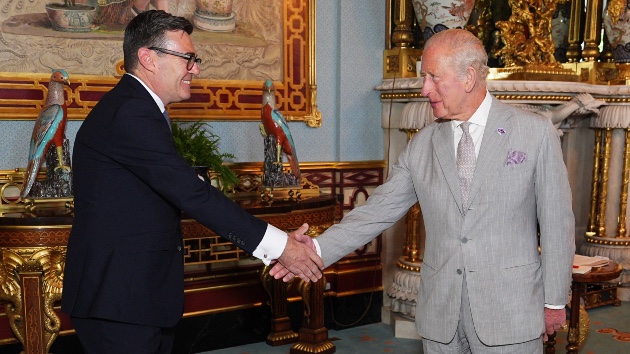
Andy Burnham becomes UK’s next prime minister after meeting with King Charles III

King Charles III welcomes Andy Burnham, during an audience at Buckingham Palace, London, where he invited the leader of the Labour Party to become Prime Minister and form a new government, on July 20, 2026 in London, England. (Photo by Aaron Chown – Pool/Getty Images)

(LONDON) — Andy Burnham officially became British prime minister on Monday — the country’s seventh leader in 10 years — having already been elected as the leader of the country’s Labour Party last week.

Burnham, who until recently was serving as the mayor of Greater Manchester, succeeded outgoing Prime Minister Keir Starmer.

Speaking outside the prime minister’s official residence — 10 Downing Street — on Monday morning, Starmer said, “Today I am here to offer my resignation and close the book on my time as prime minister. My work is done.”

“I thank the British people for the opportunity to serve. I go with good grace, I go with a smile, and I go proud of everything that we have achieved. Thank you very much,” Starmer added.

Of his successor, the outgoing prime minister said, “I now pass the baton to Andy Burnham, I wish him every success. He has my full support.”

After his address, Starmer traveled the short distance to Buckingham Palace to formally inform King Charles III of his resignation. Burnham then also traveled to palace where the king asked him to form a government.

The new prime minister then traveled to Downing Street to give his first address, telling the assembled press that Britain must show “that we can regain our stability.”

Burnham said his appointment will serve as “a circuit-breaker” for the country, pledging to deliver a new political and economic model and a 10-year plan.

Among the new prime’s commitments were to address cost of living concerns, help young people into work, end homelessness, re-industrialize the country, put “life’s essentials back under public control” and push for more local powers.

Through the rest of Monday, Burnham is expected to begin appointing cabinet ministers from Number 10.

Starmer announced that he would step down in June, following months of domestic political turmoil. Despite leading Labour to a historic majority in parliament in the 2024 general election, Starmer faced persistent external and internal criticism over his perceived failure to deliver rapid change after 14 years of Conservative Party rule in Britain.

Many in Starmer’s party had written to the prime minister asking him to step down following local elections in May, which saw the party lose more than 1,000 seats on local councils, results that were widely interpreted as a repudiation by British voters of Labour’s performance under the prime minister’s leadership.

Starmer long said he intended to see out his full five-year. Announcing his resignation in June, Starmer said, “The question my party is asking now is whether I am best placed to lead us into the next general election. I have heard the answer of my parliamentary party to that question, and I accept that answer with good grace.”

Burnham was the only candidate in the subsequent leadership election, ultimately winning nominations from 379 of the 403 Labour members of parliament — of the 650 MPs in total — in the House of Commons.

In accepting the leadership of Labour last week, Burnham said his mission was “to bring back hope” and address decades of economic inequality plus falling living standards.

“We must recognize that this generation of politicians — myself included — have failed to challenge a political culture and an economic model that simply doesn’t work well enough for ordinary people,” he said.

Burnham will become the seventh leader to take the reins of the country in 10 years, a reflection of the political and economic turbulence that has beset the country since the Brexit vote in 2016.

The incoming prime minister said he would also make British politics “less toxic, adding, “I will work to build a new politics. The country is crying out for it.”

Burnham, 56, was born in the Lancashire region of northern England. Burnham started out as a journalist, writing for trade magazines, before transitioning to work as a Labour parliamentary researcher while in his early 20s.

Burnham rose through the party ranks before being elected as the MP for his hometown of Leigh, in Greater Manchester, in 2001. He held that seat for 16 years, during which time he was appointed to several cabinet positions under Prime Ministers Tony Blair and Gordon Brown.

During Labour’s years in opposition, Burnham bid to become Labour leader twice, but was defeated by — and then served in shadow cabinets of — Labour leaders Ed Miliband and Jeremy Corbyn.

In 2017, Burnham left parliament to become the mayor of Greater Manchester. In his victory speech, Burnham heralded what he called “the dawn of a new era, not just for this city region but for politics in our country. It has been too London-centric for too long. The old political and party structures haven’t delivered for all people and for all places.”

Burnham is associated with the center left of the Labour Party, and has described himself as a socialist. Burnham’s time as Manchester mayor saw him emerge as a major proponent of shifting investment and political power out of London, and earned him the nickname “the King of the North.”

ABC News’ Kevin Shalvey contributed to this report.

Copyright © 2026, ABC Audio. All rights reserved.
Voters weigh a DeSantis successor and other key races to watch in Florida, Alaska and Wyoming

(CNN) — Florida Republicans are set to choose their nominee in the race to replace term-limited Gov. Ron DeSantis on Tuesday in a contest that has in some ways turned into a bitter intra-party feud — even though there is little drama about its likely outcome.Naples-area Rep. Byron Donalds, who is endorsed by President Donald Trump, is the favorite in the GOP gubernatorial primary. DeSantis has not endorsed him in the race and, CNN reported last month, shared his concerns about Donalds privately with Trump. But DeSantis also hasn’t backed any other candidate in a field that includes his lieutenant governor.It’s led to a vacuum that has left space for the emergence of James Fishback, a race-baiting 31-year-old who has called Donalds, who is Black, a “slave to his donors” and a “DEI Republican” who would “turn Florida into a Section 8 ghetto.”Tuesday’s contests also mark the first time voters will head to the polls under a new congressional map, designed by DeSantis to help Republicans net an additional four seats, that set off a scramble in down-ballot races.As Democrats settle a series of their own primaries in the redrawn districts, the races will also test whether democratic socialists can continue to make gains and where voters stand on issues related to Israel. Republican voters also have tough choices ahead of them, with several contentious House primaries featuring controversial candidates.Florida is the headliner on a day of primaries that also includes Alaska and Wyoming. Voters in California, meanwhile, will fill a House vacancy in a special election runoff.Here’s what to watch in Tuesday’s contests:How strong does Donalds look?Despite DeSantis’ apparent concerns with Donalds, Republicans have won every governor’s race in Florida in the last 30 years. Whoever wins on Tuesday — likely Donalds — will emerge Wednesday morning as the clear favorite to win in November.However, Democrats came close to winning the governor’s office in 2018 — the last time midterms were held with Trump in office. A relatively weak showing by Donalds on Tuesday could indicate Democrats could have an opening to make the governor’s race competitive.In addition to Fishback, other candidates in the GOP primary are Lt. Gov. Jay Collins, who has framed his campaign around a pledge to protect the DeSantis legacy even though the governor has not endorsed his own No. 2, and former state House Speaker Paul Renner.Democrats are expected to nominate party-switching former Rep. David Jolly in the race for governor. Jolly, a prominent critic of Trump, left the GOP in 2018 and last year officially became a Democrat.Slew of Florida GOP House primariesWhen Trump posted a list of Florida Republicans with his endorsement on social media earlier this month ahead of the primary, there was a notable omission: 7th District Rep. Cory Mills – whom the president endorsed in February. And when DeSantis was asked whether he supports Mills last week, the governor said no.The two-term congressman is being investigated by the House Ethics Committee for potential campaign finance violations, an accusation of a revenge porn threat and an assault allegation. Mills has repeatedly denied wrongdoing. He faces a primary challenge from former news anchor Ryan Elijah and two other candidates. Two other members of Florida’s House Republican delegation, Reps. Anna Paulina Luna and Mike Haridopolos, endorsed Elijah.Mills is not the only Republican facing a challenge on Tuesday. 6th District Rep. Randy Fine, a strident supporter of Israel who has drawn criticism for his anti-Muslim rhetoric, faces social media personality Dan Bilzerian, who has called Fine a “fat disgusting Jew” and run an openly antisemitic campaign.Meanwhile, the 19th District race to replace Donalds is among the wildest Florida primaries, with two former members of Congress from other states — North Carolina’s Madison Cawthorn and New York’s Chris Collins — both in the running, as well as a former Illinois state senator, Jim Oberweis. Trump has endorsed Catalina Lauf, a 33-year-old former Commerce Department staffer, in the race.Florida Democrats look for signs of lifeThe governor’s race and a Senate contest this fall will give down-and-out Florida Democrats, who have watched their state’s former battleground status erode as it has shifted rapidly rightward over the last decade, a chance to show they can still compete in statewide races.The primary to take on Republican Sen. Ashley Moody pits retired Army Lt. Col. Alex Vindman, a key witness in Trump’s first impeachment inquiry, against state Rep. Angie Nixon, a democratic socialist who has called for the United States to end its military support for Israel.That nominee, as well as the winner of the gubernatorial primary, will attempt to reverse a rapid rightward shift in Florida. Among the factors contributing to that change: GOP gains with Hispanic voters, an influx of new conservative residents and a state Democratic Party that has been in disarray.Early this century, Florida was perhaps the nation’s most critical swing state — decisive in the 2000 presidential election and a battleground through 2016. But Trump won the state on his way to losing the election in 2020, and then he cruised to a 13-point win there in 2024. Likewise, DeSantis, who won the governor’s office by less than half a percentage point in 2018, demolished his Democratic foe in 2022, winning by nearly 20 points.Democrats are also settling intra-party squabbles in House primaries taking place in newly redrawn districts.Among those races is the 25th District on South Florida’s east coast, where democratic socialists are looking to pick off another Democratic incumbent in Rep. Jared Moskowitz, who is backed by pro-Israel and artificial intelligence forces. Their candidate is Oliver Larkin, a 34-year-old activist and union organizer.Another Democratic primary to watch comes in the 20th District, where longtime Rep. Debbie Wasserman Schultz is taking on former Rep. Sheila Cherfilus-McCormick, who resigned from her seat in April to prevent an Ethics Committee vote on whether she should be forced out of Congress. The panel previously found her guilty of a slew of ethics violations, including accusations that she stole millions in pandemic relief funds and used it to bolster her 2021 campaign. Cherfilus-McCormick also faces separate criminal charges and has pleaded not guilty.Wasserman Schultz, however, has faced allegations of carpetbagging in the primary, as she shifted over to run in the historically Black district, which has long had a Black representative in Congress, after her current seat was redrawn to be more Republican friendly.Will AIPAC get its way in California?California is holding its special election to replace former Rep. Eric Swalwell for the rest of this year on Tuesday, and the American Israel Public Affairs Committee has spent millions to try to steer voters away from state Sen. Aisha Wahab and toward its preferred candidate — Bay Area Rapid Transit Board President Melissa Hernandez.Wahab, an outspoken critic of Israel’s military campaign in Gaza, earned nearly 43% of the votes in the June 16 special primary — well ahead of Hernandez, who finished second with nearly 17% support in the crowded race. Both candidates vying to represent the East Bay’s 14th District are Democrats.The candidates will also square off again in the fall as they vie for a full two-year term.Because of California’s mid-decade redistricting, the voters within the 14th District in November will be slightly different. The special election is taking place under the current district boundaries, while the new ones will be in effect for the general election.Two Dan Sullivans on the ballot in AlaskaDemocratic leadership believes former Rep. Mary Peltola can give her party a fighting chance at flipping the Alaska Senate seat held by Republican Dan Sullivan.But in the state’s unusual primary system — in which the top four finishers, regardless of party, advance to the general election — the bigger question might be whether another Dan Sullivan makes the cut.Republicans failed in their efforts to get a second Sullivan — a former teacher who shares the incumbent’s first and last name — booted from the ballot.The senator appears on ballots as Dan S. Sullivan and is listed as a registered Republican and the incumbent. The other Sullivan is identified as Daniel J. Sullivan Jr., and he is not listed with a party affiliation, even though he filed to run as a Republican.It’s a quirk that isn’t expected to seriously threaten the incumbent, at least not in Tuesday’s primary, but could make a difference in a razor-tight general election if even a small number of voters are confused.Alaska voters are also selecting general election opponents to take on at-large Rep. Nick Begich III, as well as candidates to replace term-limited Gov. Mike Dunleavy. Both seats are expected to remain in Republican hands in November.Trump’s influence tested in WyomingThere’s little drama about which party will win in November in Wyoming, one of the nation’s most reliably Republican states.But the state is set to see a major political shakeup, with open seats for governor, Senate and House this fall.The primary to replace term-limited Gov. Mark Gordon will test Trump’s influence, as the candidate he endorsed — state Superintendent of Public Instruction Megan Degenfelder — takes on three other viable contenders: professional bull rider Curt Blake, state Sen. Eric Barlow and Brent Bien, a former Marine Corps colonel.Degenfelder, 37, is an advocate for charter schools and vouchers who has broadly backed Trump’s education policies, including downsizing the Department of Education.Sen. Cynthia Lummis is retiring, and Rep. Harriet Hageman, who won her seat by ousting former Rep. Liz Cheney in 2022, is backed by Trump and favored to emerge from a five-person field as the senator’s Republican heir apparent.Nine candidates are vying for the House seat Hageman is vacating, though the president has not waded into that contest.The-CNN-Wire™ & © 2026 Cable News Network, Inc., a Warner Bros. Discovery Company. All rights reserved.
Read Next Story