
Ancient Egyptian burial site reveals centuries of changing traditions

Cairo — Egyptian archaeologists say they’ve uncovered remains and a myriad of artifacts in part of a Greco-Roman cemetery that dates back more than 2,300 years, revealing the evolution of funerary practices over some six centuries and showing the importance of the site itself. 

Burials discovered at the Tell Kom Aziza site, in the Nile Delta in Egypt’s northern Beheira province, near the Mediterranean coast, date from about 332 B.C. to 395 A.D. Remains and artifacts found at the site show widely varying burial practices and they point to the site itself morphing over its long period of use from a settlement into a cemetery.

“This is a very important discovery because it sheds light on and reveals more details about the site,” Nevine El-Aref, media adviser to the Minister of Tourism and Antiquities, told CBS News. “It is a unique example that shows the transformation of a settlement hub into a major burial ground spanning different ancient eras.”
ancient-egypt-burials-nile.jpg
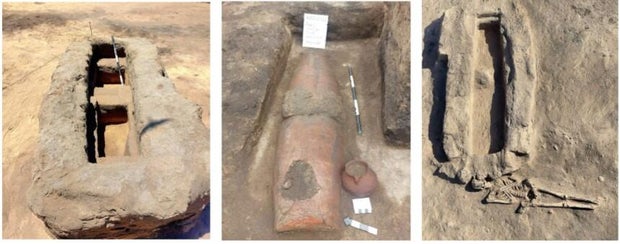
Burials discovered at the Tell Kom Aziza burial site in Egypt’s Nile Delta range from simple pits to graves lined with mudbricks to painted plaster coffins.

Egyptian Ministry of Tourism and Antiquities

Excavations revealed burial practices ranging from simple pit burials, with bodies placed directly in the ground, to graves lined with mudbricks and burials in painted plaster coffins.

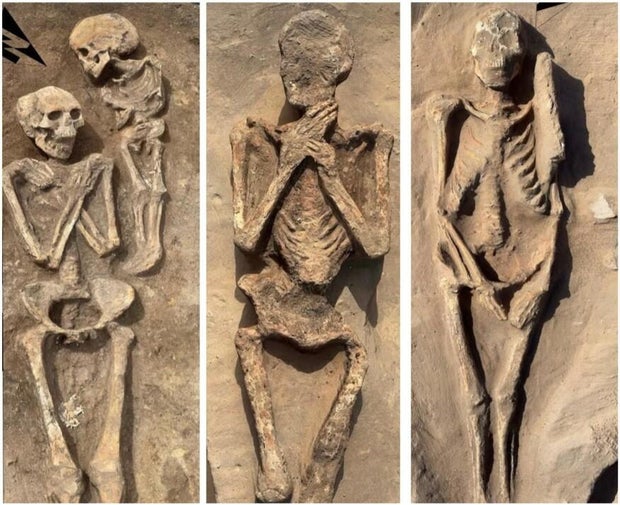
There were also individual and collective burials, according to Dr. Hisham El-Leithy, Secretary General of the Supreme Council of Antiquities, and burials oriented along both north–south and east–west axes. 

The hand positions of those interred also differed. Some individuals were buried with their hands folded or crossed over the pelvic region, while others were put in the “Osirian pose,” with their arms crossed over the chest, or with their arms extended and aligned alongside the thighs, El-Leithy said.
egypt-burials-2026.jpg
Human remains discovered at the Tell Kom Aziza site in Egypt’s Nile Delta show widely varying burial practices.

Egyptian Ministry of Tourism and Antiquities

“This diversity can be interpreted in several ways: It may reflect social differences among the individuals buried, variations in ritual practices, or a limited development within the same funerary tradition,” Khaled Abdel Ghany Farhat, the head of the team, told CBS News.

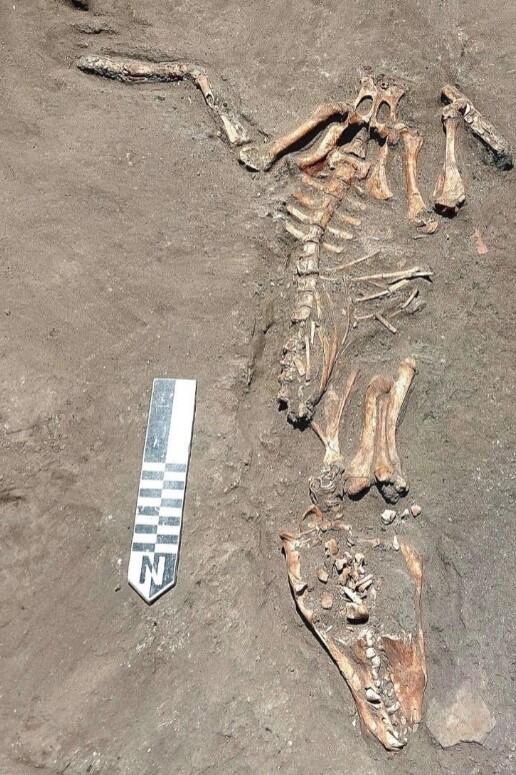
Among the significant discoveries were the complete skeletal remains of two wild boars, a rare find at ancient Egyptian funerary sites. Boars were representative at the time with Seth (or Set), a deity associated with chaos and violence in ancient Egyptian mythology.
wild-boar-ancient-egypt-burial.jpg
Among the discoveries at the Tell Kom Aziza burial site were the skeletal remains of two wild boars. Boars were representative of Seth (or Set), a deity associated with chaos and violence.

Egyptian Ministry of Tourism and Antiquities

“Even though it’s not possible yet to determine with certainty whether these remains represent intentional animal burials, remnants of domestic and economic activity, or an element with ritual significance, their presence within this context requires linking the direct archaeological evidence with the cultural and religious significance of the boar in ancient Egypt,” Mohamed Abdel Badi, Head of the Egyptian Antiquities Sector, told CBS News.

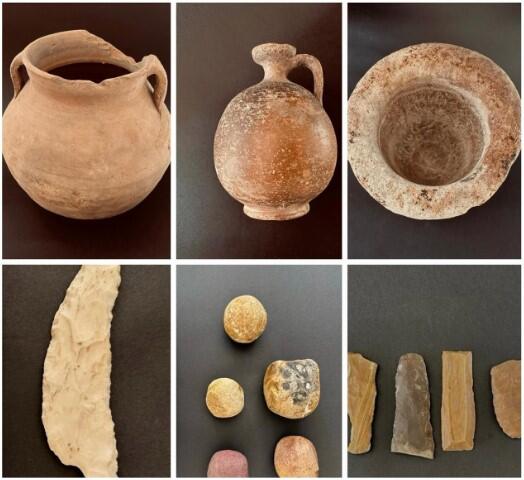
Pottery fragments dating from the Egyptian Old Kingdom — the time of the great pyramids’ construction, between around 2686 and 2181 B.C. — to the Greco-Roman period that followed some 2,000 years later, were also discovered at the site.
ancient-egypt-artifacts-nile.jpg
Pottery fragments and fragments dating from the Egyptian Old Kingdom, between around 2686 and 2181 B.C., and the Greco-Roman period that followed some 2,000 years later.

Egyptian Ministry of Tourism and Antiquities

The largely domestic items, including amphorae, burial jars, bread molds and bread trays, indicate continued or repeated use of the site over not just centuries, but millenia. 

“Excavation work at the site is still ongoing in order to uncover more secrets, understand the history of the location and its development over time, and put all the puzzle pieces together to decipher patterns of human activity in the area,” El-Aref, at the Ministry of Tourism and Antiquities, told CBS News.
Abdul El-Sayed distances himself from left-wing influencer after comments about American Jews

(CNN) — Michigan Democratic Senate nominee Abdul El-Sayed sought to distance himself Monday from Hasan Piker after the left-wing streamer and activist suggested to his Twitch viewers last week that American Jews’ support of Israel will make antisemitism worse and invite violence.El-Sayed, who is facing Republican former Rep. Mike Rogers in a critical race in the battle for the Senate majority this November, has appeared with Piker several times on the campaign trail, telling reporters he wanted to court the streamer’s massive young audience even though he disagreed with some of Piker’s views. The two walked into an event in Detroit together on the eve of El-Sayed’s narrow primary win over Rep. Haley Stevens and were photographed the same day together at a pool party with progressive influencers and House candidates.But after months of campaigning alongside Piker, El-Sayed said in a Monday statement specifically addressing Piker’s comments that “nobody speaks for this campaign besides me and my campaign spokespeople.”“I believe all Americans deserve the right to advocate for what they believe without fear of violence. This is particularly true for communities that have been intimidated for their beliefs in the past,” El-Sayed said.“My commitment to Jewish safety is the same as my commitment to the safety of my own daughters,” he added, repeating a sentiment he’s frequently espoused on the campaign trail. “Antisemitism is a scourge, and we need to address it in all its forms. And I stand against any rhetoric that puts the community at risk.”El-Sayed also sought to downplay the significance of the pro-Palestinian influencer to his campaign, as he accused “politicians and pundits” of trying “to make this race about a Twitch streamer.”Piker drew bipartisan backlash after he said last week, “If Jews in America keep putting this idea out there that they are singularly invested in Israel, eventually someone’s going to come around and take action — not against the state of Israel, mind you, but against American Jews.”He defended his remarks on X on Sunday evening as criticism of the conflation of support for Israel with American Jews. “Falsely tying Israel to Jewish people IS increasing antisemitism,” he argued, adding, “this isn’t a call for violence.”While El-Sayed is an outspoken critic of the Israeli government himself, his effort to distance himself from Piker comes as he vies to broaden his support after a bruising Democratic primary and as Rogers seeks to pick up disappointed Stevens voters.Describing Piker as El-Sayed’s “running mate,” Rogers in a social media post cast the streamer’s comments as “more calls for violence coming out of the El-Sayed campaign.”“If Abdul El-Sayed had any courage at all, he would call this out and disavow Hasan Piker once and for all,” he said. “We’re waiting, Abdul…”Michigan Democratic Rep. Hillary Scholten, who supported Stevens in the primary and has not endorsed El-Sayed, also condemned Piker’s remarks.“Piker is a hack who thrives on hate, shock and awe because he lacks substance,” she said. “It’s dangerous for everyone. We should all be calling out this disgusting rhetoric so it loses its grip on our politics once and for all.”The left-wing influencer made the comments last week during a livestream, as he discussed the refusal of state Sen. Jeremy Moss, the Democratic nominee for Stevens’ seat, to endorse El-Sayed.Piker appeared to reference an audio clip that has circulated online in recent weeks that purportedly features Moss, who is Jewish, saying that making sure the US continues supporting Israel is the only purpose of his House campaign. The lawmaker has denied making the remarks, saying in a statement that the clip is “manipulated and unsourced audio with things I never did and never would say.”Piker said: “I don’t know how people don’t recognize how dangerous this predicament is, how dangerous this is for Jews.”“You’re running around basically tying your entire identity to a country that inevitably will be seen as basically Jewish ISIS, and you’re saying, as Jews, this is all we care about,” he said. “You’re making antisemitism worse.”Moss said in a statement Monday that while he and El-Sayed have been having an ongoing conversation about Jewish and Arab safety in the US and abroad, there is still work to be done to unite the Democratic ticket in Michigan.“But provocateurs are exploiting this moment to create further divisions,” he warned. “I will not be lectured by a California podcaster about what Oakland County, Michigan’s Jewish community should and shouldn’t believe. And we certainly won’t be gaslit that we’re responsible for the antisemitic harm upon us.”Piker’s views reflect growing opposition to US support for Israel, particularly among progressives, in response to Israel’s war in Gaza and the ensuing humanitarian crisis in the Palestinian enclave following Hamas’ October 2023 attack.But the streamer also has a long history of incendiary remarks — including saying in 2019 that the United States “deserved 9/11,” a comment from which he backtracked days later.Earlier this month on NBC’s “Meet the Press,” El-Sayed said Piker’s comment about 9/11 was “dumb,” but also cast highlighting it now as playing “gotcha politics.”“I want to be held accountable for what I say and what I do, rather than this idea that we’re so stuck in cancel culture that all of us agreed was a bad idea back in 2020, but we seem to want to bring back,” El-Sayed said in that interview.The-CNN-Wire™ & © 2026 Cable News Network, Inc., a Warner Bros. Discovery Company. All rights reserved.
Read Next Story