
A look back at the 2022 FIFA World Cup final

▶ Watch Video: Mini-pitches bringing soccer to new U.S. neighborhoods

Four years ago, tens of thousands of soccer fans packed into Qatar’s Lusail Stadium to watch Argentina take on France, a matchup featuring Lionel Messi against Kylian Mbappé, in the World Cup final. 

France, the defending champion, would have been the first nation since Brazil in 1962 to win successive World Cups. But the game came down to penalty kicks in the end, with Argentina scoring four to France’s two.  

Before the 2022 final 

Anticipation built across Argentina and France ahead of the final match in 2022. In Rosario, Argentina, Messi’s hometown, a crane lifted a giant Messi shirt into the air. The blue-and-white striped jersey was also everywhere in Qatar, CBS News producer Rose Manister, who covered the 2022 World Cup, said. 

“It was everywhere, adults and children alike were wearing it constantly, even on days when Argentina weren’t playing,” she said. 
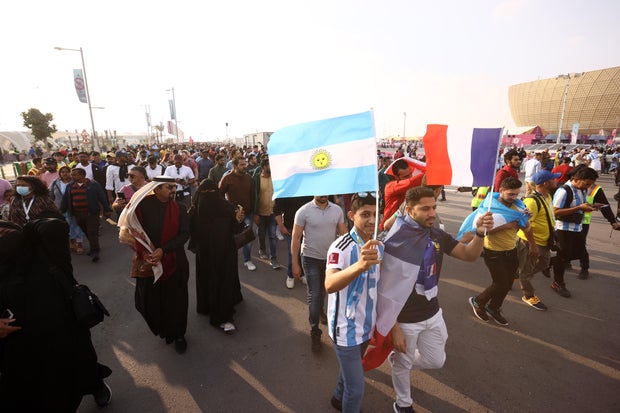
Argentina v France: Final - FIFA World Cup Qatar 2022
Fans arrive at the stadium prior to the FIFA World Cup Qatar 2022 final match. 

Robert Cianflone / Getty Images

Argentina fan Luceo Colombera was amazed by how many fans had made their way to Qatar for the final. 

“Some Argentinians, I know that they sold their house, their car to be here,” Colombera told Reuters in Spanish. “That is incredible, I think, and the dream of most of the people here is that Messi can be the champion.”

Max Pichaud attended the final from Paris.  

“I’m so excited because it is the first time I go to a World Cup final. The first World Cup I go to and it’s France, it’s my country, so I will support them until the end,” he told Reuters at the time. “Of course, we will win because we play with our hearts and the fans.”

What happened during the game

Argentina started the game off strong, with a 2-0 lead by halftime. Messi scored on a penalty kick, and Angel Di Maria scored a goal. Di Maria scored again in the second half. 

But then, in the game’s 71st minute, Mbappé scored. He quickly scored again, then scored his team’s third goal on a penalty kick. Mbappé became the second player ever to perform a hat trick — three goals during a single match — in a World Cup final. 
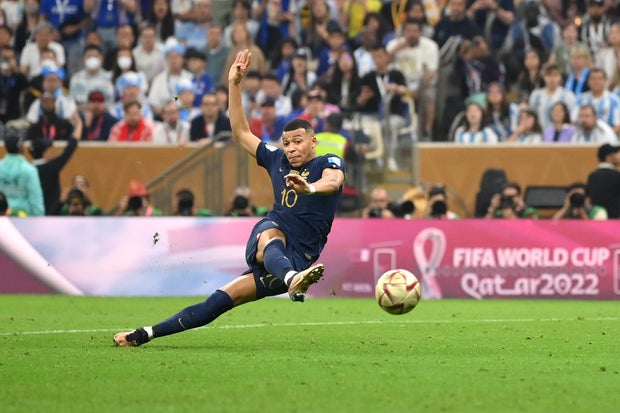
Argentina v France: Final - FIFA World Cup Qatar 2022
Kylian Mbappé of France scores the team’s second goal during the FIFA World Cup Qatar 2022 final match between Argentina and France.

Dan Mullan / Getty Images

The game eventually came down to a penalty shootout, with Argentina’s Messi, Paulo Dybala, Leandro Paredes and Gonzalo Montiel shooting on target. Only Mbappé and Randal Kolo Muani scored for France.

Messi was awarded the Golden Ball, a prize given to the tournament’s best player. He’s the only player in World Cup history to receive the Golden Ball twice. 

Fans react to Argentina’s win 

The match between Argentina and France “was probably the final that everyone in Qatar was hoping for,” Manister said. 

“And then the final was probably the greatest World Cup final of all time,” she said. 

Argentina fan Rogelio Vazquez celebrated after his team’s win in a penalty kick shootout. 

“We could have won it comfortably, but we had to suffer as always,” he told Reuters in Spanish. “But when you suffer, you enjoy it more. So let’s go, Argentina.”

French fan Kadine Galoco congratulated Mbappé on his three goals.

“But Messi got the World Cup he wanted,” Galoco told Reuters in French. “I don’t want to say I’m happy for him, but very good journey for him. And good luck to France, don’t let go, the next one is for us.”
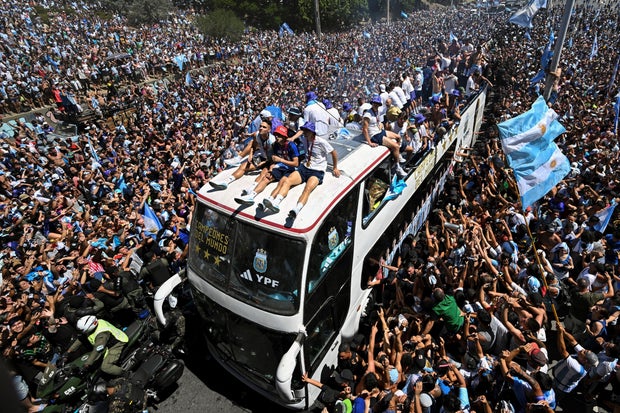
TOPSHOT-ARGENTINA-FBL-WC-2022-FANS
Fans of Argentina cheer as the team parades on board a bus after winning the Qatar 2022 World Cup in Buenos Aires, Argentina, on Dec. 20, 2022.

Luis ROBAYO /AFP via Getty Images

More than 80,000 people attended the final match at Lusail Stadium, according to FIFA. But the area was quiet the day after the final, with one fan telling Reuters it was like a ghost town. 

“But yeah, who cares. Yesterday was amazing. We watched the sunrise dancing with our compatriots. You can tell by my voice what a good time we had,” Jesica Inamorato, another Argentina fan, told Reuters in Spanish.

How big names reacted 

Messi was lauded by fans, including LeBron James and former President Barack Obama, who both called Messi the GOAT.

Athletes, including former striker Gary Lineker and Serena Williams, also weighed in. 

“It’s been an absolute privilege to watch Lionel Messi for nearly 2 decades. Moment after moment of spellbinding, breathtakingly joyous football,” Lineker wrote in a social media post. “He’s a gift from the footballing Gods. So pleased that he’s lifted the ultimate prize in our sport. Gracias y felicidades, campeón.”

Ryan Reynolds was also among those watching the final match of the 2022 World Cup. 

“This game is a gorgeous, evil curse. I love it so much make it stop,” Reynolds said at the time. 

Brazilian soccer legend Pelé, who died shortly after the World Cup, also congratulated the teams.

“Today, football continues to tell its story, as always, in an enthralling way,” he said in an Instagram post. “Messi winning his first World Cup, as his trajectory deserved. My dear friend, Mbappé, scoring four goals in a final. What a gift it was to watch this spectacle to the future of our sport.”

2022 World Cup by the numbers

According to FIFA, the 2022 World Cup featured:

  • One host country, Qatar
  • Eight stadiums
  • 32 teams
  • 64 matches
  • 88,966 fans at the final

‘Decades in Sports’: How the 1980s Miami Hurricanes became one of the most hated teams in sports history

(CNN) — Editor’s note: Watch CNN Original Series “Decades in Sports” on the CNN app. Across six episodes, the series explores the defining moments, athletes and cultural shifts that shaped sports over the past six decades, from the television revolution and Civil Rights Movement of the 1960s, right up to the impact of social media on today’s biggest stars.There have been plenty of dominant teams in the 150-plus-year history of college football, but few have left a bigger mark on the sport than the Miami Hurricanes did during the 1980s.The Canes were a team that went against the grain, trash-talking in a way that constantly got under their opponents’ skin, celebrating wildly after big plays and dancing in the end zone after touchdowns with a swagger that stood out as much as their bright orange jerseys.“That made them such a phenomenon,” says John U. Bacon, author of Fourth and Long: The Fight for the Soul of College Football, as the Hurricanes’ bold, brash and arrogant style transformed college football into something closer to theater.As Bacon also highlights in the series, “The Hurricanes were the bad boys of college football.” However, their impact was felt far beyond the gridiron, as the 1986 squad was even labeled the most hated team of all time by Sports Illustrated.For context, the 25-team list devised by Sports Illustrated featured some of the most polarizing teams in US sports history, such as the 1988-89 Detroit Pistons (widely known as the “Bad Boys”), the 2010-11 Miami Heat (universally recognized as the team that kickstarted the “superteam” era in the NBA) and the 2007 New England Patriots (who became the ultimate villains of the NFL after the infamous “Spygate” scandal.But it was this college football program which topped them all. As Bacon says, “They were more popular in Miami than the Dolphins, and the Dolphins had (1984 NFL MVP) Dan Marino.”Why Miami was so hatedThe Canes’ boisterous antics were not just empty calories – they backed it up when they stepped onto the field.Like many polarizing sports teams throughout history, Miami garnered attention because it won. Winning made the Hurricanes easy to root against, but also impossible to ignore.However, what truly set them apart is how they embraced the role of the villain.Before facing defending national champion and top-ranked Oklahoma in September 1986 in front of over 70,000 fans at the Orange Bowl, the Hurricanes famously defied protocol and refused to shake hands with the Sooners, sparking a heated exchange between the top two teams right in front of the TV cameras.Game officials intervened and even threatened to throw a penalty flag if Miami snubbed the pre-game handshake. But the Hurricanes didn’t budge and backed up their pre-game antics by beating the Sooners 28-16.Their “style ruffled a lot of feathers,” says Dr. Todd Boyd, Professor of Cinema and Music Studies at USC. But the more people disliked Miami, the more the team seemed to embrace it.Later that same season, they took it a step further.When landing in Tempe, Arizona, for the 1987 Fiesta Bowl against Penn State, which served as the national championship game, the Hurricanes famously stepped off their plane wearing full camouflage military fatigues in an attempt to intimidate the Nittany Lions.It didn’t work on that occasion, as Miami fell 14-10 in the title game. But the following year, the “Bad Boy” Hurricanes came out on top, going unbeaten and taking down the Oklahoma Sooners – again – 20-14 to win the national championship.As Van Lathan – journalist and podcaster at The Ringer – says in the series, “The 80s were an anti-hero decade.”Lathan went on to highlight that, during that time, “We are re-examining what is OK in the name of coming out on top. This is a post-Watergate America … and whatever it takes, we are going to win.”No one embodied that shift more than this group from South Florida: It was win by any means necessary.As sports journalist and podcaster Bomani Jones highlights: “It became the dominant culture of the sport.”However, none of this would have been possible without a coach who not only allowed his players the space to go about their business in such a controversial manner, but one who encouraged the brash and boisterous behavior they took to stadiums across the country: Jimmy Johnson.The Jimmy Johnson effectWhen Johnson arrived in South Florida in 1984, he had pretty big shoes to fill.Howard Schnellenberger – who helped build Miami’s college football program into one of the elite programs over five seasons – had just departed after leading the Hurricanes to their first national championship, upsetting the unbeaten, top-ranked Nebraska Cornhuskers 31-30 at the Orange Bowl.However, despite Schnellenberger being the original architect of Miami’s success, it was under Johnson that the Hurricanes truly peaked.After going 18-7 in his first two seasons, Miami went 34-2 in his final three, winning the national championship in 1987 and narrowly losing one 14-10 to Penn State in 1986 after Johnson led the Hurricanes to the first undefeated regular season in program history.But it was the culture Johnson cultivated in South Florida that made his tenure so memorable.There was a shift happening in sports in the 1980s, with players becoming more brash and expressive. It is something that is celebrated today but was highly frowned upon at the time.Johnson’s genius was not only in recognizing that shift, but also in allowing his players to be their authentic selves out on the field, because as Jones highlights in the series: “The Florida boys are different, (and) they have a really good time when they play their football.“Normally, when you get a lot of players who like to dance when they score a touchdown and like to talk a bunch of sh*t when they play, you have a coach who is trying to tamp that down and get them to behave a little bit more respectably…“Jimmy Johnson loved it! He loved it as much as they did. He’s like, ‘As long as we win, you can do whatever you want.’”On its face, it sounds simple, but it was highly effective and it was an era that redefined what a college football powerhouse could look like. They were rough around the edges, bold, brash and arrogant – but that’s what made them who they were.Better to be remembered for something than not remembered at all. And no one will forget the 1980s Miami Hurricanes, the “Bad Boys of college football.”The-CNN-Wire™ & © 2026 Cable News Network, Inc., a Warner Bros. Discovery Company. All rights reserved.
Read Next Story