2nd American infected with Ebola in DRC evacuated to Germany, WHO chief says

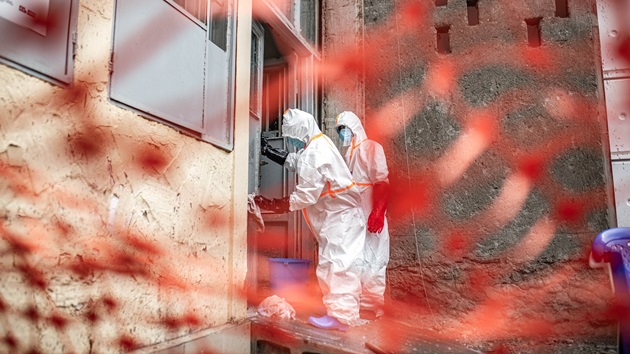
Medical workers disinfect a facility used to treat an Ebola patient at the Heal Africa Hospital on June 4, 2026 in Goma, Democratic Republic of Congo. (Daniel Buuma/Getty Images)

(NEW YORK) — A second American citizen infected with Ebola in the Democratic Republic of the Congo (DRC) has been transferred to Germany for care, the head of the World Health Organization said on Monday.

The Centers for Disease Control and Prevention (CDC) announced over the weekend that the unnamed patient works for a humanitarian aid organization and tested positive for the Bundibugyo virus, the strain of Ebola that is behind the DRC’s outbreak.

In a post on X on Monday, Dr. Tedros Adhanom Ghebreyesus, director-general of the WHO, said the organization “has provided clinical care and close monitoring” for the patient in the Ituri province, where most of the DRC’s cases have been confirmed.

Samaritan’s Purse, which has been responding to the outbreak, confirmed on Monday that one of their staff members is the infected patient.

“We can confirm that one of our Samaritan’s Purse staff members working in Bunia, Democratic Republic of the Congo (DRC), has tested positive for the Ebola virus,” Franklin Graham, president and CEO of Samaritan’s Purse, said in a statement. “This respected and faithful staff member has been a part of our Disaster Assistance Response Team for 15 years and has been serving in a logistics capacity in the DRC over the past month. He was not involved in direct patient care at our two Ebola Treatment Centers.”

Samaritan’s Purse said it immediately contacted the CDC, the State Department and the DRC’s government upon learning of the positive test and that the organization has begun contact tracing.

The first American infected with Ebola was a doctor who contracted the disease while treating patients in the DRC. Dr. Peter Stafford was evacuated to Germany at the time to receive specialty care and was hospitalized at Charité University Hospital in Berlin, according to Serge, the international Christian missionary group that employs him.

His wife, Dr. Rebekah Stafford, and their four children were also evacuated to Germany and moved into a separate space at the hospital as high-risk contacts. Peter Stafford was discharged from the hospital in June, and the family has since returned to the United States.

The outbreak in the DRC has led to more than 1,900 cases and more than 700 deaths, according to the latest figures from the DRC’s Ministry of Health.

“As infections among response personnel are not unexpected in an outbreak of this scale, protecting frontline responders must remain a top priority,” the WHO’s Tedros wrote on X. “We are deeply grateful for the courage and commitment of all health workers working to end this outbreak.”

Copyright © 2026, ABC Audio. All rights reserved.
JD Vance and the Trump team keep moving the goalposts on Iran

(CNN) — One of the Trump administration’s biggest problems in extracting itself from the Iran war is the list of very absolutist goals that President Donald Trump and his team laid out.The goals have included complete Iranian surrender, regime change, Iran never getting a nuclear weapon and ending Tehran’s support for its Middle East proxy groups like Hezbollah.As the war — now in its sixth month — has dragged on, this list of goals has conspicuously shifted and been pared back. And Vice President JD Vance appears to have pared it back recently in a remarkable way, offering the latest indication that the administration might be preparing to settle for less — maybe even a lot less.Appearing on Fox News on Thursday, Vance was asked how the war might end. And he laid out two goals.“It’s ensuring that the Gulf countries continue to send oil and gas to the world economy so that we have energy price stability,” he said, adding: “That’s goal number one: Keep oil and gas cheap for Americans all over our country.“And then, obviously, goal number two is ensure that Iran never gets a nuclear weapon.”This is not the administration’s old list of goals — and the order Vance placed them in is striking.When asked about Vance’s comments on Friday, White House press secretary Karoline Leavitt maintained that “both goals are equally as important to the president.”The administration has almost always characterized Iran never getting a nuclear weapon as the overriding concern.And even if the goals are truly equal in the administration’s mind, including oil and gas prices at all — and not other items — is a notable shift.In fact, Trump explicitly rejected this as a goal back in May. When asked if he considered Americans’ financial situation when trying to resolve the war, Trump responded, “Not even a little bit.” He signaled that denuclearization was so important that he didn’t factor in anything else.(Trump echoed that line on Friday, saying he would “never apologize” for Americans paying a little more for gas, given the stakes in Iran.)I wrote in March about how the administration frequently listed four goals for the war — but how the four goals frequently differed depending upon who was speaking.Some lists included ending funding for proxy groups, for example, while others did not. Some mentioned destroying Iran’s missile infrastructure, while others omitted that. Some mentioned getting rid of Iran’s air force and navy, but others only mentioned the navy.It was like the administration was workshopping the list in real time.But the key point here is that none of those lists included keeping oil and gas prices low in the United States.And given the Strait of Hormuz was open before the war started, that particular goal could just be read as a return to the pre-war status quo — with denuclearization being the only goal that would represent a new achievement.Indeed, the new emphasis on low gas prices from some in the administration seems like the latest sign of relaxing the goals to prepare for a conclusion to the war that comes up well shy of Trump’s initial aims.By May, it became clear the administration was no longer going to emphasize certain goals.By June, the Trump administration entered into a memorandum of understanding with Iran that barely mentioned previously central US goals.And for the last two-plus months, Trump has been saying things that sounded a lot like he might scale back his nuclear demands.While the administration previously emphasized Iran turning over its enriched uranium, Trump’s spoken about how perhaps enough damage was done to its nuclear program and its nuclear materials are buried too far underground to be accessed. The president has also talked about how the US government could simply monitor from space to make sure Iran didn’t try to retrieve them.He’s even claimed that Iran was already denuclearized.In other words, Trump sounded a lot like a guy who knew he might not be able to cow Iran into accepting a really restrictive nuclear deal.His administration talking about energy prices as “goal number one” — even if Trump isn’t — would fit neatly with this progression away from the hard-and-fast goals that the administration set out to achieve.If a return to the pre-war status quo really is “goal number one” right now, that says a lot about how little this war has accomplished.The-CNN-Wire™ & © 2026 Cable News Network, Inc., a Warner Bros. Discovery Company. All rights reserved.
Read Next Story