
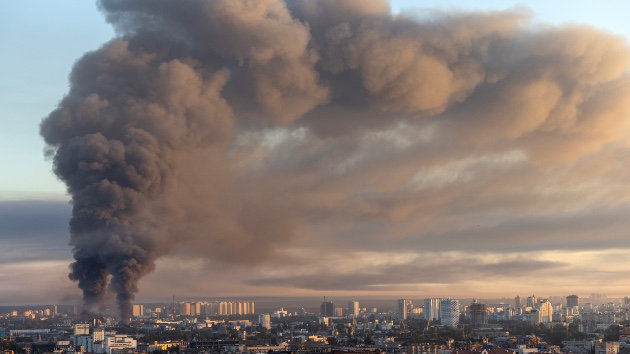
20 dead, dozens injured in Kyiv as Ukraine hit with ‘massive’ Russian strike

Smoke is seen as two major fires burn after a drone and missile attack by Russian forces on July 2, 2026 in Kyiv, Ukraine. (Photo by Paula Bronstein/Getty Images)

(LVIV, LONDON and NEW YORK) — At least 20 people were killed and dozens of others were injured after Kyiv came under attack from a “massive” barrage of Russian ballistic missiles and drones overnight, Ukrainian officials said, describing multiple explosions across the capital.

Tymur Tkachenko, head of Kyiv City Military Administration, published an updated death toll on his Telegram channel. The State Emergency Service of Ukraine said the attack’s main target was Kyiv. More than 90 people had been injured across the country.

Kyiv’s Mayor Vitali Klitschko described the attack as “massive.” President President Volodymyr Zelenskyy said first responders in the capital were “clearing the rubble, searching for people, and providing assistance.”

“Damage has been reported at more than 20 sites across the city, most of them ordinary residential buildings,” Zelenskyy said. “There was also damage to an ambulance station, a research institute, a hotel, and businesses.”

Moscow targeted Ukraine with more than 70 missiles, nearly half of which were ballistic, along with almost 500 drones in the overnight attack, Zelenskyy said.

Damage has been reported in every district in Kyiv. The worst hit was the Darnytskyi district, where part of a nine-floor apartment building collapsed, leaving people trapped inside, Klitschko. Search and rescue teams are still looking for those thought to be under the rubble, including a 15-year-old girl and her family.

Another air raid alert has been issued in Kyiv right now due to Russian drones.

In Holosiivskyi district, the roof of a multi-story residential building was on fire, Klitschko said. In the Shevchenkivskyi district, in the center of the capital, there was a fire on the roof of a hotel.

During the strikes, the mayor urged residents to stay in shelters. Klitschko said earlier that of the 34 people initially recorded as injured in the strikes, 32 were taken to the hospital; two others were treated on the spot.

The strikes targeting Kyiv came hours after the Ukrainian military struck a large Russian oil refinery in Ufa, and a military complex in the Penza region, Zelenskyy said. The night before, Ukraine also struck a satellite communications center in the Moscow region, Zelenskyy said.

Ukraine’s strikes on Russia came amid a mounting pressure campaign by Kyiv seeking to push Russia to end the war, which in February entered its fifth year.

An analysis from a U.S. think tank published on Wednesday said troop casualties in the war — missing, killed and wounded — had surpassed 2 million, including as many as 600,000 deaths.

The Center for Strategic and International Studies said in that report that the figures heavily skewed toward Russian losses, with roughly three Russians killed or wounded to every one Ukrainian killed or wounded.

Russian casualties amounted to 1.4 million people, according to the data, including 450,000 who had been killed in the war, the report said. Ukrainian forces have suffered 525,000 to 625,000 casualties, including 125,000 to 150,000 deaths, the study said.

Neither the Ukrainian nor the Russian military releases data detailing their own battlefield casualties.

The report’s authors, drawing on information collected from Western governments, including the U.S., and on open source information, said Russia also lost territory in April and May. Overall, the report’s authors said, 2026 has been counterproductive for the Russian military, and that Moscow may be losing the war.

Offering historical perspective, the report says Russian fatalities in Ukraine are more than four times greater than all U.S. fatalities in all wars combined since World War II, and more than nine times greater than all Soviet and Russian fatalities in all wars combined since World War II.

Russia’s advances in key Ukrainian areas “are among the slowest rates of advance in any war over the last century,” the report stated.

In Kyiv on Thursday, Ruslan Stefanchuk, the chair of Ukraine’s parliament, accused Moscow of using missiles and drones to deliberately target civilians, which turned “an ordinary night in the capital of a European state into a struggle for survival.”

“This crime, like every one before it, must be met not only with condemnation, but with a resolute response: stronger air defence for Ukraine, tougher sanctions against Russia, and inevitable accountability for everyone responsible,” he said on social media.

ABC News’ Patrick Reevell and Morgan Winsor contributed to this report.

Copyright © 2026, ABC Audio. All rights reserved.
Former US archivists warn that Trump’s effort to ignore records law jeopardizes national security and government continuity

(CNN) — Former leaders of the National Archives — which preserves and protects the nation’s most important documents — are urging a federal appeals court to reject the Trump administration’s effort to ignore the Presidential Records Act, a decades old law that requires presidents save all official records from their time in office.Six archivists, who served under both Republican and Democratic presidents, argue that the law is critical in maintaining “continuity of governance” and protecting national security.The archivists — a coalition covering every living person to have previously held the role before Marco Rubio’s brief appointment to the position at the beginning of Trump’s second term — filed an amicus brief Wednesday in support of a lawsuit from presidential scholars, historians and public transparency groups.The legal fight began after the Trump administration said it believed the president did not need to comply with decades-old record-keeping obligations set by Congress in the aftermath of the Watergate scandal. The law, which Trump’s Justice Department has claimed is unconstitutional, is intended to preserve documents so that future presidents, members of Congress, courts and the public can understand how an administration made critical decisions.“Preserving presidential records ensures that new leaders can have immediate and ongoing access to the data, strategy, and rationale behind past policy decisions,” the group said, noting that, in their experience, the most “frequent request for preserved presidential records comes from the incoming president’s national security advisors.”The archivists signed on to the brief are Trudy Huskamp Peterson, John W. Carlin, David S. Ferriero, Debra Steidel Wall, Colleen Shogan and William J. Bosanko — as well as Gary M. Stern, a former agency general counsel.The plea from the former archivists comes months after a federal judge in Washington said that White House staff must preserve their official records while the lawsuit plays out in court but declined to put any restrictions directly on the president, the vice president, the National Archives and archivist.In the May ruling, US District Judge John Bates concluded that the Presidential Records Act (PRA) was likely constitutional, rebuking the stance taken by the Justice Department earlier this year. The Justice Department has appealed the ruling to the US DC Circuit Court of Appeals. Oral arguments are slated for October 16.The PRA requires presidents and their staff to preserve White House records and turn those records over to the National Archives at the end of their administrations.It was instrumental in the chain of events that led to Trump’s prosecution for allegedly mishandling classified documents that he took from the White House at the end of his first term.The legal fight stems from a conclusion from Trump’s Office of Legal Counsel, a Justice Department office that gives advice to the executive branch, that the law was unconstitutional. The OLC memo was seen as an audacious move for a number of reasons, including for how it seemed to eschew Supreme Court precedent backing Congress’ power to regulate presidential record preservation. The guidance only addressed the preservation of email and text messages, rather than all electronic records, which the PRA covers.The American Historical Association and the left-leaning government transparency group American Oversight quickly filed a lawsuit, warning that presidential records they intend to use for their research “will be irretrievably lost” if the court didn’t intervene.The former archivists say the PRA “helps to bridge the gap between the outgoing and incoming administrations.”“Geopolitical tensions do not pause for an inauguration,” they wrote in the court filing. “Presidential records include the entire holdings of the National Security Council… such as sensitive intelligence assessments, treaty negotiations, and operational contingency plans. Ensuring that these files are preserved and seamlessly made available to new administration officials allows incoming national security advisors and cabinet officials to evaluate active threats, maintain diplomatic momentum, and make informed decisions during unexpected global crises.”The administration has rebuffed concerns, insisting that the “lion’s share” of presidential records are being preserved, because work being done by presidential staff on White House-issued phones is being kept.CNN’s Tierney Sneed contributed to this report.The-CNN-Wire™ & © 2026 Cable News Network, Inc., a Warner Bros. Discovery Company. All rights reserved.
Read Next Story