Trump says ‘too bad’ SCOTUS upheld birthright citizenship, pushes legislation to end it

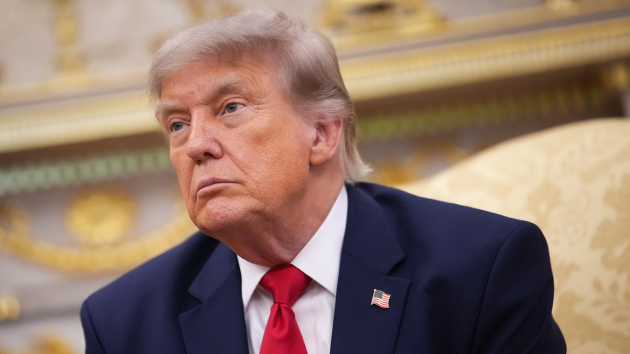
U.S. President Donald Trump attends a meeting with NATO Secretary-General Mark Rutte in the Oval Office of the White House on June 24, 2026, in Washington, DC. Secretary-General Mark Rutte is meeting with the President before the annual NATO summit next month and as the Pentagon does a six-month review of American forces in Europe. (Photo by Andrew Harnik/Getty Images)

(WASHINGTON) — President Donald Trump brushed off his loss after the Supreme Court rejected his attempt to end birthright citizenship — rooted in the 14th Amendment — on Tuesday, saying the decision is “too bad for the Country” and insisting that he can “easily make it up in Congress through Legislation.”

The court ruled in a 6-3 decision to reject Trump’s executive order that he issued on the first day of his presidency, with Chief Justice John Roberts writing for the majority, “Citizenship, then and now, was the right to have rights — to freely participate in our political community. The Framers of the Fourteenth Amendment extended that promise to every free-born person in this land. We keep that promise today.”

Trump responded to the court’s decision with a post on his social media platform, writing, “The Supreme Court upheld Birthright Citizenship, which is too bad for our Country, but we can easily make it up in Congress through Legislation, with the support of the President, that has now been determined during this process,” he wrote on his social media platform.

“No long and unwieldy Constitutional Amendment is necessary! Congress should start TODAY to work on ending expensive and unfair to our Country, Birthright Citizenship,” he added.

Birthright citizenship is rooted in both the Constitution and 1940 federal citizenship law. But even if the law were to be changed, this would likely be challenged in court on constitutional grounds with the possibility of the issue making its way back to the Supreme Court. 

ABC News reached out to the White House for more information about how the president would use Congress as a workaround for the court’s decision and if he is prepared for the issue to potentially return to legal scrutiny, but the White House referred questions back to the president’s post. 

On Monday, Trump said he would “accept” the results of the Supreme Court and acknowledged that “it’s up to them.”

In a subsequent post Tuesday, Trump again reiterated his desire to “correct” the birthright citizenship case in Congress while touting other cases that he won before the court.

House Speaker Mike Johnson, speaking at a House Republican news conference before Trump posted, said he was “very disappointed” with the decision and that Congress will look at amending the Constitution to address the issue.

“I think it subjects the country to serious challenges going forward and we’ll have to deal with it as a Congress,” Johnson said, saying the policy has been “grossly abused.”

“I’m sure we will continue to look at that. I’m sure the conclusion from this opinion is going to be you’ve got to amend the Constitution to fix that,” he said.

Johnson acknowledged a constitutional amendment would be “very complicated” and a “many-years-long process,” but said he thought it was likely the only way forward. 

Amending the Constitution would take a two-thirds majority in both chambers of Congress ratification by three-quarters of the states.

Copyright © 2026, ABC Audio. All rights reserved.
Trump’s unfinished ballroom faces uncertain path after latest legal blow

(CNN) — President Donald Trump has dug himself a hole.The future of construction on his sprawling East Wing ballroom is uncertain after a divided appeals court ruled Friday that he is unlawfully constructing the project.What happens next could be up to the nation’s highest court — to which Trump said he’d appeal — potentially Congress and maybe even his successor.“There is no clear path to this being resolved one way or the other while he is president. The likelihood that we have a hole in the ground because of political realities — not because of construction realities — is very high through the end of his term,” said Greg Werkheiser, a historic preservationist and lawyer who is embroiled in a separate lawsuit with the White House over another Trump pursuit, an effort to paint the nearby Eisenhower Executive Office Building.The ballroom — like many of Trump’s construction projects around Washington, DC — is unpopular with the public. But it’s a major priority for the president, who has championed it at every opportunity and been involved in design details big and small.“The entire Complex, Military and all, is largely built, fabricated, and paid for. Much is already on site, or being delivered,” Trump wrote on Truth Social after Friday’s ruling, blasting the court and asking why the nation’s top historic preservation group didn’t sue before construction started.Nearly six months of constructionPlanning for the ballroom began in the early months of Trump’s second term, with the White House formally announcing it on July 31, 2025.The announcement made no mention of demolishing the East Wing, which for decades served as headquarters for first ladies and their staff, nor did it frame the project as a national security imperative — an argument Trump didn’t begin making until February 2026.In late October 2025, the East Wing was razed and workers began a monthslong excavation effort resulting in a very large hole in the ground. The National Trust for Historic Preservation launched a legal challenge in December.In late February 2026, crews began work on the foundation, filling in that hole with the below-ground portion of the building, which will house a highly secretive underground bunker complex aimed at modernizing aging underground infrastructure.So far, according to a CNN analysis of photos and floor plans, the above-ground construction of the ballroom has been limited to pouring heavily reinforced concrete columns, walls and floors. The areas where the concrete frame has been completed include new offices for the first lady, some of the kitchen and some entry halls. Above the ground floor, crews have built four towering walls, almost to the planned height of the building, and begun assembling formwork to pour the floor of the actual ballroom.Construction has progressed at a rapid pace, but the new structure isn’t close to being occupiable.As the scope of the project has evolved, so has the price tag. The ballroom was initially introduced at “approximately $200 million,” with Trump emphasizing it would be privately paid for as the cost ticked up to $300 and then $400 million.Then this spring, Senate Republicans requested $1 billion that would go, in part, toward security related to the project, although that effort ultimately failed, with some in Trump’s own party worried about the optics of funding a ballroom while Americans are struggling. The funding picture became more complicated when a project summary, obtained by the Washington Post in June, estimated its price at $600 million, more than half of which would come from taxpayers.What happens nextThe crux of the legal challenge isn’t the 90,000-square-foot structure, its placement atop the South Lawn or even the 2025 demolition of the historic East Wing. Instead, it’s the processes Trump ignored along the way: bypassing congressional approval and breaking ground before required reviews and assessments were completed.The president maintains the project isn’t subject to any oversight. But it’s become mired in a complicated legal battle without a clear resolution ahead.This state of uncertainty, Werkheiser told CNN, “illustrates that the morass he’s gotten himself into with all these projects. It’s not that he can’t do them. It’s just that he refuses to do them legally, and that makes it that much more difficult for him to execute them than they would be if he just followed the rules in the first place.”On Friday, the appeals court said Trump must stop construction until Congress approves the project, but the judges paused their ruling for two weeks so the administration could have a chance to appeal to the Supreme Court — which Trump vowed to do “immediately.” Once that request is in, the justices will have to decide whether they will let the lower-court ruling take effect for now.Separately, the Supreme Court will also have to decide whether it will review the lower-court ruling against the project at all. Should the justices take up the case, recent divisions within the court’s conservative supermajority suggest that a win for Trump isn’t guaranteed.Some White House officials have questioned what will happen if the Supreme Court declines to take up the case, but the overall sentiment from top legal advisers is that the administration is well-positioned to win the case and it’s not time to be concerned yet, according to a person familiar with the matter.If Trump secures a victory, construction could continue on a project whose completion he’s estimated by summer 2028, a few months before the end of his second term.It’s also possible that the court finds Trump must secure congressional approval before the project can resume, which would set up a major political test for the president’s party. Approval would become especially unlikely if Democrats gain power of either chamber in the November midterms.And public opinion isn’t on the president’s side: In a recent CNN poll, 58% of Americans said they were dissatisfied or angry about Trump’s projects around DC, like the ballroom and renovations at the Lincoln Memorial Reflecting Pool.Trump began messaging the ballroom as a national security necessity in late February. He zeroed in on that message after Friday’s ruling, saying it’s “being built for the protection of our Country and, additionally, all future Presidents” and highlighting some of the features of the underground bunker, including bomb shelters, medical facilities and top-secret military facilities.But the appeals court said Trump could continue work on the below-ground complex even while construction of the above-ground ballroom is paused, with the judges noting that the president could, for example, “put a fully protective covering over the underground construction and other exposed portions of the construction site” to ensure the bunker isn’t unprotected.Experts suggested to CNN that even if ballroom construction is legally forced to come to a halt, work on the bunker could proceed to eliminate the national security threat Trump has warned exists and also shore up the hole from any health and safety hazards.“Hypothetically, if you stop construction now, you could redesign this and have an underground facility and reconstruct the East Wing on top of it and just close off the site. There are other alternatives beyond completing the ballroom,” said Bryan Clark Green, an architectural historian who previously served on the National Capital Planning Commission, one of the review boards that approved the ballroom in April after being stacked with Trump loyalists.Trump’s construction obsessionTrump, a former real estate developer, has made construction his second job as president — one he believes is part of his legacy, sources familiar with his thinking have said.“The thing I do best in life is build,” he told reporters during a May field trip to observe the ballroom construction.The president lashed out at the appeals court repeatedly on Friday, underscoring the personal stakes as he cast the ruling as “a National Disgrace” and “horrendous, politically motivated, and unlawful.”But in Friday’s majority opinion, DC Circuit Court Judges Patricia Millett, an appointee of former President Barack Obama, and Brad Garcia, an appointee of former President Joe Biden, placed the blame squarely on Trump.“Any risk caused by the construction project and its multi-year timetable is overwhelmingly a problem of the Defendants’ own creation,” they wrote.The judges continued: “The Defendants unilaterally and likely without lawful authority destroyed a large portion of the White House structure and dug an open pit in its place. Then, after commencing a lengthy construction project, they publicly announced to the world the vulnerabilities that self-chosen endeavor has created.”The-CNN-Wire™ & © 2026 Cable News Network, Inc., a Warner Bros. Discovery Company. All rights reserved.
Read Next Story