Taylor Swift’s history with MSG, from talent competition to wedding bash

Taylor Swift is not shy about her love for New York City, referencing it in several lyrics — from the obvious “Welcome to New York” on “1989” to more subtle references like “Your heartbeat on the High Line” in the song “Cardigan.”

And on her fourth studio album, “Red,” Swift alludes to Madison Square Garden, the venue where sources say she and Travis Kelce plan to host multiple wedding events this week.

In “The Lucky One,” Swift sings about a star who ultimately chooses a quiet life over fame, using the iconic venue as a symbol for the limelight: 

“They say you bought a bunch of land somewhere
Chose the rose garden over Madison Square 
And it took some time, but I understand it now”

But Swift doesn’t appear to be making the same choice as the subject of “The Lucky One.” She and Kelce plan to have a rehearsal dinner Thursday and a bigger celebration Friday at Madison Square Garden, according to two law enforcement sources familiar with the security planning for the events.

Beyond her lyrics, Swift has had a decadeslong history with Madison Square Garden, performing there as early as 2003 and even celebrating her 30th birthday at the venue. 

Here’s a look at her ties to the venue:

Knicks halftime show

Madison Square Garden welcomed Swift to New York in 2003 when she took part in a talent competition during halftime at a Knicks game. Swift sang “Lucky You,” an unreleased original song. 

“I performed at the Knicks’ — at Madison Square Garden’s — Kids Talent Competition at halftime when I was 12 or 13,” Swift told TIME in a 2014 interview. “And ever since then I’ve had this kind of sparkly, magical opinion of Madison Square Garden and the Knicks, since they let me sing when I was a little kid.”

“I love you, New York,” Swift yelled to the crowd during her performance. 

Tour stops

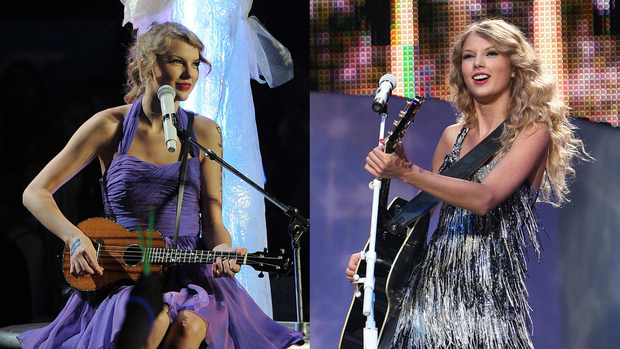
Swift had concerts at Madison Square Garden during two of her tours: “Fearless” in 2009 and “Speak Now” in 2011.

The venue wasn’t part of her later tours, as she needed larger spaces.
taylor-swift-msg.png
Taylor Swift performs at Madison Square Garden during the “Speak Now World Tour” on Nov. 22, 2011, (left) and during the “Fearless Tour” on Aug. 27, 2009 (right).

Larry Busacca/Getty Images / Jason Kempin/Getty Images

Swift also made an appearance during one of Ed Sheeran’s concerts at the venue in 2013. The duo sang their song “Everything Has Changed.”
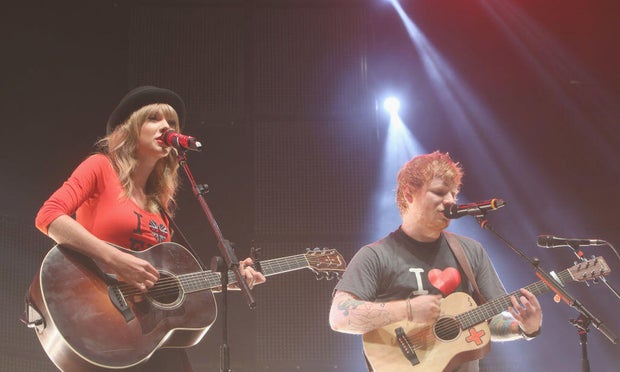
Taylor Swift joins Ed Sheeran on stage at Madison Square Garden in 2013
Taylor Swift joins Ed Sheeran on stage at his show at Madison Square Garden on Nov. 1, 2013.

Anna Webber/Getty Images for Atlantic Records

Jingle Ball

Swift has performed in five of iHeartRadio’s annual Jingle Ball events at Madison Square Garden. The concerts typically take place in early December. In 2019, the show fell on Dec. 13, Swift’s 30th birthday.

“I had a choice,” Swift said on stage, according to Variety. “Where would I want to spend my 30th birthday? The answer is: you’re looking at it. This is the first show of the 30th year of my life.” 

Radio host Elvis Duran presented Swift with a giant cake featuring images of her cats to celebrate her birthday. 
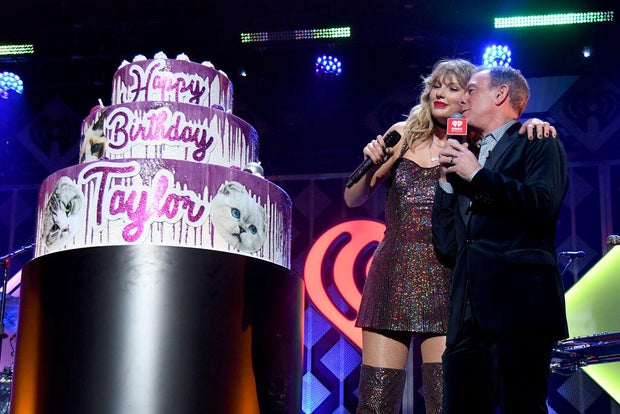
Taylor Swift at iHeartRadio's Z100 Jingle Ball 2019
Taylor Swift and Elvis Duran pose onstage during iHeartRadio’s Z100 Jingle Ball 2019 at Madison Square Garden on Dec. 13, 2019, Swift’s 30th birthday.

Kevin Mazur/Getty Images for iHeartMedia
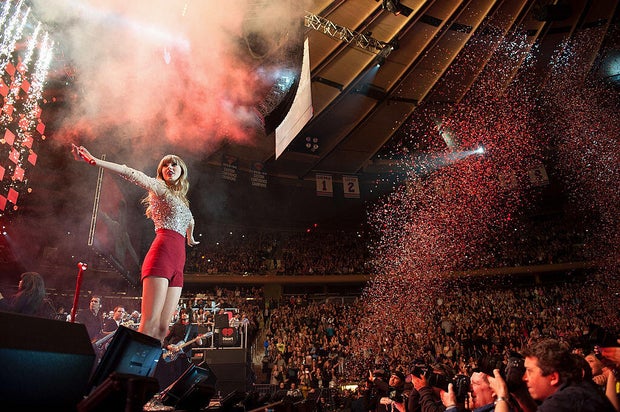
Taylor Swift at Z100's Jingle Ball 2012
Taylor Swift performs during Z100’s Jingle Ball at Madison Square Garden on Dec. 7, 2012.

D Dipasupil/FilmMagic/Getty Images

Knicks games

On top of her performances, Swift has sat in “celebrity row” at multiple Knicks games over the years. 

In the 2014 TIME interview, Swift described former Knicks star Amar’e Stoudemire and his then-wife, Alexis, as “the most normal people” at the Met Gala the years she attended. 

“I talk with them and hang with them every time I’m there. So I’ve always had this sort of love of the Knicks, just because Amar’e is so cool,” she said. 

Swift most recently appeared courtside at Madison Square Garden during Game 4 of the NBA Finals, in which the Knicks had an historic comeback against the San Antonio Spurs.  
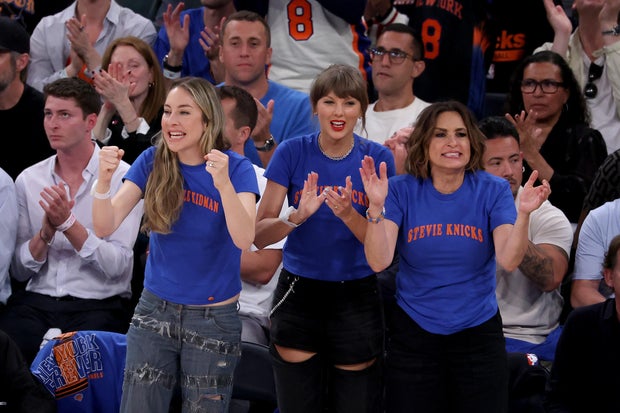
Este Haim, Taylor Swift, and Mariska Hargitay attend Game Four of the 2026 NBA Finals between the San Antonio Spurs and the New York Knicks at Madison Square Garden on June 10, 2026 in New York City.
Este Haim, Taylor Swift, and Mariska Hargitay cheer during Game 4 of the 2026 NBA Finals between the San Antonio Spurs and the New York Knicks at Madison Square Garden on June 10, 2026.

Al Bello / Getty Images

Record share of kindergartners missed required vaccines last year as Trump executive order takes aim at state mandates

(CNN) — A record share of kindergartners in the United States had an exemption for a required vaccination last school year, as the Trump administration continues to make moves to reduce the number of vaccinations recommended for children.An executive order signed by President Donald Trump last week aims to reshape the federal government’s approach to vaccines. The order offers recommendations to “give parents more information and options” — but the authority to set and enforce vaccine requirements still lies with states, and a growing share are utilizing existing policies that allow exemptions.The administration signaled that it will push states to rework their vaccine requirements to incorporate the new federal guidelines, effectively upending longstanding practices aimed at improving childhood immunization rates. It’s unclear exactly how officials plan to reinforce this, but the Department of Justice, the Department of Education and the Department of Health and Human Services have been directed to tie compliance with federal funding.The new executive order emphasizes the administration’s aim to “maximize parental choices over vaccinations for their children,” specifically noting that states should “provide religious and medical exemptions” to vaccine requirements.All 50 states have their own laws requiring certain vaccines for students to attend school, and all allow students to be exempted from school vaccine requirements for medical reasons. The vast majority of states also allow vaccine exemptions for non-medical reasons, which may be categorized as religious or personal.Utilization of these exemptions is more common than it’s ever been. Data published Monday by the US Centers for Disease Control and Prevention shows that 4.2% of kindergartners had an exemption for at least one required vaccine during the 2025-26 school year.This left about 157,000 new schoolchildren without full coverage for at least one state-mandated vaccine last school year, CDC data shows – nearly 20,000 more than the year before.The share of students with a vaccine exemption is the highest on record and twice as high as it was a decade ago. Last school year, only 0.2% of exemptions were for medical reasons, a share that has held steady for years.Exemptions increased in all but nine states, and nearly half of states report exemptions exceeding 5%, according to the CDC.According to the National Conference of State Legislatures, only four states do not allow exemptions that are not for medical reasons: California, Connecticut, Maine and New York.New York removed the option for religious exemptions for school vaccines in 2019 after measles outbreaks in the state grew to some of the largest the US had seen in decades.The new CDC data shows that the measles-mumps-rubella (MMR) vaccination rate among kindergartners fell only slightly last school year, from 92.5% to 92.4%, but that’s still well below the 95% coverage needed to provide herd immunity and prevent outbreaks.State authority to set vaccine policy has been challenged before but broadly upheld by the US Supreme Court.States are still reviewing the new executive order, but many – including those that follow federal guidance for vaccine policy and those that have broken from federal recommendations – say that it does not require any changes at the state level.“Federal recommendations do not change the requirements in Texas,” the state health department said in an email to CNN.Others responded to the president’s action with a commitment to science-based vaccine policy.“Vaccines are our most effective defense against vaccine-preventable illnesses,” Dr. Puthiery Va, director of the Maine Center for Disease Control and Prevention, said in a statement. “In Maine, vaccines remain available at no cost to eligible children through the Maine CDC’s Immunization Program. Maine’s school and child care immunization requirements remain unchanged by federal actions to date.”Changes to any state vaccine exemption laws would need to be passed by state legislatures, many of which will not meet again until January.But courts can get involved, too. Mississippi started allowing religious exemptions in 2023 after a federal court order, and a move to allow religious exemptions in West Virginia is facing legal challenges. Before these changes, both states were known to have exceptionally high childhood vaccination coverage under some of the strictest laws.Public health experts say that building trust in the safety and effectiveness of vaccines is key to reversing the decline in childhood immunization rates.“If more and more parents choose not to vaccinate their children for non-medical reasons, we will no doubt see a rise in disease outbreaks,” Dr. William Moss, an associate professor with Johns Hopkins Bloomberg School of Public Health, has said.Measles cases in the US have reached a 35-year-high this year, the vast majority of which are in people who have not been vaccinated with the MMR.But the new executive order advises that the MMR be separated into three individual shots — a dramatic change that goes against broad scientific consensus and a suggestion that could raise doubts.States have typically aligned their policies for vaccine requirements with recommendations from the CDC and its Advisory Committee on Immunization Practices (ACIP). But ACIP has undergone sweeping changes under US Department of Health and Human Services Secretary Robert F. Kennedy Jr., and actions by the federal agency and the advisory board to overhaul the childhood vaccine schedule — including a reduction in the number of diseases covered by routine vaccinations — have led many states to break from this longstanding practice.According to KFF, 28 states have announced that they will no longer follow federal vaccine recommendations. Most have indicated that they will instead follow recommendations from the American Academy of Pediatrics, an independent medical association. “For decades, the U.S. childhood immunization schedule was developed through a rigorous scientific process required by law that evaluates the safety and effectiveness of vaccines and how they should be given to patients. This transparent, expert-led process has helped prevent serious diseases, reduce hospitalizations, and save millions of lives,” the Governors Public Health Alliance said in a statement. The coalition includes more than a dozen governors who represent about a third of the US population.“President Trump’s Executive Order directing changes to longstanding federal vaccine recommendations circumvents that process and defies scientific consensus. It also risks causing confusion and endangering our children,” the alliance said.“Parents should know that vaccines currently available in the United States remain available and that the Executive Order does not change that. Governors and state public health leaders hold the power to continue working with healthcare providers, schools, and local health agencies to ensure that parents have access to trusted information and can make informed decisions regarding the health of their children.”The-CNN-Wire™ & © 2026 Cable News Network, Inc., a Warner Bros. Discovery Company. All rights reserved.
Read Next Story