
(LONDON) — Satellites don’t always stay in orbit. As they get closer to Earth, atmospheric drag can pull them lower and lower until they burn up, with solar activity speeding up the process.
NASA’s Swift Space Observatory is facing that fate — its orbit is decaying, and if left alone, it will be destroyed in a matter of months.
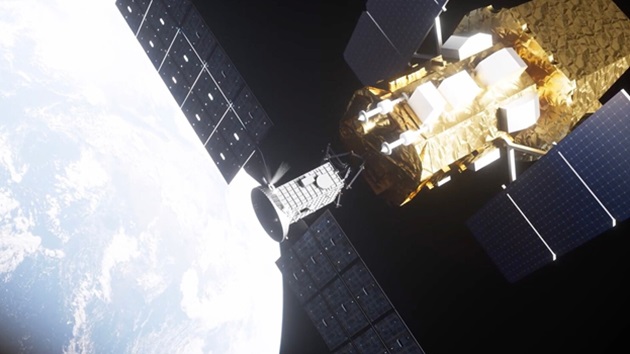
But in a first-of-its-kind mission, Katalyst Space, a startup, is teaming up with NASA to try and rescue Swift using the company’s newly developed robotic spacecraft, LINK.
“This is a historic mission, you know, some would call it the first of its kind, a robotic spacecraft that can go and capture an unprepared satellite,” said Robert Lamontagne, vice president of strategic partnerships at Katalyst Space.
Swift’s original orbit was around 370 miles above the Earth’s surface. But over the years, it’s fallen to less than 250 miles, according to NASA. Now it’s a race against the clock to keep Swift from falling even further and burning up in Earth’s atmosphere.
To save the satellite before time runs out, the Arizona-based company built its 935-pound rescue spacecraft in just 250 days. LINK was designed to physically interact with Swift despite the observatory not being designed for this kind of operation.
“Over the last nine months, we have gone from a clean sheet to a spacecraft that is currently integrated on a rocket, on an airplane ready to go to college for launch,” added Kieran Wilson, the principal investigator for LINK at Katalyst Space. “This is an absolutely unprecedented development timeline for this program.”
If all goes as planned, LINK will be launched into space on Saturday aboard a Northrop Grumman Pegasus XL rocket, which will be launched from a Lockheed L-1011 TriStar carrier aircraft taking off from Kwajalein Atoll in the South Pacific.
Once in orbit, it will take about three weeks for LINK to rendezvous with and capture the 22-year-old observatory. Over two to three months, the spacecraft will use its thrusters to raise Swift into a more stable orbit. The two will then separate as LINK lowers itself back into Earth’s atmosphere, where it will burn up, keeping it from adding to the rest of the space debris in our orbit.
The hope is that the maneuver will add 10 years to the mission and allow NASA to resume its scientific operations. The space agency had to stop most of the observatory’s scientific operations to reduce drag and slow its descent from orbit.
“No one thought it was going to be possible,” said Shawn Domagal-Goldman, NASA’s division director for astrophysics. “No one thought we would get as far as we’ve already gotten today.”
The clock is ticking for the $30 million mission to be completed. According to NASA, Swift is currently falling at roughly eight kilometers per month, and the space agency estimates it will drop below 300 kilometers sometime around October.
According to Wilson, at that point, the satellite will be “too low” for the rescue mission to be executed.
A potential blueprint for saving satellites
Earth’s orbit is littered with lots of aging satellites. If the mission is successful, NASA and Katalyst hope it could help establish a blueprint for future satellite rescues so fewer spacecraft are abandoned. Katalyst envisions having a fleet of spacecraft that can repair, refuel and upgrade satellites in need of help.
“Katalyst is here really to kind of mark the end of that throwaway model and the start of a new model where we think the spacecraft operators should no longer be constrained by the silly decisions that were made before launch,” Lamontagne said.
There’s no guarantee the rescue will be successful. Swift wasn’t designed to be grabbed by another spacecraft, and its age could make it vulnerable to damage during the capture.
“We still have to get spacecraft on orbit. We have to operate the spacecraft there successfully. And as we’ve all seen before, that’s a very challenging thing to do,” said Wilson.
“Rendezvous is going to be a challenge. It’s always a technical challenge, but we think we’re ready to handle that,” he added.
NASA says space weather and how the Earth’s atmosphere interacts with the spacecraft could also impact the outcome.
“If my confidence proves true and this team pulls off everything perfectly, the darn sun puffing up the darn atmosphere, at the wrong time,” Domagal-Goldman said. “There are still unknowns, both in terms of the dynamic nature of this part of Earth’s atmosphere, and its response to solar activity that is beyond all of our control.”
The Swift Space Observatory is a NASA satellite built to study gamma-ray bursts, the brightest and most powerful explosions in the universe. Swift uses multiple instruments, including three multiwavelength telescopes that can collect data in visible, ultraviolet, X-ray and gamma-ray light. NASA has used it to study black holes, stars, comets and other celestial objects.
“Swift can routinely conduct follow-up with things that go bump in the night within minutes. It really is NASA’s first responder,” said Brad Cenko, Swift’s principal investigator at NASA’s Goddard Space Flight Center.
Launched in 2004, the observatory was supposed to last only two years. But it’s been operating for more than two decades.
“Last year, Swift received five requests from the community to follow up newly discovered sources each and every day. That’s more annual community requests than any other NASA facility,” Cenko added.
Copyright © 2026, ABC Audio. All rights reserved.