
WHO director arrives in Canary Islands to oversee hantavirus cruise evacuation

▶ Watch Video: Hantavirus cruise passengers to be evacuated to home countries, including Americans

World Health Organization Director-General Dr. Tedros Adhanom Ghebreyesus arrived in Tenerife Saturday to personally oversee the painstaking process of evacuating more than 100 people from a cruise ship dealing with an outbreak of the rare and deadly hantavirus.

Addressing the people of the Canary Islands, where the ship will anchor off the coast of its largest island, the WHO chief said the public’s concern is legitimate after what the world experienced in 2020 during the global coronavirus pandemic.

“This disease is not COVID,” Tedros said, reiterating a letter he wrote earlier Saturday. “The risk to the local population is low.”

Tedros said that the nature of the hantavirus is not the same as the coronavirus, but “that trauma is still in our minds.”

“That’s why also I came here,” he said. “To be on the side of the people because saying things from far could be easy. But I had to change my plans to come here because this is very, very important to the whole world and to the people of Tenerife as well.”

The Dutch-flagged MV Hondius cruise ship is expected to arrive at the island of Tenerife early Sunday, officials said.

Eight people on the ship had confirmed or suspected cases of the hantavirus and three people have died, the WHO said on Friday. None of the 147 people currently on board, including 60 crew members, are symptomatic, according to Oceanwide Expeditions, which owns the vessel.

Tedros estimated Saturday that there will be six evacuation flights headed for the EU and four for non-EU countries.

There are 17 Americans on the MV Hondius, according to Oceanwide Expeditions, who will be taken off the ship in a small boat, taken to shore and immediately to a plane on the runway waiting for them. The plane, provided by the U.S. government with oversight from the Centers for Disease Control and Prevention, will take the Americans to the National Quarantine Center at the University of Nebraska, Omaha, according to the CDC. 

“I’m sure they’re very anxious to get home, but (we need) to make sure they do that in the most safe way possible,” Maria van Kerkhove, WHO’s acting director of the Department of Epidemic and Pandemic Preparedness and Prevention, said at a press conference on Saturday.

Each country with passengers on board the ship will proceed with a similar evacuation to awaiting planes, according to the Spanish Health Ministry.

The WHO said it was recommending each country keep the passengers removed from the ship in isolation for 42 days from the last point of exposure to the virus.
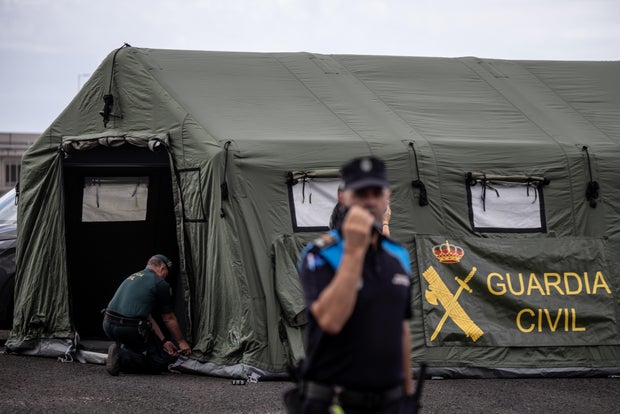
Cruise Ship MV Hondius To Dock In Tenerife
A member of the Guardia Civil finishes erecting a tent at an expected reception point for passengers from the MV Hondius on May 9, 2026, in Tenerife, part of the Canary Islands, Spain.

Chris McGrath / Getty Images

The disease is usually acquired through close contact with rodents, and is not transmissible from person to person. However, testing of those who were sickened on the Hondius has confirmed they have the Andes strain of the virus, the only variation that can be transmitted through close contact with a sick individual. 

However, health experts say the chances of widespread transmission are very small.

“I know that when you hear the word ‘outbreak’ and watch a ship sail toward your shores, memories surface that none of us have fully put to rest,” Tedros said in the letter addressed to the people of the Canary Islands earlier Saturday. “The pain of 2020 is still real, and I do not dismiss it for a single moment. But I need you to hear me clearly: this is not another COVID.” 

“The current public health risk from hantavirus remains low,” he continued. “My colleagues and I have said this unequivocally, and I will say it again to you now.”

The ship left Argentina on April 1 for a cruise stopping at several remote islands in the south Atlantic, including Tristan da Cunha and Saint Helena, both British territories.

The outbreak on the ship appears to have started with a Dutch couple who traveled around South America, the only place the Andes strain exists, in the months leading up to the cruise. The couple spent time bird-watching in areas where rodents are known to have tested positive for hantavirus, according to Oceanwide Expeditions.

The husband died on the ship April 11, while his wife was one of 32 people who disembarked the ship in Saint Helena, according to Oceanwide Expeditions. She would fly to South Africa and then die days later when she was removed from a KLM Airlines plane because she was too sick to fly, according to the airline.

Dozens of people on the plane or who disembarked at Saint Helena are already under observation around the world, including in the U.S. None of the people in the U.S. — in Texas, Virginia, Georgia, Arizona, New Jersey and California — are experiencing any symptoms of the virus, the state’s respective health departments have confirmed to CBS News.
Liberia once offered Black Americans a new home. Decades on, it is receiving migrants the US wants out

(CNN) — Is Liberia an American dumping ground — or a place where a new generation of arrivals can build a new life?That’s the question Liberians are asking themselves after the first people to be deported to the West African country from the United States arrived in the capital, Monrovia.The 20 people on the flight from Louisiana were the first to be sent under an agreement that could see up to 1,200 people transferred to Liberia, a country of less than 6 million people, many of them descendants of formerly enslaved Black Americans.Liberian officials said the new arrivals were from “African and western hemisphere countries.”Liberia is one of several countries that have agreed to take migrants being deported from the US under the Trump administration’s anti-immigration crackdown. The arrivals are coming to a nation whose history is deeply tied to migration from the US.Nearly two centuries ago, free and formerly enslaved Black Americans crossed the Atlantic to settle in what would become Liberia – a name that translates as “land of the free.”Now, a country shaped in part by that migration is accepting people the US wants to remove.For Liberians, that has thrown up a mix of feelings in a country still recovering from a long and bloody civil war.“This country is going through a lot, and having more people come in — can we handle all of this?” said Pheta Morris, 48, a descendant of the Black Americans who settled in Liberia.But she said she sees the new arrivals through the lens of Liberia’s history and is struck by the contrast.“I think about the Americo-Liberians — people who were rejected where they were and needed somewhere to go, and Liberia opened its arms to them,” she said.“Back then, people needed somewhere they could be free, accepted and welcomed. Now, people are being rejected from the US, and Liberia is opening its doors to them.”The first transfer has already faced complications.Reuters reported that five migrants who refused to disembark after arriving in Monrovia were flown instead to Equatorial Guinea in Central Africa, where they are held with more than 30 other migrants previously sent there by the US.A US State Department spokesperson said implementing the Trump administration’s immigration policies was a “top priority,” adding that the department generally does not comment on private diplomatic communications with other governments.CNN has contacted Liberia’s information ministry for more details about the agreement and its terms.A country shaped by AmericaThe first group of free Black Americans arrived in Liberia in the early 1820s.Over the following decades, thousands more made the journey, with the American Colonization Society helping to establish settlements along the West African coast. The US State Department says about 16,000 Black Americans migrated to Liberia during the 19th century.The migration was complicated. Some Black Americans saw Liberia as a chance to escape racism and build a new life, while others opposed the colonization movement and rejected the idea that free Black people should leave the US.Africans rescued from slave ships by the US Navy were also brought to Liberia. The settlements eventually formed the Republic of Liberia, which declared independence in 1847.The American influence remains visible today. Liberia’s flag resembles that of the US; its capital was named Monrovia after America’s fifth President James Monroe, and its early institutions were heavily influenced by Washington.Conmany Wesseh, a former Liberian lawmaker and member of the ruling Unity Party who was nominated as Liberia’s ambassador to the United Nations and later the European Union under former president Ellen Johnson Sirleaf, said that history continues to shape how Liberians view the US.For Wesseh though, the arrival of the deportees raises a more immediate question: Can Liberia, a country still struggling with basic infrastructure and services, accommodate more people?The cost of taking them inLiberia began rebuilding after a 14-year civil war ended in 2003, but Wesseh said the country still needs major investment. Poverty levels remain high and youth unemployment stands at 40%, according to African Development Bank data.“Our country needs a great deal of support,” he said. “We are short on medical facilities, and we have problems with education.”He questioned how the country would manage an influx of people from abroad.“They will have to go to the same hospitals. You won’t create a new hospital for them,” he said. “There’s no spare housing. We don’t have existing housing to put new people in.”Wesseh said Liberia’s development needs may have influenced the government’s decision, with officials hoping the agreement would bring support from Washington.Liberian authorities described the arrangement as humanitarian and said the deportees will be treated as guests who can seek asylum or leave the country.Asked whether he viewed the deal as humanitarian assistance, a diplomatic arrangement or the US outsourcing its immigration enforcement, Wesseh chose the latter.“I think (the administration of US President Donald Trump) just sees this as a place to dump people,” he said. “They want to take them off their hands and dump them in this country.”A chance for a new startFrancis Dennis had long known that his family had roots in the migration of Black Americans to Liberia in the 19th century. But just a few weeks ago, he became curious about his family’s past and began using AI genealogy tools to dig deeper into that history.The 71-year-old former president of the Liberia Chamber of Commerce told CNN he traced his great-great-great-grandfather to Snow Hill, a town on Maryland’s Eastern Shore in the US, using the technology and notes left by his father.He said the research also pointed him to the name of the vessel that carried his ancestor across the Atlantic to Liberia, along with a list of its passengers.Generations later, Dennis is watching another group arrive in Liberia from the US. But he does not believe their circumstances have to define what comes next.“People may have their apprehension about a new life, but it’s also an opportunity,” he said. “Some may be happy, some may resent it, but it opens a new window, a new opportunity.”His own ancestor crossed the Atlantic generations ago and became part of the community that helped shape modern Liberia.Now, he hopes those arriving under very different circumstances will also see the country as a chance for a fresh start.“The ball will be in their court,” Dennis said. “Are they going to seize it as an opportunity for a new start, a fresh start, a new life? Or will they be thinking about the past?”The-CNN-Wire™ & © 2026 Cable News Network, Inc., a Warner Bros. Discovery Company. All rights reserved.
Read Next Story