
WHO chief says ‘work not over’ after evacuation of hantavirus-stricken ship

▶ Watch Video: Why hantavirus incubation period worries officials

World Health Organization chief Tedros Adhanom Ghebreyesus said Tuesday that “our work is not over” to contain hantavirus after evacuations from a cruise ship hit by a deadly outbreak of the illness.

The fate of the MV Hondius has sparked international alarm after three passengers died in an outbreak of the rare virus for which no vaccines or specific treatments exist.

Yet health officials have stressed that the global public health risk is low and rejected comparisons to the start of the COVID-19 pandemic.

“There is no sign that we are seeing the start of a larger outbreak,” Tedros told a joint news conference in Madrid with Spanish Prime Minister Pedro Sanchez.
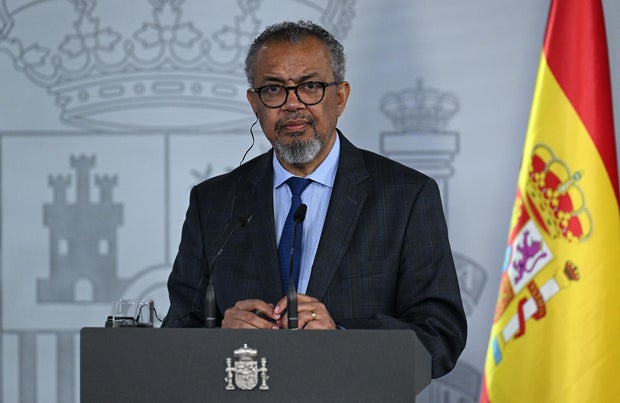
Spanish PM Sanchez, WHO chief Ghebreyesus discuss hantavirus situation in Madrid
World Health Organization (WHO) Director-General Tedros Adhanom Ghebreyesus at jnews conference in Madrid on May 12, 2026.

Burak Akbulut / Anadolu via Getty Images

“But of course the situation could change, and given the long incubation period of the virus, it’s possible we might see more cases in the coming weeks,” Tedros said.

More than 120 passengers and crew on the MV Hondius were flown out from Spain’s Canary Islands on Sunday and Monday, and countries have adopted different health measures for their returning evacuees.

Most countries have followed the WHO’s guidelines, which include a 42-day quarantine and constant monitoring of high-risk contacts.

“I hope they (countries) will follow the advice and recommendations we are making,” Tedros said in Madrid.

Eighteen American passengers who were on the ship returned to the U.S. on Monday and are being monitored at medical facilities in Nebraska and Georgia.

Jay Bhattacharya, the acting director of the U.S. Centers for Disease Control and Prevention, said it doesn’t make sense to sound “a five-alarm fire bell” because the risk to the public from hantavirus is “much, much lower” than what we saw with the COVID-19 pandemic. 

“It’s very different than COVID, and we should treat it differently than COVID,” Bhattacharya told “CBS Evening News” anchor Tony Dokoupil on Monday when asked about the lack of daily briefings on the outbreak. 

The MV Hondius presented diplomatic challenges as different countries negotiated over who would receive it and treat its passengers.

Cape Verde, an archipelago off Africa’s west coast, refused to receive the ship, and it remained anchored offshore the capital Praia as three people were evacuated to Europe by air last week.

Spain allowed the vessel to anchor off the Canary Islands for the evacuation of passengers and crew on Sunday and Monday, but Cape Verde’s regional government fiercely opposed the measure.

Defending his government’s policy, Sanchez said the “world does not need more selfishness or more fear. What it needs are countries that show solidarity and want to step forward.” 

Organización cristiana afirma que un misionero de EE.UU. secuestrado en Níger fue liberado tras nueve meses de cautiverio

Kevin Rideout, un misionero estadounidense que estuvo cautivo en Níger durante nueve meses, fue liberado y entregado a funcionarios de Estados Unidos, informó el viernes la organización misionera para la que trabajaba.“Estamos agradecidos de confirmar que nuestro buen amigo y hermano en Cristo, Kevin Rideout, fue liberado después de más de nueve meses en cautiverio”, dijo a CNN Phil Bauman, director internacional de SIM.“Kevin goza de buena salud y está bajo el cuidado de funcionarios de Estados Unidos”, señala el comunicado, que agrega que Rideout pronto se reunirá con su familia.Rideout fue secuestrado afuera de su casa en la capital, Niamey, el 21 de octubre de 2025, según SIM, una organización misionera cristiana con sede en Charlotte que afirma trabajar en más de 70 países.Tres hombres no identificados lo secuestraron y posteriormente se dirigieron hacia la región occidental de Tillaberi, donde operan militantes islamistas, informó en ese momento la agencia de noticias Reuters, citando a un diplomático no identificado.Al día siguiente del secuestro, la Embajada de Estados Unidos en Níger advirtió sobre una “mayor preocupación por la amenaza de secuestro” y aumentó los requisitos de seguridad para el personal de la Embajada.Según The New York Times, que informó primero sobre su liberación, Rideout estaba bajo custodia del FBI y gozaba de buena salud, según imágenes que demostraban que estaba vivo, de acuerdo con un funcionario de Estados Unidos no identificado.El FBI se negó a hacer comentarios cuando CNN se puso en contacto con la agencia.No estaba claro cómo ni cuándo fue liberado, ni qué grupo lo mantenía cautivo al final de su cautiverio, informó The New York Times, que agregó que es posible que haya sido trasladado recientemente.Níger ha sufrido un aumento de los ataques de grupos militantes vinculados con Al Qaeda y el autodenominado Estado Islámico, particularmente en la región de la triple frontera con Malí y Burkina Faso, y a lo largo de su frontera sur con Nigeria.En mayo, las fuerzas de Estados Unidos y Nigeria falleció al comandante de alto rango de ISIS, Abu-Bilal al-Minuki.CNN se puso en contacto con la Casa Blanca, el Departamento de Estado y el Pentágono para solicitar comentarios.The-CNN-Wire™ & © 2026 Cable News Network, Inc., a Warner Bros. Discovery Company. All rights reserved.
Read Next Story