
WHO chief says ‘work not over’ after evacuation of hantavirus-stricken ship

▶ Watch Video: Why hantavirus incubation period worries officials

World Health Organization chief Tedros Adhanom Ghebreyesus said Tuesday that “our work is not over” to contain hantavirus after evacuations from a cruise ship hit by a deadly outbreak of the illness.

The fate of the MV Hondius has sparked international alarm after three passengers died in an outbreak of the rare virus for which no vaccines or specific treatments exist.

Yet health officials have stressed that the global public health risk is low and rejected comparisons to the start of the COVID-19 pandemic.

“There is no sign that we are seeing the start of a larger outbreak,” Tedros told a joint news conference in Madrid with Spanish Prime Minister Pedro Sanchez.
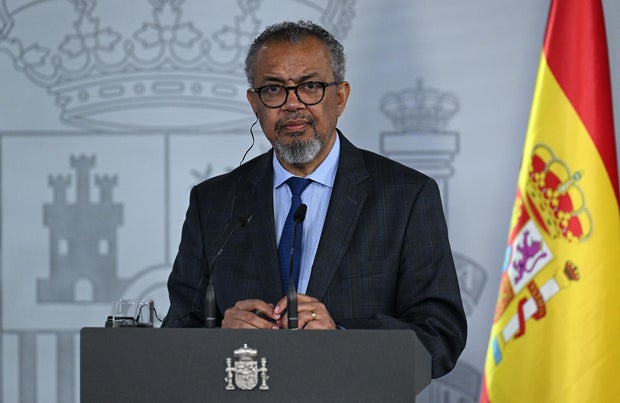
Spanish PM Sanchez, WHO chief Ghebreyesus discuss hantavirus situation in Madrid
World Health Organization (WHO) Director-General Tedros Adhanom Ghebreyesus at jnews conference in Madrid on May 12, 2026.

Burak Akbulut / Anadolu via Getty Images

“But of course the situation could change, and given the long incubation period of the virus, it’s possible we might see more cases in the coming weeks,” Tedros said.

More than 120 passengers and crew on the MV Hondius were flown out from Spain’s Canary Islands on Sunday and Monday, and countries have adopted different health measures for their returning evacuees.

Most countries have followed the WHO’s guidelines, which include a 42-day quarantine and constant monitoring of high-risk contacts.

“I hope they (countries) will follow the advice and recommendations we are making,” Tedros said in Madrid.

Eighteen American passengers who were on the ship returned to the U.S. on Monday and are being monitored at medical facilities in Nebraska and Georgia.

Jay Bhattacharya, the acting director of the U.S. Centers for Disease Control and Prevention, said it doesn’t make sense to sound “a five-alarm fire bell” because the risk to the public from hantavirus is “much, much lower” than what we saw with the COVID-19 pandemic. 

“It’s very different than COVID, and we should treat it differently than COVID,” Bhattacharya told “CBS Evening News” anchor Tony Dokoupil on Monday when asked about the lack of daily briefings on the outbreak. 

The MV Hondius presented diplomatic challenges as different countries negotiated over who would receive it and treat its passengers.

Cape Verde, an archipelago off Africa’s west coast, refused to receive the ship, and it remained anchored offshore the capital Praia as three people were evacuated to Europe by air last week.

Spain allowed the vessel to anchor off the Canary Islands for the evacuation of passengers and crew on Sunday and Monday, but Cape Verde’s regional government fiercely opposed the measure.

Defending his government’s policy, Sanchez said the “world does not need more selfishness or more fear. What it needs are countries that show solidarity and want to step forward.” 

Exclusive: Congress discussing affidavits from Epstein survivors about Lesley Groff as survivors told CNN she lied

(CNN) — The House Oversight Committee has discussed with Jeffrey Epstein survivors the possibility of the women providing affidavits about longtime Epstein assistant Lesley Groff – coming on the heels of multiple survivors telling CNN that Groff had lied to the committee last month.The ongoing deliberations between the committee and Epstein survivors were confirmed to CNN by three sources familiar with the matter and have not been previously reported. One Epstein survivor and two family members of another victim also told CNN that they were asked by the committee to comb through the transcript of Groff’s interview with the panel and alert the committee to anything that looks problematic.These developments signal that the committee is taking the accounts of Epstein survivors seriously and preparing to hold Groff accountable if she is found to have lied to Congress. While it is not clear what additional steps, if any, the committee might ultimately take related to Groff, lying to Congress is a crime. Committee investigators have also been poring over Groff’s testimony and references in the Epstein files to determine whether Groff was truthful.CNN has reached out to Groff’s lawyer for comment. They did not respond to CNN’s previous request for comment about what survivors said about her interview with Congress.Groff worked for Epstein for almost two decades and managed every detail of Epstein’s day-to-day schedule, making her transcribed interview session with the House Oversight Committee in June a significant part of Congress’ ongoing investigation into Epstein. She has denied any knowledge of Epstein’s crimes, and told lawmakers last month that she had been duped by a “master manipulator and deceiver.”But the release of her interview transcript drew outrage from Epstein survivors. CNN reported on survivors taking issue with some of Groff’s key claims, including her insistence that she never met any of the girls and women whom she arranged to give massages to Epstein.Six Epstein survivors previously told CNN they did meet Groff in person and were dismayed to learn of Groff’s denial.Lara Blume McGee, who says she met Epstein as an aspiring model and was abused from 2001 to 2003, said she remembers meeting Groff at least twice at Epstein’s townhouse, while Lisa Phillips, who says she was in her early 20s when she first met Epstein, told CNN: “Of course I’ve met her in person.”Groff also repeatedly told lawmakers that she never asked for or knew the ages of the girls and young women who came to see Epstein, including the fact that some of them were minors. She also said she was never aware that some were coming from local high schools.Epstein survivor Marina Lacerda told CNN that Groff regularly asked her detailed questions about new girls that Lacerda planned to bring to Epstein, and that Groff was sensitive to Epstein’s preference for younger girls – so much so that she started asking Lacerda to tell her friends to bring their school IDs to their sessions with Epstein.“She would ask, ‘What does the girl look like? Where is she from? How old is she?’ over the phone,” Lacerda said.Another survivor, Sharlene Rochard, said it was not possible that Groff didn’t know her age, because she had Rochard’s passport information to plan travel. “Of course she knew how old we were because she had to look at our IDs to book our flight,” Rochard said.One anonymous woman said she was also “100 percent” certain Groff knew that she was a minor. “I went to a private Catholic school and she would always ask me to leave school early,” she said. Epstein liked to see her in her school uniform, and that she said there were many times when Groff saw her wearing her uniform.Survivors said Groff also was not telling the truth when she said she never directly paid the girls and women; some described receiving fresh cash in white envelopes from Groff during their years of abuse.Lacedra, who said she was just shy of turning 14 when she first met Epstein, told CNN Wednesday that she would be glad to provide an affidavit to the oversight committee about Groff.The committee did not comment for this story. A spokeswoman for the committee previously told CNN that the committee is “currently reviewing Ms. Groff’s transcript against the available evidence.” She added: “We welcome any additional evidence from individuals who possess information.”The-CNN-Wire™ & © 2026 Cable News Network, Inc., a Warner Bros. Discovery Company. All rights reserved.
Read Next Story