▶ Watch Video: New UFO files released by U.S. government
The Pentagon has begun the long-anticipated release of government files related to what it calls “Unidentified Anomalous Phenomena” — UFOs or any potential signs of alien life. On Friday, May 8, it started posting declassified documents, photos and videos that it said “have long fueled justified speculation,” after President Trump called for their release earlier this year.
Questions about what the federal government may know about extraterrestrial life in the cosmos — or possibly even here on Earth — have long inspired imaginations, sci-fi literature and blockbuster films, not to mention decades of conspiracy theories.
Mr. Trump posted on social media on Feb. 19 that Defense Secretary Pete Hegseth and other agency heads should “begin the process of identifying and releasing Government files related to alien and extraterrestrial life, unidentified aerial phenomena (UAP), and unidentified flying objects (UFOs), and any other information connected to these highly complex, but extremely interesting and important, matters.”
His announcement came after former President Obama told a podcaster who asked about aliens, “They’re real, but I haven’t seen them.” He later clarified that he never saw evidence during his time in the White House and just meant that “statistically, the universe is so vast that the odds are good there’s life out there.” Mr. Trump told reporters he isn’t sure if aliens exist but suggested his predecessor may have been referring to “classified information.”
With the release, the American public could learn what, if anything, the government has documented about the unexplained sightings, such as one seen in a video made public last year by a member of Congress showing a U.S. missile striking an unidentified glowing orb in the sky and appearing to bounce off it.
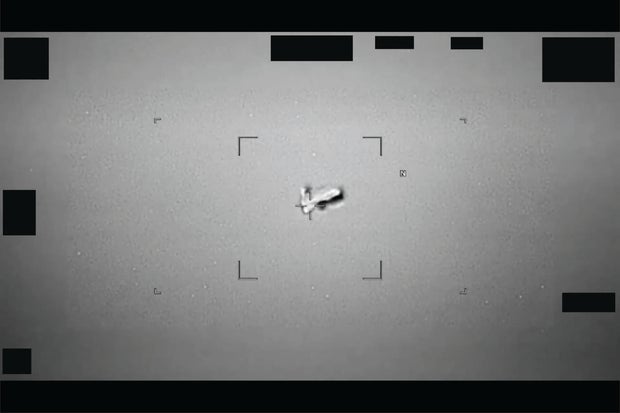
Image released by Pentagon
There were more than 750 new UAP sightings between May 2023 and June 2024, according to a government report. While these instances may currently be unexplained, experts said one benefit of releasing the files may be that scientists, analyzing the data, can help provide factual explanations.
Sean Kirkpatrick, former top government UFO investigator
Sean Kirkpatrick, the first director of the U.S. Department of Defense’s All-domain Anomaly Resolution Office (AARO), which investigates unidentified flying objects, says people expecting to see evidence of alien life here on Earth may be disappointed.
“There are going to be unsatisfied people,” he told CBS News.
“You’re going to have a bunch of people who are going to continue to cry conspiracy, they’re going to say there’s a cover-up,” Kirkpatrick said. He views Mr. Trump’s order as a “distraction for the administration.”
Kirkpatrick, a physicist who led AARO from July 2022 to Dec. 1, 2023, was tasked with investigating unidentified flying objects and other unidentified aerial or anomalous phenomena.
What he found ranged from “hazing” in the Air Force to what he called “deceptions” designed to hide secret defense programs. Kirkpatrick said his office “had to stand up anything they could declassify,” but proof of extraterrestrial life wasn’t there.
“Nothing would have made me happier in that job but to have discovered alien technology and rolled it out,” said Kirkpatrick. “I don’t expect to see anything new.”
Kirkpatrick believes there’s likely life out in the universe somewhere, but “the probability that extraterrestrial intelligent life is here is little to none.”
Federica Bianco, NASA study team
Federica Bianco, an associate professor at the University of Delaware’s astronomy and physics department, echoed Kirkpatrick’s perspective.
“The probability that we are the only life form or even the only technical society in the universe is negligibly small,” Bianco said.
Bianco was part of NASA’s independent team studying unidentified anomalous phenomena.
“As a scientist and a member of the NASA UAP panel, I haven’t seen anything that indicates that we have observed phenomena that violate the laws of physics and require an alien society visiting us to be explained,” Bianco said.
Neil deGrasse Tyson, astrophysicist
Neil deGrasse Tyson, the director of the Hayden Planetarium at the American Museum of Natural History’s Rose Center for Earth and Space, knows what he’ll look for in the files:
“An actual alien. If one is presented, then no documents are necessary at all,” Tyson told CBS News.
Tyson said the files may help illuminate “that most people who look at the sky (day or night) are unfamiliar with optical, climactic, and astronomical phenomena. When that’s the case, a person is prone to report mysterious and unidentified objects.”
“The urge to have immediate answers drives many people to explain what they see as visiting space aliens from across the galaxy,” Tyson said. “I call this, ‘aliens of our ignorance.'”
He noted that in the age of the internet and social media, it would be hard now to hide a visit from otherworldly creatures.
“Billions of photos and a million hours of video are uploaded daily to the internet, and none of them contain images of actual aliens,” Tyson said. “The implicit assumption is that the government (somehow) has access to visiting aliens that no one else in the world with a smart phone has. And that the government has successfully kept it a secret among hundreds and possibly thousands of people. All the while, forgetting Benjamin Franklin’s edict, ‘Three people can keep a secret if two of them are dead.'”
Tyson wrote about what it would take for aliens to reach Earth in his upcoming book, “Take Me To Your Leader: Perspectives on Your First Alien Encounter.”
“In science, skepticism is foundational to our profession, so we uphold standards of evidence that some interpret as disinterest or even denial. Don’t take it personally, it’s how any and all objective truths have ever been established in this world,” Tyson writes in the prologue to the book, which is scheduled for publication in May.
Shelley Wright, observational and experimental astrophysicist
Dr. Shelley Wright, an observational and experimental astrophysicist at the University of California San Diego, said scientific inquiry into unidentified anomalous phenomena and other life forms often creates a “giggle factor” among people.
Wright, who also served on NASA’s independent study team, said she believes there needs to be more scientific inquiry around this topic and the public has a deep curiosity to know more. She said often people ask her, “Are we alone out here?”
As a scientist, Wright said she is always looking for “life in the universe” and is humbled by how big the universe and our galaxy is. She noted, “The possibility of other alien life existing is likely, but it doesn’t mean it’s near us.”
Regardless, she said she’s “excited” for the document release but doesn’t expect to find much after her experience on the independent study team, which only viewed unclassified documents.
Wright said she expects most of the documents to be heavily redacted due to the sensitivity of the surveillance equipment used by the military responsible for sighting many of the UAPs. She said that releasing information could encroach on national security.
However, she added that the administration could declassify security and surveillance documents from decades ago, allowing scientists to study the material with new technologies that weren’t available when the data was originally collected. This decision, she said, could protect national security and allow scientists to understand more about what was captured by surveillance.
Janna Levin, professor of physics and astronomy
The universe is vast and contains countless other planets, but in our solar system, scientists have long determined Earth is the only planet teeming with life.
CBS News contributor Dr. Janna Levin, a professor of physics and astronomy at Barnard College of Columbia University, said that even as we learn more about the universe, “life still seems rare.” That’s why astronomers are “very excited” about the prospect that the released documents may hold clues.
She said astronomers aren’t really looking for the little green men of 20th-century sci-fi, but instead are excited about potential evidence of microbes. These are the tiny particles astronomers are looking for because microbes were responsible for starting life on Earth. “Let’s just get life started,” she said.
Levin said it’s possible microbes from other planets might have been carried here via a natural object that plunged to Earth.
She said she’d like to keep “an open mind” about what might be in the documents.
“If there is anything in them, it would be really thrilling,” Levin said. But she cautioned: “If there are claims of actual technologies from other civilizations — I don’t think anyone is actually expecting that, scientifically. I think if you’re expecting that, you’re going to be disappointed.”
Avi Loeb, theoretical physicist
Harvard theoretical physicist Avi Loeb, a prominent researcher of anomalous phenomena, said the key is to study the documents from the vantage of known physics.
Loeb told CBS News that he spoke with members of Congress last week and told them he hopes they’ll look to scientists like himself when they examine the files. He said that in most instances of unidentified phenomena, “something mundane might explain the data.”
He pointed to footage aired before Congress last summer that purported to show a missile being fired at what a congressman referred to as an “orb” off the coast of Yemen in 2024.
Loeb said when he examined the footage, he concluded there was a simple explanation.
“I said, ‘No, it’s not anomalous, it was just a drone,” Loeb recalled.
When Loeb gets the chance to examine the files, he’ll be searching for the unexplainable.
“There might well be a few incidents out of hundreds that would really be anomalous, and that’s what I’m looking for,” he said.
Loeb said there’s a “fundamental question” to examining each incident with seeming anomalous data: “Are the objects we see as anomalous operating under the fundamental abilities of humans?”
If not, he’s intrigued. An object that appears to defy physics could be extraterrestrial, he said.
Loeb leads the Galileo Project, which searches for artifacts from extraterrestrial civilizations near Earth. He has written about why much of the currently classified material may be of no interest to him: Some information may have been kept from the public to avoid exposing sophisticated military sensors and systems to adversarial nations, or because officials believe certain unidentified objects were manufactured by those adversaries.
“I am not interested in technologies manufactured by humans on Earth. The history of terrestrial technology does not interest me,” Loeb wrote. “I am far more curious about whether a more advanced civilization exists in interstellar space.”