
Pope Leo calls for ‘disarming’ of AI in technology-focused encyclical

▶ Watch Video: Pope Leo warns about dangers of AI

Rome — Pope Leo XIV issued a major document Monday focused largely on the implications of the rise of artificial intelligence for humanity, warning the technology could make civilization itself “less human.”

Pope Leo, who has repeatedly clashed with the Trump administration over the Iran war and some U.S. officials’ religious justification for it, also appeared to dismiss the argument that the conflict was a necessary preemptive measure for American safety.

“Today, more than ever, without prejudice to the right to self-defense in the strictest sense, it is important to reaffirm that the ‘just war’ theory, which has all too often been used to justify any kind of war, is now outdated,” he wrote in his Magnifica Humanitas (Magnificent Humanity), an 82-page teaching known as an encyclical.

Leo also issued a first-ever apology for the Vatican’s role in facilitating and justifying the transatlantic slave trade, calling it “a wound in Christian memory.”

“For this, in the name of the Church, I sincerely ask for pardon,” he wrote. 

But the vast majority of the encyclical was devoted to what Leo clearly sees as humanity’s risk-laden embrace of AI.

Pope Leo warns AI could make civilization “less human”

When the world’s first U.S.-born pope chose his name last year, Leo deliberately invoked the last pope to bear it: Pope Leo XIII, whose landmark 1891 encyclical Rerum Novarum helped guide the Catholic Church through the upheaval of the Industrial Revolution.

More than a century later, the Chicago native attempted something similarly ambitious for the AI Revolution.

In the Magnifica Humanitas, the leader of the world’s roughly 1.4 billion Catholics warned that artificial intelligence risked making civilization “less human,” hollowing out work, concentrating wealth and reducing people to systems driven by data and efficiency rather than dignity and morality.

“The pressing duty,” Leo wrote, is “to remain profoundly human.”
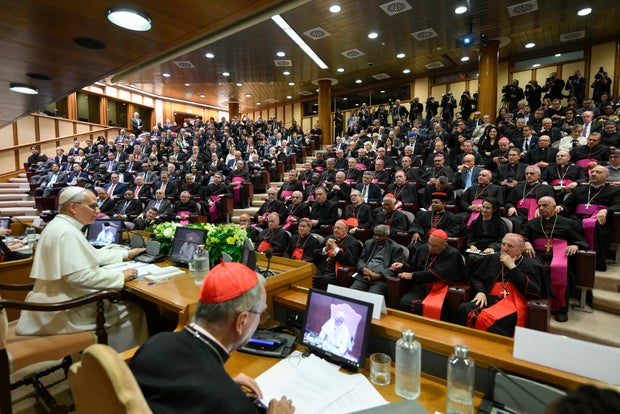
Presentation of Pope Leo XIV First Encyclical Letter 'Magnifica Humanitas'
Pope Leo XIV, flanked by Vatican Secretary of State cardinal Pietro Parolin, attends the presentation of his first Encyclical Letter “Magnifica Humanitas” at the Synod Hall on May 25, 2026 in Vatican City, Vatican.

Simone Risoluti/Vatican Media via Vatican Pool/Getty

Leo called for the “disarming” of AI, warning that the technology could fuel “a race for ever more powerful algorithms and larger datasets, driven by the desire to secure geopolitical or commercial dominance.” 

The document marks the first major papal encyclical written in the era of generative artificial intelligence, and it frames the current technological revolution not merely as an economic challenge, but as what the pope calls an “anthropological” one — a crisis touching the meaning and purpose of humanity.

“Please note that the encyclical is not about AI,” Cardinal Michael Czerny, one of the Vatican officials who helped present the document, told CBS News. “It’s about the human condition during the time of AI.”

In unusually direct language for a Vatican document, Leo — who holds a degree in mathematics — warned of the growing power of IT companies, with influence that can rival that of governments. 

At the same time, the pope stressed that technology itself is not inherently evil.  

“Artificial intelligence is a great human achievement,” Cardinal Czerny said. “We have a lot to admire and a lot to be thankful for … But we can’t renounce responsibility.”  

The Vatican’s concerns extend well beyond Silicon Valley. The encyclical repeatedly echoes broad societal concerns that AI could ⁠hollow out the middle class; ⁠eliminate vast numbers of jobs; ⁠deepen inequality; fuel social fragmentation; and normalize AI-driven warfare.

“There exists no algorithm capable of making war morally acceptable,” the encyclical states.

“Constraints that can sometimes conflict with doing the right thing”

That warning arrives as militaries around the world rapidly integrate AI into weapons systems. CBS News recently observed U.S. forces conducting exercises in Morocco and saw first-hand the growing use of AI-assisted targeting systems and autonomous technologies, including systems linked to Maven, the Pentagon’s AI platform.

One of the more striking aspects of the Vatican’s rollout of Leo’s encyclical was the inclusion of Christopher Olah, a co-founder of the AI company Anthropic, who was there in person alongside senior church officials on Monday.
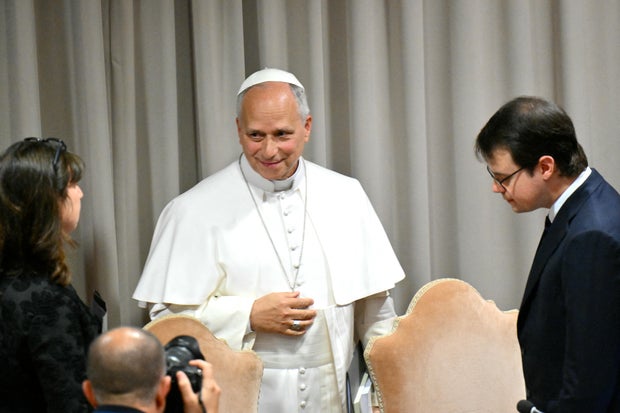
VATICAN-IA-ENCYCLICAL-MAGNIFICA HUMANITAS
Pope Leo XIV speaks with co-founder of U.S. artificial intelligence (AI) company Anthropic, Christopher Olah (right) and the Professor of Catholic Social Thought & Practice at the Durham University (left), Anna Rowlands, at the end of the presentation of the Encyclical Letter “Magnifica Humanitas,” focused on the rise of artificial intelligence, at the Vatican, May 25, 2026.

Alberto PIZZOLI/AFP/Getty

Olah said AI companies work “inside a set of incentives and constraints that can sometimes conflict with doing the right thing,” and he welcomed input from outside, including from the Catholic Church, to “push events in a better direction.”

“The questions raised by AI are bigger than the AI research community,” he said.

Leo said he had accepted an invitation from Olah, “to walk together, to listen and to speak and together to find the way for humanity,” and he was confident that, “together, we can discern the major questions of our time, and so, the future of humanity.” 

While Anthropic has often presented itself as a safety-conscious, “human-first” AI company, the Trump administration recently listed it as a supply-chain risk over its refusal to let the Pentagon use its technology in automated lethal systems or mass domestic surveillance. 

Its models remain integrated in military and intelligence applications, however, as CBS News has witnessed.

When asked whether Anthropic’s reputation as a human-centered AI company had influenced the Vatican’s decision to engage with it, Czerny replied: “I’m sure it did.”

He stressed, however, that dialogue with AI companies should not be mistaken for Vatican endorsement.

“We dialogue with anyone,” Czerny said. “We don’t endorse.”  

The encyclical repeatedly returns to the idea that the dangers posed by AI are not simply technological, but spiritual and existential paralysis.

“We’re overwhelmed,” the cardinal told CBS News. “We feel like we actually have nothing to say … and this paralyzes us.”  

Asked whether the pope worried that people were beginning to treat AI as a substitute for God, Czerny answered: “Yes … many things become substitutes for God and we call them idols.”

Just as the Industrial Revolution transformed labor and capital, the AI revolution is transforming humanity itself, the pope cautioned in his remarks.

Residentes de la ciudad a la que están enviando a los haitianos deportados afirman que no están preparados para acogerlos

La costa norte de Haití es donde el país se enfrenta al vasto Atlántico con todo su bagaje.Allí está Labadie, el complejo turístico privado abierto solo a cruceros estadounidenses y turistas extranjeros.Justo al lado se encuentra la Isla de la Tortuga, tristemente célebre punto de tránsito para traficantes de personas. Y luego está Cap-Haïtien, una ciudad impregnada de la historia revolucionaria del país y, más recientemente, el destino predilecto de la administración Trump para deportar a migrantes haitianos.Desde el devastador terremoto que azotó Haití en 2010, Cap-Haïtien se ha convertido en un importante centro de acogida para personas desplazadas internamente que huyen de desastres y violencia en otras partes del país.Y tras la victoria legal del Gobierno de Trump este mes para eliminar las protecciones temporales contra la deportación de cientos de miles de personas en Estados Unidos, es posible que la ciudad reciba pronto a muchas más personas.El jueves se registró el primer vuelo de deportación a Haití desde Estados Unidos tras la revocación del Estatus de Protección Temporal (TPS), que había protegido de la deportación a unos 350.000 haitianos en Estados Unidos y les había otorgado permisos de trabajo legales.Ahora, las comunidades haitianas en todo Estados Unidos se enfrentan a la nueva realidad de ser vulnerables a la represión inmigratoria del Gobierno de Trump.“¡Es un gran día para deportar inmigrantes ilegales! ¡Buenos días, Estados Unidos!”, publicó el secretario del DHS, Markwayne Mullin, en X el jueves por la mañana, horas antes de que despegara el vuelo de deportación a Haití.Poco después del mediodía, 161 personas descendieron del vuelo chárter en Cap-Haïtien, según la Oficina Nacional de Migración de Haití.Algunos se arrodillaron para besar el suelo, otros se cubrieron el rostro y se alejaron rápidamente de la prensa local allí reunida.La pregunta en Cap es cuántos más seguirán el mismo camino. Los lugareños dicen que la ciudad ya está desbordada.“Cap-Haïtien por sí solo no puede recibir más gente”, declaró Demonstène Reynold, un mecánico que vive en Cap. “No solo recibimos deportados de fuera de Haití… debido a la crisis política, también tenemos gente de Hinche y Puerto Príncipe, del interior del país”.La ciudad luce muy diferente a como era en años anteriores. El tráfico está congestionado y los puntos limpios están desbordados.Un hospital visitado por CNN estaba repleto de pacientes haciendo cola al aire libre, con madres meciendo a sus bebés bajo el sol mientras esperaban.Louis Ronald Espoir, administrador del Hospital Fort Saint Michel de la ciudad, afirmó que los centros médicos de la ciudad están al límite de su capacidad. “Como pueden ver aquí mismo, todos los hospitales de la región están llenos a pesar de los esfuerzos del Gobierno. Si están llenos con la población actual, mentiría si dijera que podemos admitir a alguien más”.El vuelo del jueves se produce en un momento en que los defensores de los derechos de los inmigrantes en Estados Unidos expresan su preocupación por los peligros de deportar personas a la nación caribeña.Los críticos, que exigen mayores restricciones inmigratorias, han acusado al Gobierno de Trump de no expulsar a los indocumentados con la suficiente rapidez.La administración Trump ha argumentado repetidamente que Haití es lo suficientemente seguro como para que los haitianos regresen, a pesar de la advertencia del Departamento de Estado de “No viajar” y la prohibición de la Administración Federal de Aviación sobre los vuelos comerciales estadounidenses a ese país.En una entrevista en junio en el programa “State of the Union” de CNN, Mullin defendió la decisión de repatriar a los haitianos y argumentó que el país se beneficiaría de su regreso.Según explicó, la advertencia del Departamento de Estado de “no viajar” se emitió por la preocupación por los estadounidenses, no por los haitianos, “porque están secuestrando o intentando secuestrar a personas de Estados Unidos porque creen que sus familias tienen el dinero para pagar el rescate”.Pero la epidemia de secuestros en el país ha afectado principalmente a los haitianos, cuyas bandas son conocidas por raptar incluso a personas muy pobres.Este brutal negocio se concentra en torno a la capital, Puerto Príncipe, donde también han aterrizado vuelos de deportación estadounidenses.CNN está solicitando comentarios del Departamento de Seguridad Nacional (DHS) sobre el vuelo del jueves a Cap-Haïtien, los motivos de la deportación de los pasajeros a bordo y si alguno de ellos se encuentra entre las personas que recientemente perdieron el Estatus de Protección Temporal (TPS).En el extremo opuesto del país con respecto a Puerto Príncipe, Cap-Haïtien se considera, en general, un lugar seguro en cuanto a la violencia de las pandillas. Sin embargo, a algunos les preocupa que una gran afluencia de inmigrantes pueda desestabilizar una zona ya de por sí superpoblada.Angie Bell, la exalcaldesa de la ciudad, dice que anima a la gente a regresar, pero que el país necesita mejorar su capacidad para recibirlos. “Necesitamos mucho más desarrollo y más seguridad como medida preventiva, con tanta gente llegando”, afirma Bell.Según sus cálculos, la población de la ciudad se ha disparado, pasando de unos 350.000 habitantes en el último censo de 2003 a al menos 800.000. “Debido a la falta de vivienda, tenemos mucha gente que trabaja en la ciudad pero vive en las afueras”, afirmó.El Gobierno haitiano y organizaciones humanitarias como la Oficina Internacional para las Migraciones trabajan para aliviar la carga de la población local y ayudar a los recién llegados a distribuirse por todo el país.A los deportados se les suele ofrecer comida y algo de dinero para continuar su viaje, así como alojamiento durante algunas noches y ayuda para localizar a sus familiares.Pero, como indican las cifras de población, muchos no se irán de Cap-Haïtien. Y no todos los deportados sabrán siquiera adónde ir.Según Jean Négot Bonheur Delva, director de la agencia de migración de Haití, quien recibió el vuelo de deportación del jueves en el aeropuerto, uno de los pasajeros que desembarcó nunca había estado en Haití.Nacido en la República Dominicana de padres haitianos antes de mudarse a Estados Unidos, no estaba claro cuál sería su próximo destino, dijo Delva, y agregó: “No sabe nada de Haití”.The-CNN-Wire™ & © 2026 Cable News Network, Inc., a Warner Bros. Discovery Company. All rights reserved.
Read Next Story