
New species of blue octopus discovered 5,900 feet underwater

▶ Watch Video: Scientists connect the health of deep sea creature populations with global climate

On the ocean floor near the Galapagos Islands, a submersible controlled by scientists came across a mysterious octopus as blue as the ocean that “could curl up in the palm of your hand.”

“He’s tiny! It’s blue!” one excited scientist was recorded as saying when she first caught sight of the cerulean cephalopod on footage transmitted from the sub.

The team from the Charles Darwin Foundation had just discovered a new species of octopus about 5,900 feet below the water’s surface, according to research published on Monday.

“Right away, I knew it was something really special,” said octopus expert Janet Voight, who was asked to identify the strange species.

At first the curator at the Field Museum of Natural History in Chicago had to make do with photos of the animal. Then she received its preserved body in the mail.

“When it arrived, I was like ‘Oh! My goodness! It’s beautiful,'” Voight told AFP.
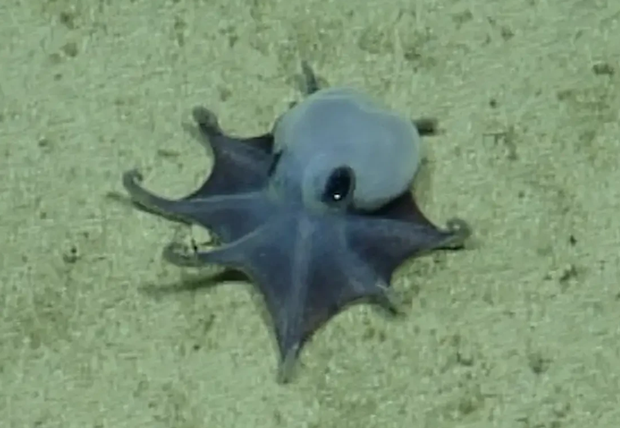
New species of octopus on sea floor
The new species of octopus found deep in the ocean near Isla Darwin.

Charles Darwin Foundation

She was immediately interested because the closest known octopus of that shape lives off the coast of Uruguay — in a different ocean on the other side of South America.

Normally to describe a new octopus species, a specimen needs to be cut open so that its mouth, beak, teeth and other parts can be examined.

“We only had the one specimen, so I didn’t want to take it apart,” Voight said.

Instead, the team at the Field Museum used CT scans to take thousands of X-ray images, then compiled them to make a 3D model of the octopus, revealing its insides.

“There’s nothing like spending the day looking at something no other human has ever seen,” the Field Museum’s X-ray lab head Stephanie Smith said in a statement.

“Deep purple”

The new species, named Microeledone galapagensis, stands out for reasons other than its blue hue, which is believed to be the rarest color in nature.

The octopus appears to be the runt of the Megaleledonidae family, whose members are normally much larger and live in the Southern Ocean surrounding Antarctica.

“Its stubby little arms with only one row of suckers set it apart from most octopus we are familiar with,” Voight said.

Even among “other species with short little arms and a single sucker row, its coloration and smooth skin on the back surface separate it,” she added.

While the octopus is light blue on its back, underneath it is a “very deep purple,” Voight said.

“We think this color pattern helps keep it safe. If the octopus grabs a prey item that emits light, that light may attract predators that might then eat the octopus,” she explained.

“So the octopus puts its dark-colored web over the prey item, keeping itself safe.”

Surprisingly, it is not uncommon to find new species of octopus in the deep sea — particularly in areas that have not been well explored, which is a massive amount of the ocean floor.

“If you took all the land on Earth and pieced it together, you would not cover the Pacific Ocean,” Voight pointed out.

She added that she had last seen a new octopus in 2023, off the coast of Costa Rica.

The first sighting of the new blue octopus was made in 2015 near Darwin Island, named after the English scientist whose visit to the Galapagos helped him form the theory of evolution.

It’s also the first new octopus species that Voight has officially led a team of scientists in describing, in her four-decade career studying octopus evolution, according to the Field Museum.

“These are little octopuses that live in the deep sea, and hardly anybody on Earth has ever gotten to see them. I just feel lucky that I got to work with them,” Voight said.

Voight’s research on the species was published in the journal Zootaxa.

There are around 300 species of octopus worldwide, living in all of the world’s oceans.  

In 2024, a team of scientists said they discovered four new species of octopus in the waters off Costa Rica. 

De la Espriella asume como presidente de Colombia y promete derrotar al crimen: “La opción del diálogo está agotada”

Abelardo de la Espriella asumió este viernes la presidencia de Colombia y dio su primer mensaje como jefe de Estado para el cuatrienio 2026-2030, que estuvo marcado por críticas a su antecesor, el izquierdista Gustavo Petro, y por su promesa de hacer de la seguridad y del combate a los grupos criminales una prioridad.El político de ultraderecha, líder del movimiento Defensores de la Patria, llegó por la tarde a la ceremonia de investidura acompañado de su esposa e hijos. En el recinto de Cali destinado para el acto oficial, se tomó su tiempo para saludar a quienes lo esperaban en el lugar y subió al escenario, donde rindió juramento y recibió la banda presencial por parte del presidente del Congreso, el senador Honorio Henríquez.Momentos después, en el Cantón Militar Pichincha, pronunció su primer discurso como mandatario, en el que tomó poco más de una hora para repasar su agenda de Gobierno, hacer sus primeros anuncios y, a la manera de muchos otros presidentes, prometer que gobernará para todos los ciudadanos y no solo para aquellos que votaron por él.En seguridad, sostuvo que el objetivo de su Gobierno es “derrotar sin tregua al narcoterrorismo y a todas las organizaciones criminales que amenazan la libertad de Colombia”. Para ello, ordenará a las Fuerzas Armadas y a la Policía que combatan de frente a todas las estructuras que generen violencia, buscará erradicar los cultivos ilícitos y publicará una lista de agrupaciones designadas narcoterroristas a las que pondrá en la mira.“Los integrantes de las bandas criminales y del narcoterrorismo tienen dos caminos: someterse al imperio de la ley o enfrentar la fuerza decidida del Estado colombiano y su fuerza pública”, dijo.“En las próximas horas, mi Gobierno expedirá el listado de grupos narcoterroristas, con el propósito de dotar a nuestra gloriosa fuerza pública de instrumentos eficaces para el combate frontal del crimen. La opción del diálogo está completamente agotada. El Estado históricamente fue suficientemente noble. El Estado, bajo el régimen que ha terminado, fue suficientemente cómplice”, añadió, en una crítica al Gobierno de Petro.Lanzó otras más adelante. Cuando habló de la lucha contra la corrupción, por ejemplo, aseguró que el Gobierno de Petro no se condujo con integridad y que su administración ahora será distinta.“Existe otro enemigo menos visible y no por ello menos destructivo: la corrupción. Los que se apropian del dinero del pueblo son unos forajidos que atentan contra el bienestar de todos los colombianos. Los cuatro años que hoy concluyen estuvieron marcados por un manejo irresponsable de los recursos públicos. El erario fue tratado con una irresponsabilidad que indigna a cualquier ciudadano honrado”, dijo.Horas antes, en Bogotá, Petro se despidió de la presidencia y aseguró que todo lo que hizo desde el cargo fue “en función del pueblo”. En los días previos, en sus redes sociales siguió cuestionando el triunfo de De la Espriella en la segunda vuelta electoral realizada en junio, sin presentar pruebas de sus dichos.En su discurso en Cali, De la Espriella también anunció que presentará una reforma tributaria, prometió mejorar el sistema de salud, austeridad en el gasto público y atraer inversiones, y afirmó que Colombia construirá “alianzas estratégicas” con países con los que comparta valores y condenará “toda forma de totalitarismo”.Hacia el final de su mensaje, se dirigió a su esposa y a sus hijos, a quienes dijo que los cambios que buscará realizar tienen el objetivo de que los niños como ellos en el futuro tengan un país próspero.De la Espriella, el abogado que se presenta como un “Tigre” y outsider de la política, tuvo este viernes su primer día en la presidencia. Para él, ahora comenzará el desafío de gobernar.The-CNN-Wire™ & © 2026 Cable News Network, Inc., a Warner Bros. Discovery Company. All rights reserved.
Read Next Story