
New dinosaur weighing as much as 9 elephants identified by scientists

Scientists have identified a massive new dinosaur from remains discovered in Thailand, with the creature estimated to have weighed as much as nine adult elephants.

The long-necked herbivore stretched 88 feet and weighed about 27 tons, according to a study published in the journal Scientific Reports.

It probably roamed what is now Thailand between 100 million and 120 million years ago and is the largest ever found in Southeast Asia, researchers said.

They estimated the new dinosaur had the same heft as nine adult Asian elephants.

“Our dinosaur is big by most people’s standards — it likely weighed at least 10 tons more than Dippy the Diplodocus,” said lead researcher Thitiwoot Sethapanichsakul, referring to the enormous composite cast previously on display at London’s Natural History Museum.
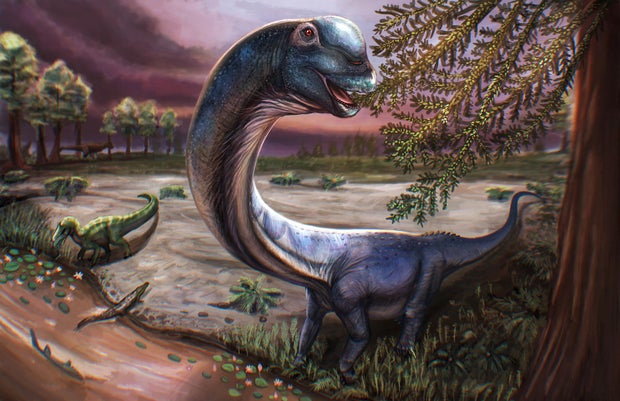
Meet Nagatitan, Southeast Asia's largest dinosaur
An artist’s reconstruction shows the dinosaur whose fossils were unearthed in Thailand.

Patchanop Boonsai/Handout via Reuters

The Thai Ph.D. student called the newly discovered sauropod “the last titan” because it was unearthed in one the youngest rock formations where dinosaurs are found in Thailand, according to University College London.

The region later became a shallow sea, he added, “so this may be the last or most recent large sauropod we will find in Southeast Asia.”

The first remains of the enormous creature were unearthed a decade ago by locals in northeast Thailand, but the excavation was not completed until 2024, according to the study, published Thursday.

The remains partially resembled those of previously discovered sauropods, but had enough unique features to be considered a new species.

It has been dubbed Nagatitan chaiyaphumensis after a “mythological serpent-like creature found in various Asian cultures, especially in northeastern Thailand, often associated with water and Buddhism, and titan, a giant in Greek mythology,” the authors write.

At the time the Nagatitan roamed the region, the ecosystem’s largest predator was a relative of the meat-eating dinosaur Carcharodontosaurus, which measured about 26 feet long and weighed about 3.5 tons.

“At that size, it was dwarfed by Nagatitan. At full size, Nagatitan likely had very little to fear in terms of predation,” Sethapanichsakul told the Reuters news agency.
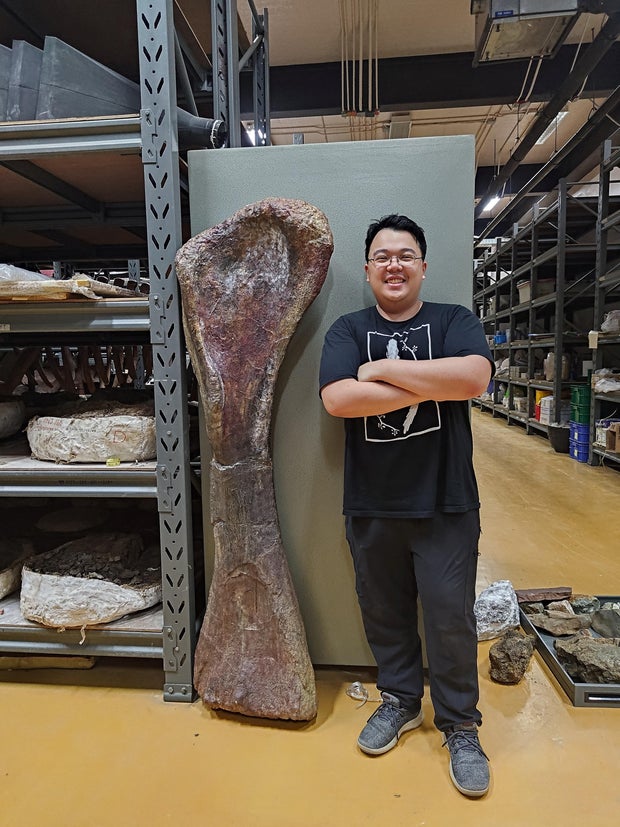
Meet Nagatitan, Southeast Asia's largest dinosaur
Researcher Thitiwoot Sethapanichsakul poses with a front leg bone of the Nagatitan at the Sirindhorn Museum in Thailand in a photograph released May 14, 2026.

Thitiwoot Sethapanichsakul/Handout via Reuters

A life-size reconstruction is on display at Bangkok’s Thainosaur Museum, according to University College London.

In 2023, a dinosaur skeleton uncovered by scientists in northeastern Thailand was also deemed to be a newly discovered species. The skeleton of Minimocursor phunoiensis — which lived 150 million years ago on what is now the Khorat Plateau — represented “one of the best-preserved dinosaurs ever found in Southeast Asia,” scientists said at the time.

Autoridades federales detienen polémicos trabajos de seguridad fronteriza dentro del Parque Nacional Big Bend

Todas las obras de construcción relacionadas con la seguridad fronteriza en el Parque Nacional Big Bend quedan suspendidas temporalmente, anunció el lunes Rodney Scott, comisionado de la Oficina de Aduanas y Protección Fronteriza de Estados Unidos.Scott dijo en un video publicado en X que había aterrizado en Texas y se dirigía a visitar el parque y hablar con las fuerzas del orden locales y otras partes interesadas.“Anoche ordené detener toda actividad de construcción en ese parque hasta que pueda llegar allí y realizar una evaluación personal”, dijo en el video.La medida de Scott se produjo después de que CNN y otros medios informaran sobre el uso de maquinaria pesada por parte del Gobierno durante la última semana para arrasar y excavar partes del parque nacional con el fin de construir caminos de patrullaje y barreras para vehículos.La actividad forma parte de un proyecto más amplio de la CBP para instalar una extensa infraestructura de seguridad fronteriza a lo largo del río Bravo en esta remota región de Texas. El Sector Big Bend se extiende a lo largo de una cuarta parte de la frontera entre Estados Unidos y México, pero registra solo alrededor del 1 % de las detenciones fronterizas debido al accidentado terreno de la zona.Los planes actuales de la CBP para la región más amplia de Big Bend incluyen la construcción de 175 millas (281 kilómetros) de muro de bolardos de acero de 30 pies (9 metros) de altura a lo largo del río Bravo, en zonas al oeste del parque nacional. La agencia no tiene previsto construir un muro en el parque nacional ni en el parque estatal, pero ha comenzado a despejar terrenos para 200 millas (321 kilómetros) de caminos de patrullaje y 17 millas (27 kilómetros) de barreras para vehículos en lugares específicos, informó la agencia la semana pasada. El proyecto de Big Bend también incluye planes para construir 165 millas (265 kilómetros) de barreras para vehículos en zonas al este del parque nacional.CNN informó anteriormente que Scott se reuniría el martes con autoridades locales que se oponen al proyecto fronterizo de la CBP.The-CNN-Wire™ & © 2026 Cable News Network, Inc., a Warner Bros. Discovery Company. All rights reserved.
Read Next Story