
Kenyan court blocks opening of U.S. Ebola quarantine center on air base

▶ Watch Video: Trump administration building Ebola quarantine facility in Kenya

A Kenyan High Court judge on Friday temporarily blocked a Trump administration attempt to set up an Ebola quarantine facility on an air base in the East African country. White House officials said earlier this week that a 50-bed facility would be operational from Friday for American citizens exposed to or infected by the virus.

The non-profit Katiba Institute, whose mission is to defend Kenya’s constitution, filed the restraining application Thursday, citing a lack of transparency and public participation and arguing that “constitutional recklessness” had implications for “grave public health.” 

The U.S. Centers for Disease Control and Prevention has identified six known strains of Ebola, four of which cause significant illness in humans. The most lethal Zaire strain has a mortality rate of up to 90%, according to the World Health Organization, while the Bundibugyo strain — behind an ongoing outbreak centered in the Democratic Republic of Congo — has a mortality rate between 30-50%. 
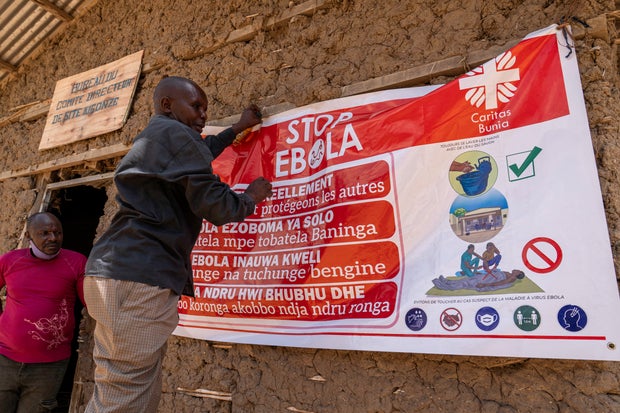
DRCONGO-HEALTH-EBOLA
A man hangs an Ebola awareness banner in the Kigonze camp in Bunia, in the eastern Democratic Republic of the Congo, May 28, 2026.

Glody MURHABAZI/AFP/Getty

Trump administration officials said the facility on the Laikipia Air Base, about 124 miles from Kenya’s capital Nairobi, was being designed to provide access to high-quality care for Americans who need to quickly get out of Congo and quarantine without the risks of a lengthy trip back to the U.S.

Another administration official said the government was planning for a facility that would serve “asymptomatic individuals” who may have been exposed to Ebola, in cooperation with the Kenyan government.

As of Thursday, the U.S. was not aware of any exposed Americans who were to be transported to the center, senior administration officials told CBS News.

The Kenyan court said Friday that “a conservatory order is hereby issued restraining the respondents from establishing … any Ebola exposure, quarantine, isolation or treatment facility in Kenya.”

Another organization, the Law Society of Kenya, has also filed a constitutional petition against the proposed Ebola quarantine center, but there was no immediate ruling on that Friday.

“Kenya appears to have been selected as an alternative containment site, thereby externalizing infectious disease risk management to the Republic’s territory,” Katiba said in its legal challenge.  

The Kenyan government has 48 hours to respond to the petition.

Kenya’s health ministry has said it’s open to working with other governments, including the United States, but has not spoken in any detail about the proposed U.S. quarantine facility.

cbsn-fusion-trump-administration-building-ebola-quarantine-facility-kenya-thumbnail.jpg

On Thursday, Secretary of State Marco Rubio spoke with Kenyan President William Ruto by phone, and a State Department spokesperson later said Washington would provide $13.5 million toward the African country’s Ebola defense operations.

The current Ebola outbreak, focused in Congo’s conflict-plagued Ituri Province on the border with Uganda and South Sudan, is believed to have killed at least 220 people and infected more than 900 others. 

Uganda has confirmed seven Ebola cases, but with a lag time in confirming infections due to the virus’ long gestation period and slow public health reporting in the region, health experts fear there could be a surge in cases confirmed in the weeks ahead.

‘You better treat me as a hostile witness,’ Suge Knight associate says in combative testimony during Tupac murder trial

Las Vegas (CNN) — The murder trial over the fatal shooting of Tupac Shakur has captured the nation’s attention, but on Day 2, a star witness said he’d rather be just about anywhere else.“You didn’t volunteer to come or anything like that?” prosecutor Binu Palal asked, acknowledging former Mob Piru Bloods gangbanger James McDonald.“Not at all,” said McDonald.The reluctant testimony of the former associate of Death Row Records owner Marion “Suge” Knight provided the biggest fireworks in the murder trial of Duane “Keffe D” Davis Tuesday, as emotions rose around the death of the top-selling rapper and the Death Row label’s biggest star.Despite being a self-described “hostile witness” who only appeared under a court summons, McDonald provided distinctly candid testimony about the violent conflict between the Crips and Bloods street gangs in Los Angeles.“Any time you’re dealing with the gang life, there’s going to be violence at any given time,” said McDonald, who ran security at Knight’s Las Vegas Club 662 the night Shakur was killed.Palal asked McDonald if he recalled any times when he was present and disagreements turned violent.“Are you serious? Don’t ask me that right here,” McDonald responded. “I can say that on both sides, when each neighborhood met each other, there was a lot of tension, I’ll say that.”On the night of Shakur’s shooting, McDonald said he was helping to coordinate security at Club 662, the night spot operated by Knight and the intended destination for him and Shakur when they were shot in their vehicle about a mile away.Investigators say Davis obtained the weapon used to fatally shoot Shakur and was in the vehicle from which the shots were fired. Prosecutors say the killing was part of a tit-for-tat exchange of violence between Crips and Bloods revolving around Davis’ nephew, Orlando “Baby Lane” Anderson, who is believed to have pulled the trigger and died in a separate gang shooting two years later.McDonald, now a 61-year-old grandfather who says he’s retired from the life, said the ongoing beef between Death Row, the top West Coast rap label, and Bad Boy Records, controlled by Sean “Puffy” Combs on the East Coast, rekindled what had become a relatively cold war between Crips and Bloods.McDonald, his black Atlanta Braves baseball cap folded and laid on the witness box, frequently shifted uncomfortably during questioning about the specific activities of other people involved in the gangs. Even though McDonald has renounced the gang life – and acknowledged he still does not like Davis personally – there was no way he was going to be a snitch, even under court order.“You’re asking me questions, I can’t answer those questions,” said McDonald, looking occasionally to the judge in the vain hope of being excused from giving specifics.“Talk to your lawyer, man,” McDonald said directly to Davis when asked for specific names of people at Club 662 on the night of the murder. “This dude is trippin’.”McDonald became furious with defense attorney Michael Sanft as he was asked to provide more details on the gang activity, arguing it would only make Davis look worse.“I’m not finna send him to prison. You are!” McDonald roared at the attorney.Although he didn’t witness Shakur’s murder himself, James McDonald – whose brother Alton “Buntry” McDonald was involved in the attack on Anderson on the night of Shakur’s murder – says people in his gang knew right away there would be immediate payback for the shooting, even before Shakur died six days later.“People left Las Vegas that same night, after they found out and got in their cars and went home, because it was a situation,” he said. “Pac was shot. Retaliation is a ‘mug’. Come on, man. Like, it was for real, for real.”Death Row security head denies involvement in Shakur murderAfter McDonald’s fiery testimony, jurors heard from Reggie Wright, Jr., who had become the official head of Death Row Records security at that time while still also working as a sworn police officer in Compton, California.Wright – testifying from an electric scooter as a result of the effects of Long Covid – told the court his work for Knight’s organization, which he did alongside other private security jobs, was different than the role of McDonald, who he acknowledged knowing was in the Bloods gang.“While they weren’t official security, would you say they provided a different form of security?” Palal asked.“That would be a fair. Yes, that’s correct,” Wright responded.Tensions had been rising between the coasts, Wright acknowledged, and he had even assigned a second security guard to Shakur after the release of his notorious diss track, “Hit ‘Em Up,” which took on Combs’ Bad Boy Records and its top artist, Christopher “Biggie Smalls” Wallace, directly.Wallace was killed in another drive-by shooting six months later in Los Angeles, a murder which has never been solved.Wright acknowledged his second agent for Shakur ended up calling out for work on the night of the murder. Although Knight and Shakur were followed by security, they were in their black BMW alone.“For some reason, he didn’t show up,” Wright said of the absent agent.Wright was cited in July by Davis in a jailhouse interview as a possible person who actually orchestrated Shakur’s killing. In court, Wright again denied the claim.“Did you have anything to do with the murder of Tupac Shakur?” asked Palal.“Absolutely not,” responded Wright.Graphic autopsy photos shown in courtBefore McDonald brought emotion to the witness stand, the day began with some testimony that appeared excruciating for the Shakur family. Prosecutors showed autopsy photos of Shakur, taken moments after his death following six days in the hospital.The photos showed tubes from the hospital still connected to Shakur’s face, along with other signs of what the prosecutor and a forensic pathologist called “evidence of medical intervention.” The famous “Thug Life” tattoo across Shakur’s chest could be seen.Other photos displayed an open bullet wound under Shakur’s right armpit. A row of sutures nearby across the top of his chest showed where Shakur’s severely damaged lung had been removed during the unsuccessful attempts to save his life.Jurors also saw a larger gunshot wound along his top right thigh and a slightly smaller wound near Shakur’s right buttock. A bullet fragment recovered from his body was shown separately, laid on a paper towel.Shakur’s family in the court gallery had been advised ahead of time that the graphic visuals were going to be shown and described. Shakur’s sister Sekyiwa and his stepbrother Mopreme chose to leave before the testimony started. Family friend Tuere Burns initially remained, but covered her eyes with her hand as the first photos were shown and then walked out of the courtroom, visibly shaken.Davis and the jury did not have any visible reaction to seeing the photos of Shakur’s body.Fiery witness ends the day on a quieter noteIn a case filled with unexpected turns, one of the most unlikely events Tuesday happened outside of the courtroom. After his furious testimony and sharp elbows with Davis’ defense, James McDonald waited in the lobby of the 16-story courthouse for another encounter with Sanft.But this time, it was to say he was sorry for letting things get so personal.“I just wanted to apologize to you,” McDonald told Sanft, reaching for a handshake.The defense attorney said he understood the witness stand was a pressure cooker.“I mean, we’ve never met (before),” Sanft responded, “so I get it.”McDonald told reporters he didn’t want to play a role in potentially putting Davis in prison, but also said Davis had to recognize he had put himself into jeopardy by talking so much. “Running his damn mouth. Shut up!” McDonald said. “The case is old. It’s over, but for (money) you want to sit up here and tell people what you did? The average gang member don’t do that. And he’s paying for it.”The-CNN-Wire™ & © 2026 Cable News Network, Inc., a Warner Bros. Discovery Company. All rights reserved.
Read Next Story