
Kenyan court blocks opening of U.S. Ebola quarantine center on air base

▶ Watch Video: Trump administration building Ebola quarantine facility in Kenya

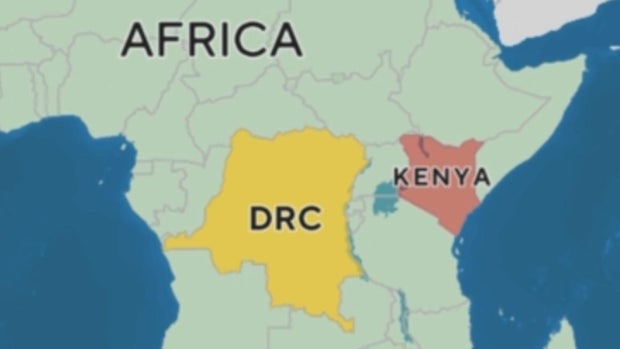
A Kenyan High Court judge on Friday temporarily blocked a Trump administration attempt to set up an Ebola quarantine facility on an air base in the East African country. White House officials said earlier this week that a 50-bed facility would be operational from Friday for American citizens exposed to or infected by the virus.

The non-profit Katiba Institute, whose mission is to defend Kenya’s constitution, filed the restraining application Thursday, citing a lack of transparency and public participation and arguing that “constitutional recklessness” had implications for “grave public health.” 

The U.S. Centers for Disease Control and Prevention has identified six known strains of Ebola, four of which cause significant illness in humans. The most lethal Zaire strain has a mortality rate of up to 90%, according to the World Health Organization, while the Bundibugyo strain — behind an ongoing outbreak centered in the Democratic Republic of Congo — has a mortality rate between 30-50%. 

DRCONGO-HEALTH-EBOLA
A man hangs an Ebola awareness banner in the Kigonze camp in Bunia, in the eastern Democratic Republic of the Congo, May 28, 2026.

Glody MURHABAZI/AFP/Getty

Trump administration officials said the facility on the Laikipia Air Base, about 124 miles from Kenya’s capital Nairobi, was being designed to provide access to high-quality care for Americans who need to quickly get out of Congo and quarantine without the risks of a lengthy trip back to the U.S.

Another administration official said the government was planning for a facility that would serve “asymptomatic individuals” who may have been exposed to Ebola, in cooperation with the Kenyan government.

As of Thursday, the U.S. was not aware of any exposed Americans who were to be transported to the center, senior administration officials told CBS News.

The Kenyan court said Friday that “a conservatory order is hereby issued restraining the respondents from establishing … any Ebola exposure, quarantine, isolation or treatment facility in Kenya.”

Another organization, the Law Society of Kenya, has also filed a constitutional petition against the proposed Ebola quarantine center, but there was no immediate ruling on that Friday.

“Kenya appears to have been selected as an alternative containment site, thereby externalizing infectious disease risk management to the Republic’s territory,” Katiba said in its legal challenge.  

The Kenyan government has 48 hours to respond to the petition.

Kenya’s health ministry has said it’s open to working with other governments, including the United States, but has not spoken in any detail about the proposed U.S. quarantine facility.
cbsn-fusion-trump-administration-building-ebola-quarantine-facility-kenya-thumbnail.jpg

On Thursday, Secretary of State Marco Rubio spoke with Kenyan President William Ruto by phone, and a State Department spokesperson later said Washington would provide $13.5 million toward the African country’s Ebola defense operations.

The current Ebola outbreak, focused in Congo’s conflict-plagued Ituri Province on the border with Uganda and South Sudan, is believed to have killed at least 220 people and infected more than 900 others. 

Uganda has confirmed seven Ebola cases, but with a lag time in confirming infections due to the virus’ long gestation period and slow public health reporting in the region, health experts fear there could be a surge in cases confirmed in the weeks ahead.

DOJ asking secretive court to remove Afghan woman allegedly tied to terror plot

The Justice Department is seeking to convince a federal judge to deport a Texas-based Afghan woman who prosecutors allege is an "alien terrorist," it revealed Wednesday, in the first-ever test case before a secretive court that has never convened since it was created three decades ago.Nazira Haji Zada, 47, of Fort Worth, Texas, will appear Thursday morning in the Alien Terrorist Removal Court in Washington, D.C., where a judge will hear evidence from the Justice Department over whether she should be removed from the United States, according to the Justice Department and court filings. The government is accusing her of links to a foiled Islamic State-inspired terrorist plot to carry out a mass shooting on Election Day in 2024."The allegations in this case show the matriarch of an ISIS-sympathizing family aiding in a plot to launch a mass casualty attack on American voters on Election Day," Acting Attorney General Todd Blanche said in a statement.Zada has never been publicly charged by the government with any crimes of terrorism, and has no known criminal history, according to the government.Last year, her son Abdullah Haji Zada and son-in-law Nasir Ahmad Tawhedi each pleaded guilty in a federal court in Oklahoma to purchasing two AK-47 style rifles and 500 rounds of ammunition from an undercover FBI agent as part of an alleged plot targeting the 2024 election in support of the Islamic State.At the time of his arrest in 2024, Zada's son was only 17. He was charged as an adult and pleaded guilty to gun crimes when he was 18. Tawhedi pleaded guilty to terrorism and gun offenses.In an unclassified FBI summary filed in the Alien Terrorist Removal Court, the government alleged that Zada "supported" her son and son-in-law's conspiracy. The FBI also alleged she "pledged loyalty to ISIS" and "worked to indoctrinate her children with ISIS ideology," citing information from a "reliable source.""Nazira worked with Tawhedi to radicalize the family and to conceal their pro-ISIS teaching and planned family relocation to ISIS-controlled territory from her unsuspecting husband," the FBI wrote.The Alien Terrorist Removal Court was created by Congress in 1996 and signed into law by President Bill Clinton. It was set up to deport noncitizens who could not be removed by the traditional legal process because the information about their cases was classified and could not be made public for national security reasons.The targets of noncitizen terrorist removal proceedings — including legal permanent residents — are not permitted to review the classified evidence against them, and unlike in criminal proceedings, they are barred from legally challenging how the evidence was collected by the government.Applications for removal must be certified by the attorney general and are reviewed by the court ex parte and in camera — meaning the target of the deportation proceeding is not a party to the hearing.If the application is accepted, it moves to the removal stage and a public hearing is conducted. As part of that, the Justice Department also releases an unclassified summary of the case, as it did in a newly created website for the court that was only launched on July 17.Until July 15, when the Justice Department first filed its removal application against Zada, the Alien Terrorist Removal Court had been a "zombie" court that existed only on paper. It had never been used before, and prior efforts by the Justice Department earlier on after its creation to find a test case failed.The court is structured similarly to the Foreign Intelligence Surveillance Court, another secret court that reviews sensitive requests for surveillance warrants. All five of its judges also sit on the FISC and are appointed by the chief justice of the Supreme Court.U.S. District Judge Joan Ericksen, who sits on the federal bench in Minnesota, is the chief judge of the Alien Terrorist Removal Court, and will preside over Zada's public removal hearing at the federal courthouse in Washington, D.C., at 11 a.m. ET Thursday.Zada has a green card, according to publicly unsealed court records. Under the rules of the court, lawful permanent residents are afforded the right to government-appointed counsel  — though that attorney may not share classified evidence with the defendant.According to court filings, her spouse was employed at the Bagram Air Base in Afghanistan from 2009 to 2016, and was granted a green card under a program for Afghans who assisted U.S. forces during the war in Afghanistan.CBS News could not immediately determine who may represent Zada at her removal hearing on Thursday. CBS News has reached out to the defense attorney who represented her son in his criminal case in the Western District of Oklahoma, where the original case was brought.Tawhedi and Abdullah Haji Zada were arrested on Oct. 7, 2024, after purchasing the firearms and ammunition from the undercover agent.Abdullah Haji Zada, who was also a green card-holder like his mother, was sentenced to 15 years in prison. In his plea deal, he consented to being deported to Afghanistan after serving his sentence and acknowledged his lawful permanent resident status would be revoked.Tawhedi, 28, pleaded guilty on June 13, 2025, to conspiring and attempting to provide material support and resources to the Islamic State.Both were accused of conspiring to relocate their female and juvenile male family members, including Nazira Zada, to Islamic State-controlled territory in Afghanistan while their alleged Election Day plot was carried out. 
Read Next Story