
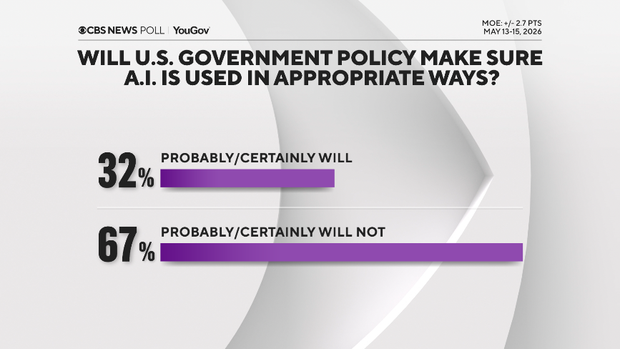
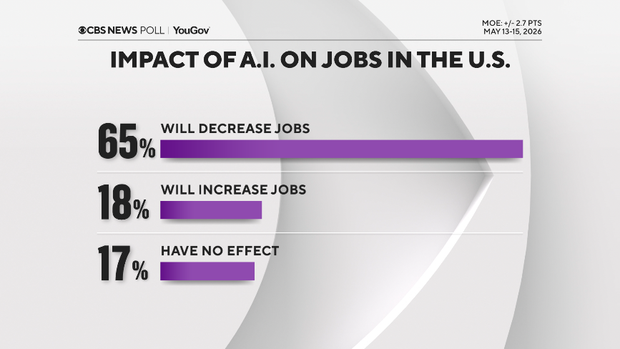
Most Americans continue to believe AI will reduce the number of jobs in the U.S., but that’s not their only AI concern. They are also skeptical about whether the U.S. government will implement a policy to ensure the technology is used appropriately.
That skepticism is fairly widespread. Majorities across age groups and education levels don’t think government policy will ensure AI is used appropriately. Democrats and independents share that view, while Republicans are generally divided.
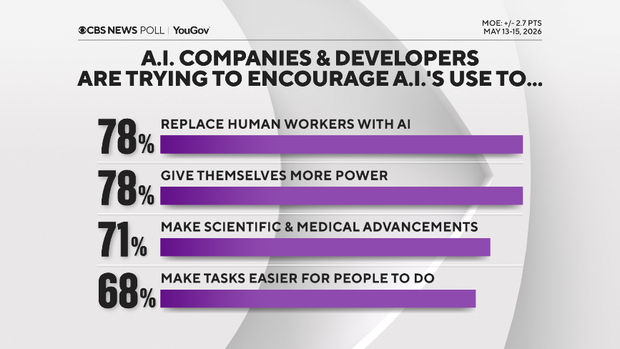
Meanwhile, people see a range of reasons AI companies are encouraging AI use — from making everyday tasks easier to replacing human workers altogether.
Two-thirds of Americans think U.S. government policy certainly or probably will not make sure AI is used in appropriate ways. Those who hold that view are especially likely to believe AI will cost the U.S. jobs.
When asked about a range of potential reasons AI companies and developers are encouraging AI use, big majorities see these companies giving themselves more power and replacing human workers with AI as top motives. Sizable but relatively smaller majorities also see making scientific and medical advancements and simplifying tasks for people as reasons to encourage its use.
AI and jobs
As was true over the past year, a majority of Americans continue to think AI will take away U.S. jobs.
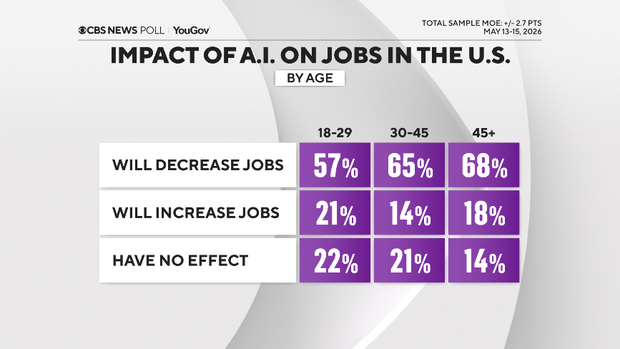
Most younger and older Americans foresee a reduction of jobs due to AI, although younger people relatively less so.
This may be because younger Americans tend to be more familiar with AI. Previous CBS News polling has shown that younger people report using AI themselves and having a good understanding of it in higher numbers than older people.
Anthony Salvanto and Fred Backus contributed to this report.
This CBS News/YouGov survey was conducted with a nationally representative sample of 2,064 U.S. adults interviewed between May 13-15, 2026. The sample was weighted to be representative of adults nationwide according to gender, age, race, and education, based on the U.S. Census American Community Survey and Current Population Survey, as well as 2024 presidential vote. The margin of error is ±2.7 points.