
Mysterious ‘golden orb’ found in deep sea in 2023 is finally identified

▶ Watch Video: A dive to the deepest parts of all five oceans

Scientists have solved the mystery of a “golden orb” found thousands of feet underwater by researchers from the National Oceanic and Atmospheric Association in 2023, the agency said on Wednesday

The orb was found in the Gulf of Alaska, by a remotely operated underwater vehicle. The device was over two miles underwater when it spotted a “strange, golden, mound-shaped object with a hole in it, stuck to a rock,” NOAA said. It was collected and sent to the Smithsonian National Museum of Natural History for study. 

Allen Collins, the director of NOAA Fisheries’ National Systematics Laboratory and a zoologist, said that he thought “routine processes” would allow scientists to identify the object. But the orb proved trickier. 
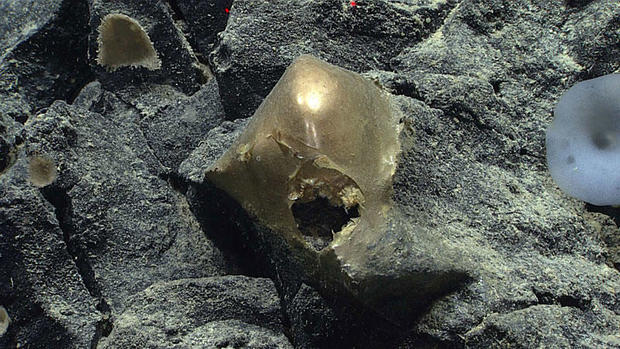
orb-800.jpg
Scientists with NOAA discovered an unidentified golden orb-like organism while operating a remote deep-sea diving vessel off the coast of Alaska on August 30.

NOAA

“This turned into a special case that required focused efforts and expertise of several different individuals. This was a complex mystery that required morphological, genetic, deep-sea and bioinformatics expertise to solve,” Collins said. 

First, scientists studied the physical structure of the orb. They found it didn’t have animal anatomy, but that it was a “fibrous material” covered with stinging cells, like an anemone or coral might be. Those cells were identified as spirocysts, a specialized cellular structure that can capture prey. Such cells only exist on one group of aquatic invertebrates, called cnidarians. 

The research team realized that the cells looked similar to the ones seen in a specimen collected in 2021. They compared the golden orb to that specimen, and found they were the same species. 

Initial DNA testing on the golden orb and the 2021 specimen was inconclusive, but whole-genome sequencing showed that both were “genetically almost identical” to a kind of cnidarian called Relicanthus daphneae. More analysis allowed the team to determine that the orb “had once been part of the base of a giant sea anemone,” NOAA said in a video explaining the process

The golden object that caught everyone’s eye is usually hidden underneath the anemone, NOAA said, but somehow, this one “seems to have been left behind.” Scientists still don’t know what happened to the top of the anemone. In the video, NOAA suggested it might have died or moved to a new home. 

The full anemone has a pink-colored, cylindrical body that can grow to up to three feet across, according to researchers. Its tentacles can be up to six feet long. It stinging spirocysts are the largest among all known cnidarians.

“So often in deep ocean exploration, we find these captivating mysteries, like the ‘golden orb,'” said NOAA Ocean Exploration acting director William Mowitt. “With advanced techniques like DNA sequencing, we are able to solve more and more of them. This is why we keep exploring—to unlock the secrets of the deep and better understand how the ocean and its resources can drive economic growth, strengthen our national security, and sustain our planet.” 
A cosmic breadcrumb trail leads astronomers to a discovery in another galaxy

(CNN) — A faint ribbon of stars in a distant galaxy has led astronomers to a discovery that could reveal secrets about one of our universe’s greatest mysteries.Hidden within the Hubble Space Telescope’s archival data, researchers found the barely visible trail of stars — the first globular cluster stellar stream detected outside the Milky Way. The celestial phenomenon, located in a galaxy roughly 115 million light-years from Earth, is the remnant of a dense ball of stars being slowly pulled apart by the gravity of its host galaxy. As the cluster loses stars, the remnants form a long, narrow stream.Astronomers have found dozens of stellar streams within the Milky Way, but because these trails are faint and hard to detect, many more are likely left to be discovered. Now, with evidence that they occur in other galaxies, astronomers may be able to use them as cosmic tracers to understand better how galaxies form and evolve.The finding, which was detailed in a study published Wednesday in the journal Nature, also allowed the team of astronomers to map the galaxy — known as UGC 9050-Dw1 — and its gravitational field by modeling the stream.Because the galaxy’s gravity influences the stellar stream’s shape and motion, the researchers used the trail of stars to trace the galaxy’s gravitational field. Through their modeling, they were also able to estimate the galaxy’s total mass, how much of it is made up of visible objects, such as stars, and how much is composed of dark matter — a mysterious form of matter that cannot be seen but has gravity.When the study team started to realize that it had found a stellar stream beyond our galaxy, “it was very exciting,” said co-lead author Julie Kiel Holm, a doctoral fellow at the Niels Bohr Institute at Denmark’s University of Copenhagen who studies globular clusters and the formation of stellar streams. “And then we sort of looked at each other and asked, ‘Where do we go from here?’“Dark matter intrigues scientists because they don’t know what it is, yet they can see its gravitational influence on stars and galaxies. “About 80% to 85% of our universe, we think is dark matter, so that makes it very, very enticing to try and figure out what it is,” Kiel Holm added.Stellar streams have been used to help scientists map the dark matter within our own galaxy. Now, those same tools can be used to help better understand the dark matter composition and structure of other galaxies that share the universe.Spotting stellar streamsThe newly discovered stream is located within an ultra-diffuse galaxy — one that is spread out and extremely faint, which likely made the stellar stream easier to spot, the study authors speculated.“At the same time, these ultra-diffuse galaxies are thought to be very massive, and you need to be massive in order to actually pull out stars from that parent cluster,” said co-lead author Sarah Pearson, an associate professor at DTU Space, the National Space Institute at the Technical University of Denmark.“So those two things together — the fact that it provides a faint background, but also has a strong enough tidal field to pull out stars from the cluster — is a great combination if you would want to find one of these,” she added.When trying to identify these streams, astronomers look for thin, elongated structures on their telescopes. The streams can also be tracked through their movement along the sky; however, doing so requires a telescope to be in the same position over time, and the technique has so far only been able to find stellar streams in the Milky Way.“The area that the Hubble can see is actually not that big. So you have to be very, very lucky to be able to see this, and we don’t really know where to look to basically target them,” said study coauthor Tjitske Starkenburg, a research assistant professor at the Center for Interdisciplinary Exploration and Research in Astrophysics at Northwestern University in Evanston, Illinois.The study authors predict that future telescope advancements will allow for further detection of these clusters within and outside our galaxy. Starkenburg pointed to NASA’s Nancy Grace Roman Space Telescope that is expected to launch at the end of the month and will have a larger field of view, “like 100 Hubbles in one image.”Detecting a faint stellar stream in a galaxy outside the Local Group — our galactic neighborhood that consists of more than 50 galaxies that are gravitationally bound together — is remarkable, David Martínez-Delgado, an astrophysicist and researcher for the nonprofit foundation ARAID at the Center for Studies of the Cosmos Physics of Aragón in Teruel, Spain, said in an email. Martínez-Delgado was not involved with the new study.“I had previously thought that detecting globular cluster tidal tails in external galaxies would be extremely challenging, given their small angular size and extremely low surface brightness,” he added. “This result demonstrates that, with sufficiently deep and high-resolution observations, such structures may be detectable well beyond the Local Group.”A record of galactic evolutionStellar streams can act as records of a galaxy’s past, giving astronomers clues about how galaxies change over time. When a larger galaxy pulls apart a smaller dwarf galaxy, the dwarf’s stars can stretch into a stream — a cosmic breadcrumb trail of that encounter.Streams from globular clusters, such as the one described in the study, preserve that history on a smaller scale, revealing how the cluster has traveled through its host galaxy and how the galaxy’s gravity has gradually pulled it apart. By tracing that history, researchers can then learn how the galaxy’s mass is distributed, including the unseen dark matter that shapes its gravitational field.Observing the first globular cluster stellar stream outside the Milky Way opens the door to detecting more of these phenomena in galaxies across the universe. The study authors said they hope that future detections will help reveal more secrets about other galaxies as well as the dark matter within them.One feature worth further research, the authors noted, are the gaps or clumps in stellar streams that scientists theorize develop when small concentrations of dark matter pass through them. “But there are other things that could cause some of those similar effects,” Starkenburg said.Finding more streams, perhaps in other galaxies, and observing whether they have similar gaps or clumps, “that’s a much stronger argument for that it has to be dark matter,” Starkenburg added.Many questions remain about dark matter despite its existence being known for almost a century, Pearson noted.“It really is just one of the biggest open questions in physics,” she said. “What is the nature of dark matter? Is it a particle? Is it many? Is it something completely different? We don’t know.”The-CNN-Wire™ & © 2026 Cable News Network, Inc., a Warner Bros. Discovery Company. All rights reserved.
Read Next Story