▶ Watch Video: A dive to the deepest parts of all five oceans
Scientists have solved the mystery of a “golden orb” found thousands of feet underwater by researchers from the National Oceanic and Atmospheric Association in 2023, the agency said on Wednesday.
The orb was found in the Gulf of Alaska, by a remotely operated underwater vehicle. The device was over two miles underwater when it spotted a “strange, golden, mound-shaped object with a hole in it, stuck to a rock,” NOAA said. It was collected and sent to the Smithsonian National Museum of Natural History for study.
Allen Collins, the director of NOAA Fisheries’ National Systematics Laboratory and a zoologist, said that he thought “routine processes” would allow scientists to identify the object. But the orb proved trickier.
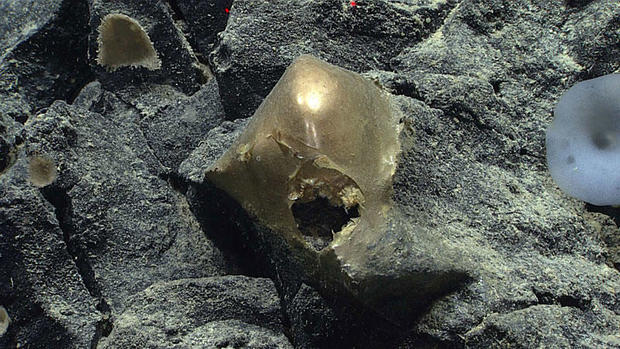
NOAA
“This turned into a special case that required focused efforts and expertise of several different individuals. This was a complex mystery that required morphological, genetic, deep-sea and bioinformatics expertise to solve,” Collins said.
First, scientists studied the physical structure of the orb. They found it didn’t have animal anatomy, but that it was a “fibrous material” covered with stinging cells, like an anemone or coral might be. Those cells were identified as spirocysts, a specialized cellular structure that can capture prey. Such cells only exist on one group of aquatic invertebrates, called cnidarians.
The research team realized that the cells looked similar to the ones seen in a specimen collected in 2021. They compared the golden orb to that specimen, and found they were the same species.
Initial DNA testing on the golden orb and the 2021 specimen was inconclusive, but whole-genome sequencing showed that both were “genetically almost identical” to a kind of cnidarian called Relicanthus daphneae. More analysis allowed the team to determine that the orb “had once been part of the base of a giant sea anemone,” NOAA said in a video explaining the process.
The golden object that caught everyone’s eye is usually hidden underneath the anemone, NOAA said, but somehow, this one “seems to have been left behind.” Scientists still don’t know what happened to the top of the anemone. In the video, NOAA suggested it might have died or moved to a new home.
The full anemone has a pink-colored, cylindrical body that can grow to up to three feet across, according to researchers. Its tentacles can be up to six feet long. It stinging spirocysts are the largest among all known cnidarians.
“So often in deep ocean exploration, we find these captivating mysteries, like the ‘golden orb,'” said NOAA Ocean Exploration acting director William Mowitt. “With advanced techniques like DNA sequencing, we are able to solve more and more of them. This is why we keep exploring—to unlock the secrets of the deep and better understand how the ocean and its resources can drive economic growth, strengthen our national security, and sustain our planet.”