Book excerpt: ‘The Let Them Theory’ by Mel Robbins

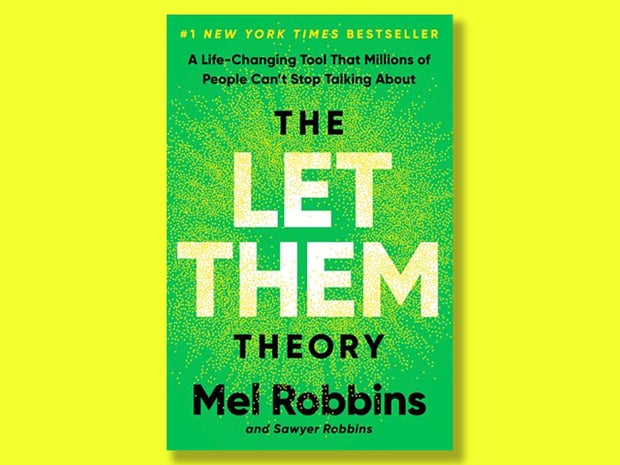
the-let-them-theory-cover-hay-house-1280.jpg

Hay House

We may receive an affiliate commission from anything you buy from this article.

Mel Robbins’ podcasts, TED Talk and bestselling books, including “The 5 Second Rule,” have made her one of the most successful motivational speakers.

In her latest bestseller, “The Let Them Theory” (Hay House), she discusses how personal growth is only possible when you stop pouring energy into things you cannot control – which includes changing other people.

Read an excerpt below, and don’t miss Norah O’Donnell’s conversation with Mel Robbins on “CBS Sunday Morning” February 1!


“The Let Them Theory” by Mel Robbins

Prefer to listen? Audible has a 30-day free trial available right now.


I’ve spent the last two years researching the Let Them Theory: why it works, and how you can use it to transform your life and improve your relationships with other people.

In writing this book, I’ve spoken to many of the world’s leading experts in psychology, neuroscience, behavioral science, relationships, stress, and happiness. You’ll meet them as you read the book, and their research will help you apply the theory in countless situations in your life. As you’ll soon see, the science is clear: This thing works. And it works really well.

But this book isn’t just about introducing you to the Let Them Theory. It’s about a fundamental law of human nature: All human beings have a hardwired need for control.

We all have an innate desire to control everything about our lives: our time, our thoughts, our actions, our environment, our plans, our future, our decisions, and our surroundings. Feeling in control makes you feel comfortable and safe, so naturally you try to control everyone and everything around you—oftentimes, without even realizing it. 

But the fact is, there is one thing you will never be able to control. No matter how hard you try, you will never be able to control or change another person. The only person you are in control of is you. Your thoughts, your actions, your feelings.

For too long you’ve been working against this fundamental law of human nature. You’ve been fighting to change people, battling to control situations, worrying about what people say, think, or do; and in doing so, you’ve created unnecessary stress, tension, and friction for yourself and in your relationships. I did too.

The Let Them Theory has transformed my entire approach to life and how I deal with other people. Instead of resisting the natural flow of human nature, I learned to embrace it. Instead of wasting my energy on something I can’t control—what others say, think, and do—I poured my energy into what I can control: me.

The result? I gained more control over my own life than I have ever had before. It was freeing. I stopped making other people the problem, and in doing so, my relationships improved in ways I never thought possible. It was like unlocking a door that had been sealed shut for years. And behind it? A life where I’m no longer weighed down by the need to manage other people.

In the coming pages, you’ll learn all about the theory, the easiest way to start using it, and how awesome it feels when you do. You’ll also learn about a surprising discovery I made early in our research. The Let Them Theory isn’t just … Let Them. Yes, it begins with these two words, but that’s not the whole story. Let Them is just the first half of the equation. There is a second, even more crucial step to this theory: Let Me.

In the next chapter, we’ll unpack both Let Them and Let Me and explore the science and psychology behind each one of the two steps. Then, you’ll learn about the eight core areas of your life where the theory will have the biggest positive impact. We’ll talk about your relationships, career, emotions, opinions, stress, love life, struggles, chronic comparison, friendship, and most importantly, your relationship with yourself. 

Over and over, you’ll learn how you’ve been trying to control the wrong things and unknowingly made other people a problem. The truth is, other people should be one of the greatest sources of happiness, support, and love in your life. But they can’t be if you keep trying to control what they feel, say, and do. That ends with this book.

Master the Let Them Theory, and you’ll stop exhausting yourself trying to control the uncontrollable. This isn’t just about feeling better. It’s about redesigning how you live your entire life. I can’t wait for you to discover the space and freedom to experience your life the way you’ve always wanted—on your terms.

Let’s begin.

     
From “The Let Them Theory” by Mel Robbins. Copyright © 2024 by Mel Robbins. All rights reserved. This excerpt, or any parts thereof, may not be reproduced without permission.


Get the book here:

“The Let Them Theory” by Mel Robbins

Buy locally from Bookshop.org


For more info:

Trump is trying to tighten the screws on an Iran numb to economic pain

(CNN) — Iran, already drained by years of sanctions and a brutal military onslaught from the United States and Israel, now faces another test as President Donald Trump moves to further tighten the economic screws on the Islamic Republic.The US is preparing measures, to be revealed at a news conference later on Monday, of what Treasury Secretary Scott Bessent promises to be “the toughest sanctions in history” amid deadlock on talks to end the six-month war and as Iran continues inflicting global economic pain by disrupting shipping through the crucial Strait of Hormuz.By the admission of its own top officials, Iranians are suffering.“We are apologetic that these problems exist, as we find ourselves in a full-scale economic, military, and security war,” Iran’s President Masoud Pezeshkian said, according to state media.“As the government, we are seeking with all our being to steer inflation, public problems, people’s livelihoods, people’s jobs, people’s future, and people’s lives towards dignity and pride,” he added.Videos on social media published last week showed empty markets in Tehran and Karaj, with sellers complaining that their fresh produce is not being bought. One resident of Tehran and another business owner told CNN that economic pressures have become “untenable.”Not only is everything expensive, Nima, a 36-year-old resident of Tehran, told CNN, but some of the “important things needed we can’t even get, like certain medications.”An owner of a small shop who chose to remain anonymous to speak freely about the economic conditions said he is barely making ends meet.“We are running out of some of the foreign products like foreign shampoo and conditioner, toothpaste. We have limited stock and it’s now too expensive for most people, but even the Iranian-made products I’ve had to raise prices on,” he said.‘Immediate Pain’But even with fresh economic pressure, experts say that unless the Trump administration uncovers fresh methods to choke off Tehran’s revenue streams, Washington will once again face a regime long practiced in sanction evasion, resourceful at finding new ways to generate income, and betting on its ability to survive the US’ economic pressure.Over decades of international pariahdom, the Islamic Republic was forced to develop sophisticated methods to mitigate the impact of Western sanctions, creating a decentralized network of front companies, brokers, exchange houses, and a shadow tanker fleet that uses ship-to-ship transfers, altered tracking data, and false documentation to move oil.In 2024, $9 billion of Iranian shadow banking activity occurred through US correspondent accounts, the US Financial Crimes Enforcement Network said, based on reporting from American financial institutions. Shell companies, including those in oil, shipping, and investment, facilitate billions of dollars in transactions through networks spanning the United Arab Emirates, Hong Kong, and Singapore, according to the Treasury Department.Payments are often made in the Chinese yuan, through barter arrangements, or outside the dollar-based banking system, Umud Shokri, an energy strategist and senior visiting fellow at George Mason University told CNN.The latest measures will “squash” the economy of “this murderous regime” and curtail Iran’s ability to “project power through their proxies” and its ability to pay the Iranian military, Bessent told CNBC in a recent interview.But experts said that ordinary Iranians will most likely bear the brunt of the new sanctions.“Ordinary Iranians will experience the most immediate pain, and further sanctions would weaken the rial, increase inflation, raise the cost of imported goods and industrial inputs, and reduce household purchasing power,” Shokri said.Even if public and military spending, as well as regional allies, suffer under the new strict economic sanctions, it will be the wage earners, pensioners, small businesses, and lower-income families that would be particularly vulnerable, he added.The “politically connected” institutions and intermediaries would be partially “insulated” as they continue profiting from smuggling, currency manipulation, and control over scarce imports, Shokri said.Experts say that for the US to effectively target Iran’s economy, it will need to target major Chinese buyers of Iranian oil, independent refineries, and banks processing Iranian revenue, but that could also risk retaliation from Beijing against Washington.In a Truth Social post Trump threatened other countries with “tremendous economic consequences” if they provide any type of “lifeline” to Iran, without naming specific nations.Washington would have to target the central nodes of Iran’s trade rather than continue sanctioning replaceable vessels and shell companies,” Shokri said, adding that the US could aim to sanction tanker managers, insurers, ports, ship-to-ship transfer providers while adding more restrictions on technology that could end up with dual-use military functions.‘Weather The Storm’Even though the Iranian government has expanded domestic production while operating its sophisticated network of front companies to procure essential goods, largely from China, the Islamic Republic has demonstrated that it can transfer the sanctions burden onto an already struggling population while protecting the institutions essential for the regime’s survival.Weeks before the war, Iranians took to the streets to protest rising costs and inflation.Yet after initially acknowledging the economic struggle, the government once again accused the protesters of being foreign agents before unleashing one of the worst crackdowns in the Islamic Republic’s history.For now, the Iranian regime is using the war to justify poor economic conditions and a once struggling government has been given an excuse to its exhausted population, while it is arguably Trump who faces greater political pressure from US consumers angry at gas prices ahead of midterms.“They are willing to weather the storm, and they are willing to go through the pain,” Dina Esfandiary, Middle East geoeconomics lead at Bloomberg Economics told CNN. “None of the measures that President Trump is contemplating are going to make Iran capitulate.”What is required, Esfandiary says, is “diplomacy and carrots” with Iran, which “of course is not at all being contemplated.”For now, Neda, a 34-year-old Tehran resident struggling with kidney disease and needing medication, is holding her breath as she is once again forced to buy only half of her monthly dose.“I have so much anxiety all the time because without the medication I won’t really survive,” she said. “You know, I went to the doctor the other day and the nurse said people weren’t even able to show up to their appointments for dialysis.”“The people receiving chemotherapy stopped going because they just cannot afford it anymore.”The-CNN-Wire™ & © 2026 Cable News Network, Inc., a Warner Bros. Discovery Company. All rights reserved.
Read Next Story