Nurses strike begins in New York City as thousands walk off jobs

▶ Watch Video: Largest nurses strike in New York City history is underway

The largest nurses strike in New York City history is underway after negotiators for five major hospitals and the state nurses union failed to agree to a new contract by Monday’s deadline. 

The New York State Nurses Association said nearly 15,000 nurses are now walking off their jobs at five privately-run hospitals, including Mount Sinai Hospital, Mount Sinai Morningside, Mount Sinai West and NewYork-Presbyterian in Manhattan, and Montefiore Einstein in the Bronx. 

NYSNA said nurses at Mount Sinai started the strike at 6 a.m., while nurses at the remaining hospitals started picketing an hour later.

Gov. Kathy Hochul declared a state of emergency in anticipation of the strike amid worries it could jeopardize critical care for thousands of patients in the city.  

NYC Nursing Strike
Nurses strike outside Mount Sinai West Hospital on Monday, Jan. 12, 2026, in New York.

Yuki Iwamura / AP

Montefiore said it was preparing for the strike to last multiple weeks. 

“NYSNA’s leaders continue to double down on their $3.6 billion in reckless demands, including nearly 40% wage increases, and their troubling proposals like demanding that a nurse not be terminated if found to be compromised by drugs or alcohol while on the job. We remain resolute in our commitment to providing safe and seamless care, regardless of how long the strike may last,” Montefiore Senior Vice President Joe Solmonese said.

A Mount Sinai spokesperson said, “Unfortunately, NYSNA decided to move forward with its strike while refusing to move on from its extreme economic demands, which we cannot agree to, but we are ready with 1,400 qualified and specialized nurses — and prepared to continue to provide safe patient care for as long as this strike lasts.”

Some nurses, however, did report to work despite the strike. Mount Sinai said 20% showed up on Monday.

A statement from NewYork-Presbyterian said, “While NYSNA has told nurses to walk away from the bedside, we remain focused on our patients and their care. This strike is designed to create disruption, but we have taken the necessary steps so our patients continue to receive the care they trust us to provide … We’re ready to keep negotiating a fair and reasonable contract that reflects our respect for our nurses and the critical role they play, and also recognizes the challenging realities of today’s healthcare environment…We have proposed significant wage increases that keep our nurses among the highest paid in the city, enhancements to their outstanding employer-funded benefits and new measures that reflect our shared commitment to safe staffing and workplace safety. However, good faith bargaining requires compromise from both sides.”

Mamdani joins picket line

New York City Mayor Zohran Mamdani joined picketers outside NewYork-Presbyterian in Washington Heights. 

“In every one of our city’s darkest periods, nurses showed up to work. Their value is not negotiable and there worth is not up for debate,” Mamdani said. “They show up and all they are asking for in return is dignity, respect and the fair pay and treatment that they deserve. They should settle for nothing less.” 

Mamdani released a similar statement the night before the strike on X.

“This city can and must ensure the continuity of care. FDNY, Emergency Management, the public health system and all of my senior leadership are working tirelessly to ensure nurses’ demands for dignity can be heard and care is still received,” the mayor said. 

Mamdani urged both sides to meet at the bargaining table.
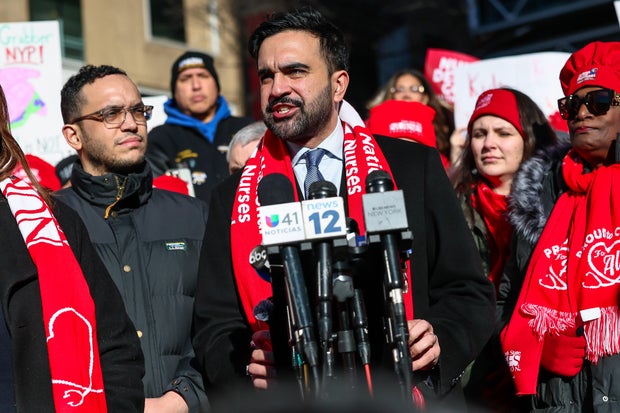
15,000 Nurses From Large Hospitals Go On Strike In New York City
Mayor Zohran Mamdani speaks during a press conference as nurses from New York-Presbyterian/Columbia University Irving Medical Center strike outside the hospital on January 12, 2026. 

Michael M. Santiago / Getty Images

“They must bargain in good faith and they must arrive at a deal that is satisfactory to all, that allows the nurses who work in this city to live in this city,” he said. 

Hochul also said she wants a deal made as soon as possible. 

Why are nurses on strike?

Both sides bargained throughout the weekend, but were unable to reach a deal.

NYSNA has accused Montefiore, Mount Sinai and NewYork-Presbyterian of putting profits over safe patient care. The union said the wealthiest hospital systems in the city are refusing to compromise on issues like pay raises, safe staffing levels, full health care coverage, pensions, and workplace protections against violence.

“Health care workers are being stretched to their limits, and as workplace violence in hospitals is on the rise, nurses are asking simply for the basics,” New York Attorney General Letitia James said at the news conference with Mamdani. 

Cecilia Barreto, a registered nurse picketing outside Mount Sinai West, said striking was a last resort. 

“I have been here two years and I’ve made such great bonds with the nurses here, and I know that there are nurses who have battled cancer and depend on their health care. So we need to make sure that the health care we receive stays intact because their lives depend on it,” Barreto said. 

“Instead of guaranteeing health care for nurses, these wealthy hospitals are pushing to cut health benefits for nurses who put their own health on the line to care for New Yorkers,” Nancy Hagans, president of NYSNA, said on Saturday.

NYC Nursing Strike
Nurses strike outside Mount Sinai West Hospital on Monday, Jan. 12, 2026, in New York.

Yuki Iwamura / AP

An earlier statement from Montefiore called some of the demands “reckless and irresponsible.” All of the hospitals impacted called the strike “reckless” in a joint statement, accusing the nurses of abandoning patients. 

“NYSNA leadership has chosen to abandon patients in their time of need, but Montefiore Medical Center, Mount Sinai, and NewYork-Presbyterian will not. Their decision to walk out on our patients can only be described as reckless,” the hospitals said.

Some hospitals in the area were able to reach a deal with NYSNA, including all of Northwell Health facilities in Nassau County, while others previously pulled back their strike notices

What the strike means for patients

Gov. Hochul last week signed executive orders to ensure the state Department of Health has staff at the impacted hospitals for the duration of the New York City nurses strike, ensuring patient safety and continuity of care.   

Montefiore said that emergency rooms will remain open. 

Hospital officials said no one should delay treatment or put off appointments, but patients should be alert for any direct updates from their health care providers. 

NYSNA also said patients should continue to seek care, with leaders at a news conference Sunday saying going to get care is not crossing a strike line. 

The bottom line for patients is that the hospitals will remain open and care will continue during the strike.

Some family members of patients are concerned as the strike continues on Monday night. 

Nurses can’t pick up prescriptions at Montefiore Hospital

A video shows one nurse being denied access to the Montefiore Weiler Hospital while trying to pick up prescriptions.

The nurse said employees’ health insurance is through Montefiore, and they can only pick up medications from a Montefiore pharmacy. 

“Additionally, many nurses live in the Bronx, and their families get their care from Montefiore. If their family goes to the ER or is admitted, they’re saying we can’t go visit them,” the nurse said in a statement.

The woman in the video tells the security guard she is contracted to receive medications only through this pharmacy.

The guard says they should’ve made arrangements to pick up the medication before, as they knew the strike was happening on Monday. 

A Montefiore spokesperson said nurses who are on strike can request their prescriptions be delivered directly to their homes.

“NYSNA nurses are able to attend any medical appointments scheduled at the medical center during the strike, as well as visit any family members who are inpatients, as long as they can provide proper documentation,” a statement read. 

ICE planea gastar hasta US$ 20 millones en guantes de descarga eléctrica para agentes

Agentes de Inmigración y Control de Aduanas podrían pronto estar equipados con guantes que emiten descargas eléctricas, los cuales, según el fabricante, están diseñados para desescalar encuentros con individuos.ICE planea gastar entre US$ 10 millones y US$ 20 millones para adquirir los dispositivos, conocidos como CTG 5 G.L.O.V.E, que significa Generador de Emisión de Bajo Voltaje de Salida, según un aviso publicado el lunes por el Departamento de Seguridad Nacional.Según el contrato anticipado en el portal del DHS para la previsión de oportunidades contractuales, los dispositivos serían entregados antes del 31 de marzo de 2027. No está claro cuántos planea comprar el DHS, el costo por guante ni cuándo comenzarían a usarlos los agentes.El aviso se produce mientras las agencias encargadas de realizar arrestos migratorios enfrentan un escrutinio por lo que los críticos califican como tácticas agresivas y peligrosas, y en medio de la presión de la administración Trump para realizar alrededor de 2.000 arrestos diarios.El portal del DHS se refirió a los dispositivos como “un Dispositivo de Distracción Conductiva y Desescalada que será entregado a los agentes de Investigaciones de Seguridad Nacional (H.S.I.) y de Operaciones de Ejecución y Remoción (ERO)”.El Departamento de Seguridad Nacional y el fabricante del dispositivo, Compliant Technologies LLC, no respondieron de inmediato a las solicitudes de comentarios de CNN.El Departamento de Seguridad Nacional (DHS, por sus siglas en inglés) dijo a The Associated Press, que fue el primer medio en informar sobre la historia, que estaba trabajando en una respuesta a su consulta pero que no tenía una declaración inmediata. Jeff Niklaus, fundador y CEO de Compliant Technologies, dijo a AP por correo electrónico que la empresa no podía hacer comentarios.Compliant Technologies comercializa el G.L.O.V.E como un “dispositivo portátil de desescalada” que puede cambiarse al modo eléctrico. Según un manual de usuario para los modelos CTG4 y 5 en el sitio web de Compliant Technologies, los guantes pueden suministrar un voltaje máximo de hasta 380V que “inhibe/distrae al sujeto para que no realice movimientos musculares coordinados”.El manual indica que no se deben aplicar más de dos guantes a un sujeto al mismo tiempo y que no deben usarse por más de 15 segundos en muchos casos. Si ocurre un incidente en el que “el agente o el público se vean en peligro”, se sugiere que los guantes se utilicen según sea necesario hasta que se logre el “control y cumplimiento”, o que se utilice un nivel de fuerza superior.El manual de usuario señala que los guantes deben entrar en contacto directo con la piel y no son efectivos a través de la ropa o el cabello.En su sitio web, la empresa dice que los guantes están destinados a “complementar las herramientas existentes para las fuerzas del orden, correccionales, seguridad, servicios médicos de emergencia y las fuerzas armadas”, y los describe como un “’socio invisible’ para mejorar la eficacia del usuario cuando opera dentro de las tácticas, técnicas y procedimientos ya establecidos por sus agencias”.La empresa advierte de que los guantes no deben usarse como “castigo” ni en personas de alto riesgo, incluidas mujeres embarazadas, personas mayores, niños pequeños y personas con discapacidades graves. También advierte en contra de su uso ante “desafío verbal o beligerancia”.Cualquier persona que utilice los guantes debe estar certificada y recertificada cada dos años para poder seguir utilizándolos, según el manual de usuario.El aviso del DHS indicó que la solicitud para un contrato sin licitación podría publicarse tan pronto como este viernes.Dispositivos similares se han utilizado antes en algunas operaciones de las fuerzas del orden y en centros penitenciarios.En 2024, la filial de CNN, KOKH, informó que la cárcel del condado de Oklahoma planeaba comenzar a usar guantes eléctricos producidos por la misma empresa, los cuales podrían aplicar descargas a los reclusos a una tasa de al menos 210 voltios.Justin Morris, distribuidor de Compliant Technologies en Oklahoma, dijo en ese momento que la forma en que se utiliza la tecnología no es capaz de causar lesiones.“Solo estamos activando suficientes unidades motoras a través de la piel para estimular el sistema nervioso periférico. Solo la parte sensorial de eso. Así que no causamos ninguna lesión con nuestro dispositivo”, dijo Morris, según KOKH, y agregó: “Usualmente obtenemos cumplimiento en tres segundos”.John Peters, presidente del Instituto para la Prevención de Muertes bajo Custodia, quien está estudiando cómo se ha utilizado el dispositivo, dijo a AP que la sensación es “inmediata y aguda, y te distrae. Yo lo describo como una picadura de abeja”.“Si el agente recibe algún tipo de resistencia por parte de la persona, ciertamente es una herramienta eficaz”, dijo Peters. “Para agentes más pequeños, más débiles o de mayor edad, creo que tiene una gran ventaja” porque puede producir reducciones más rápidas y acortar los enfrentamientos, añadió.El entonces CEO de la cárcel del condado de Oklahoma dijo a KOKH en 2024 que el dispositivo es ideal para su personal, mayoritariamente femenino.Sin embargo, según el periódico The State de Carolina del Sur, citando a la División de Cumplimiento de la Ley de Carolina del Sur, los dispositivos también se han utilizado en incidentes previos que resultaron en cargos penales.En 2022, dos funcionarios penitenciarios del Centro de Detención del Condado de Laurens fueron acusados de golpear y aplicar descargas eléctricas a un recluso con “un dispositivo paralizante portátil G.L.O.V.E.” en dos incidentes separados, según SLED, informó el periódico.Kica Matos, presidenta del Centro Nacional de Leyes de Inmigración, criticó duramente la propuesta de equipar a los agentes de ICE con los guantes.“Esta es una agencia fuera de control con un fondo discrecional de US$ 80.000 millones que les permite inventar y financiar nuevas formas de infligir crueldad a nuestras comunidades”, dijo a CNN, describiendo el posible equipamiento de los agentes con los guantes como “repugnante y bárbaro”.Defensores de los derechos civiles, incluidos miembros de la Unión Estadounidense de Libertades Civiles (ACLU, por sus siglas en inglés), también expresaron alarma ante el plan.Jenn Rolnick Borchetta, subdirectora de proyectos sobre vigilancia policial en la ACLU, dijo a AP que el público no debería tener confianza en que los agentes de ICE usarán los dispositivos de manera adecuada y cuestionó por qué serían necesarios estos dispositivos para la aplicación de la ley migratoria civil.“ICE pasó el último año demostrando a este país que son demasiado rápidos para usar la fuerza. Ahora podrán aplicar descargas eléctricas con solo presionar un botón que tal vez nadie más pueda ver que están usando”, dijo. “Introducir guantes que pueden usarse tan fácilmente para infligir un dolor terrible en los encuentros es una receta para causar daño al público”.The-CNN-Wire™ & © 2026 Cable News Network, Inc., a Warner Bros. Discovery Company. All rights reserved.
Read Next Story