
Nurses strike begins in New York City as thousands walk off jobs

▶ Watch Video: Largest nurses strike in New York City history is underway

The largest nurses strike in New York City history is underway after negotiators for five major hospitals and the state nurses union failed to agree to a new contract by Monday’s deadline. 

The New York State Nurses Association said nearly 15,000 nurses are now walking off their jobs at five privately-run hospitals, including Mount Sinai Hospital, Mount Sinai Morningside, Mount Sinai West and NewYork-Presbyterian in Manhattan, and Montefiore Einstein in the Bronx. 

NYSNA said nurses at Mount Sinai started the strike at 6 a.m., while nurses at the remaining hospitals started picketing an hour later.

Gov. Kathy Hochul declared a state of emergency in anticipation of the strike amid worries it could jeopardize critical care for thousands of patients in the city.  
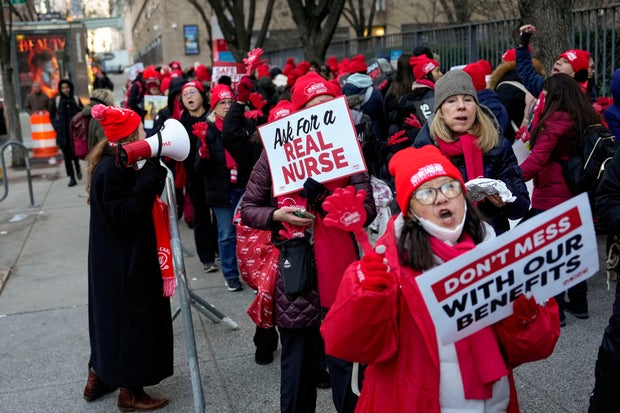
NYC Nursing Strike
Nurses strike outside Mount Sinai West Hospital on Monday, Jan. 12, 2026, in New York.

Yuki Iwamura / AP

Montefiore said it was preparing for the strike to last multiple weeks. 

“NYSNA’s leaders continue to double down on their $3.6 billion in reckless demands, including nearly 40% wage increases, and their troubling proposals like demanding that a nurse not be terminated if found to be compromised by drugs or alcohol while on the job. We remain resolute in our commitment to providing safe and seamless care, regardless of how long the strike may last,” Montefiore Senior Vice President Joe Solmonese said.

A Mount Sinai spokesperson said, “Unfortunately, NYSNA decided to move forward with its strike while refusing to move on from its extreme economic demands, which we cannot agree to, but we are ready with 1,400 qualified and specialized nurses — and prepared to continue to provide safe patient care for as long as this strike lasts.”

Some nurses, however, did report to work despite the strike. Mount Sinai said 20% showed up on Monday.

A statement from NewYork-Presbyterian said, “While NYSNA has told nurses to walk away from the bedside, we remain focused on our patients and their care. This strike is designed to create disruption, but we have taken the necessary steps so our patients continue to receive the care they trust us to provide … We’re ready to keep negotiating a fair and reasonable contract that reflects our respect for our nurses and the critical role they play, and also recognizes the challenging realities of today’s healthcare environment…We have proposed significant wage increases that keep our nurses among the highest paid in the city, enhancements to their outstanding employer-funded benefits and new measures that reflect our shared commitment to safe staffing and workplace safety. However, good faith bargaining requires compromise from both sides.”

Mamdani joins picket line

New York City Mayor Zohran Mamdani joined picketers outside NewYork-Presbyterian in Washington Heights. 

“In every one of our city’s darkest periods, nurses showed up to work. Their value is not negotiable and there worth is not up for debate,” Mamdani said. “They show up and all they are asking for in return is dignity, respect and the fair pay and treatment that they deserve. They should settle for nothing less.” 

Mamdani released a similar statement the night before the strike on X.

“This city can and must ensure the continuity of care. FDNY, Emergency Management, the public health system and all of my senior leadership are working tirelessly to ensure nurses’ demands for dignity can be heard and care is still received,” the mayor said. 

Mamdani urged both sides to meet at the bargaining table.
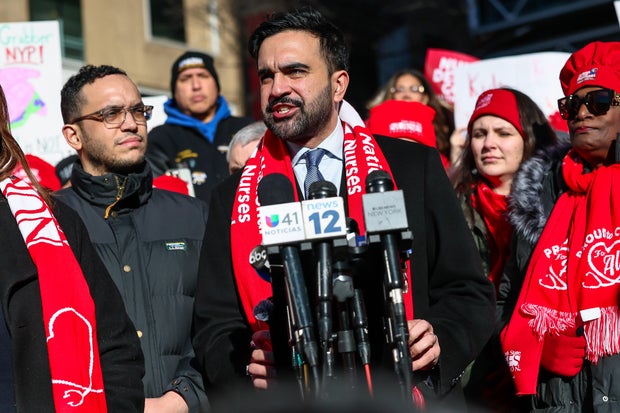
15,000 Nurses From Large Hospitals Go On Strike In New York City
Mayor Zohran Mamdani speaks during a press conference as nurses from New York-Presbyterian/Columbia University Irving Medical Center strike outside the hospital on January 12, 2026. 

Michael M. Santiago / Getty Images

“They must bargain in good faith and they must arrive at a deal that is satisfactory to all, that allows the nurses who work in this city to live in this city,” he said. 

Hochul also said she wants a deal made as soon as possible. 

Why are nurses on strike?

Both sides bargained throughout the weekend, but were unable to reach a deal.

NYSNA has accused Montefiore, Mount Sinai and NewYork-Presbyterian of putting profits over safe patient care. The union said the wealthiest hospital systems in the city are refusing to compromise on issues like pay raises, safe staffing levels, full health care coverage, pensions, and workplace protections against violence.

“Health care workers are being stretched to their limits, and as workplace violence in hospitals is on the rise, nurses are asking simply for the basics,” New York Attorney General Letitia James said at the news conference with Mamdani. 

Cecilia Barreto, a registered nurse picketing outside Mount Sinai West, said striking was a last resort. 

“I have been here two years and I’ve made such great bonds with the nurses here, and I know that there are nurses who have battled cancer and depend on their health care. So we need to make sure that the health care we receive stays intact because their lives depend on it,” Barreto said. 

“Instead of guaranteeing health care for nurses, these wealthy hospitals are pushing to cut health benefits for nurses who put their own health on the line to care for New Yorkers,” Nancy Hagans, president of NYSNA, said on Saturday.

NYC Nursing Strike
Nurses strike outside Mount Sinai West Hospital on Monday, Jan. 12, 2026, in New York.

Yuki Iwamura / AP

An earlier statement from Montefiore called some of the demands “reckless and irresponsible.” All of the hospitals impacted called the strike “reckless” in a joint statement, accusing the nurses of abandoning patients. 

“NYSNA leadership has chosen to abandon patients in their time of need, but Montefiore Medical Center, Mount Sinai, and NewYork-Presbyterian will not. Their decision to walk out on our patients can only be described as reckless,” the hospitals said.

Some hospitals in the area were able to reach a deal with NYSNA, including all of Northwell Health facilities in Nassau County, while others previously pulled back their strike notices

What the strike means for patients

Gov. Hochul last week signed executive orders to ensure the state Department of Health has staff at the impacted hospitals for the duration of the New York City nurses strike, ensuring patient safety and continuity of care.   

Montefiore said that emergency rooms will remain open. 

Hospital officials said no one should delay treatment or put off appointments, but patients should be alert for any direct updates from their health care providers. 

NYSNA also said patients should continue to seek care, with leaders at a news conference Sunday saying going to get care is not crossing a strike line. 

The bottom line for patients is that the hospitals will remain open and care will continue during the strike.

Some family members of patients are concerned as the strike continues on Monday night. 

Nurses can’t pick up prescriptions at Montefiore Hospital

A video shows one nurse being denied access to the Montefiore Weiler Hospital while trying to pick up prescriptions.

The nurse said employees’ health insurance is through Montefiore, and they can only pick up medications from a Montefiore pharmacy. 

“Additionally, many nurses live in the Bronx, and their families get their care from Montefiore. If their family goes to the ER or is admitted, they’re saying we can’t go visit them,” the nurse said in a statement.

The woman in the video tells the security guard she is contracted to receive medications only through this pharmacy.

The guard says they should’ve made arrangements to pick up the medication before, as they knew the strike was happening on Monday. 

A Montefiore spokesperson said nurses who are on strike can request their prescriptions be delivered directly to their homes.

“NYSNA nurses are able to attend any medical appointments scheduled at the medical center during the strike, as well as visit any family members who are inpatients, as long as they can provide proper documentation,” a statement read. 

Europe’s economy faces a one-two punch from extreme weather and war

London (CNN) — Nuclear power plants idled. Crops harvested at 3 a.m. Iconic tourist attractions shuttered early.Soaring temperatures are forcing drastic measures in Europe, where successive heatwaves are straining an economy already under pressure from US tariffs, Chinese competition and higher energy prices because of the Iran war.Romania’s state-owned nuclear power producer Nuclearelectrica started disconnecting its sole operational reactor from the power grid Thursday because of record-low water levels in the Danube, crucial for cooling its equipment, the company confirmed to CNN. The country has declared a state of energy emergency throughout August and asked businesses and households to voluntarily reduce consumption, Reuters reported.Elsewhere, France and Hungary have had to curtail nuclear power due to low river levels and high temperatures. Drought conditions are also fueling devastating, costly wildfires and reducing crop yields, threatening to push up food prices.Europe’s sweltering summer could cost the economy €180 billion ($208 billion) this year, or 1% of GDP – roughly the entire expected economic growth of the European Union, according to an estimate by Netherlands-based Triodos Bank. “Lower labor productivity is likely to have the largest economic impact, alongside disruptions to agriculture, energy and transport,” the bank said in a report this month.Swaths of Europe are enduring their fifth heatwave of the year this week, with parts of Britain, France, Spain and Italy under extreme heat warnings. The latest scorcher comes after Western Europe recorded its hottest June and July on record, according to Copernicus, the European Union’s climate monitor. In Paris, extreme heat prompted the Eiffel Tower and the Louvre to close early on some days.While some analysts doubt the heat will have a sizeable impact on economic growth this year, pointing to improved business confidence in July and increased GDP in the first half, hot weather is not the only economic threat.Europeans also face the prospect of hikes to their energy bills this winter, as natural gas prices climb. The price of benchmark natural gas futures traded near their highest levels since the start of the Iran war this week, and almost twice as high as the same time last year.The war in the Middle East has made cargoes more scarce and, in turn, more expensive, raising the prospects of another energy crunch. Blistering heat has also raised demand for air conditioning, driving up natural gas consumption at a time when stores need to be refilled ahead of winter.“The EU natural gas market is vulnerable looking ahead to peak winter demand,” Kieran Tompkins, senior climate and commodities economist at Capital Economics wrote in a note earlier this month. “Storage levels are the lowest for this point in the year for over a decade.”Dry rivers, overnight farmingThe Danube is not the only critical European waterway drying out as a result of a prolonged drought.In Germany, Europe’s biggest economy, record-low water levels in the Rhine – an important transport route for industrial goods such as steel and chemicals – could shave 0.3 percentage points off the country’s GDP growth this year, according to economists at pan-European bank ING. That would be a heavy blow for an economy growing at less than 1% a year.BASF, the German chemicals giant, said it may be unable to fulfil orders of some chemical compounds because the Rhine’s low water levels have restricted the supply of certain key raw materials.“We are… shifting volumes to alternative modes of transport such as trucks and rail,” the company told CNN, noting that it was also using a greater number of vessels specifically designed to navigate shallow waters. A number of German states have temporarily suspended Sunday driving bans for trucks in an emergency effort to mitigate supply chain disruption.The European Commission said earlier this year that EU member states should be investing about €70 billion ($81 billion) per year to 2050 in climate adaptation — spending that could boost economies but will also pile pressure on strained government budgets.Some companies have already started adapting in innovative ways. In England, a notoriously rainy part of the world, family-owned Rookery Farm is harvesting its crop at 3 a.m. to ensure it has sufficient moisture content.“Harvest is no longer just about dodging the rain – we’re now adapting to crops that can become too dry, meaning more night-time harvesting to meet the quality standards our customers require,” farmer Eleanor Gilbert said in a video posted to Instagram.High energy prices aheadAs Europe grapples with successive heatwaves, it also faces the prospects of a winter energy crunch. Gas storage levels across the EU were 59% full on Tuesday, according to data from Gas Infrastructure Europe — well below the average for this time of year and on par with levels seen during summer 2021, when Russia had begun restricting exports to the continent.“I’m really concerned,” Anne-Sophie Corbeau, a researcher at Columbia University’s Center on Global Energy Policy, said of the EU’s ability to replenish diminished stocks.“There have been very few cargoes… exiting the Strait of Hormuz. All of them are going to Asia,” she told CNN.Summer is primetime in Europe for stocking up on gas before the colder winter months, when prices are often considerably higher. Yet the Strait of Hormuz is still effectively shut, choking off one fifth of the world’s supply of liquefied natural gas — a liquid form of the fuel carried by tankers.Remaining cargoes, such as those from the United States, are also more likely to head for Asia than Europe, say analysts, because demand there is particularly strong and buyers are stumping up more.But this is “not a ’22 crisis,” said Christoph Halser, senior analyst of gas and LNG research at Rystad Energy, referring to that year’s historic price spikes in Europe following Russia’s full-scale invasion of Ukraine.Since then, the continent has greatly reduced its imports of Moscow’s gas — the bulk of which arrived via pipelines — as well as reduced its overall consumption.“Gas demand in Europe today is roughly 20% lower than, let’s say, in 2021,” Halser told CNN.Massimo Di Odoardo, vice president of gas and LNG research at Wood Mackenzie, is also confident that Europe will avoid a dire scenario of energy shortages and blackouts.The risk of shortages are “overstated” he said, adding that the region has the means to “buy itself out” of any such predicament.Still, prices are unnervingly elevated.The price of Europe’s benchmark natural gas contract settled at €61 ($70) per megawatt hour on Wednesday, well above the €32 ($37) logged on the same day in 2025, according to Intercontinental Exchange data.During the winter, “Europe should be really worried about a situation where the Strait of Hormuz doesn’t open because this could certainly result in prices being extremely high,” Di Odoardo said.The-CNN-Wire™ & © 2026 Cable News Network, Inc., a Warner Bros. Discovery Company. All rights reserved.
Read Next Story