Washington — The Navy quietly disciplined 18 Navy SEALs earlier this year after military investigators found a private group chat that contained racist memes targeting a Black SEAL who was also in the chat, according to documents and a Naval Special Warfare spokesperson.
Using the Freedom of Information Act, CBS News obtained the Navy’s investigation into members of SEAL Team Four, along with years of the unit’s internal surveys, which give naval officers insight into the culture, morale and effectiveness. The investigation and other records show racial harassment towards one of the team’s own members inside a force that prides itself on unit cohesion and honor—prompting action from the top commander.
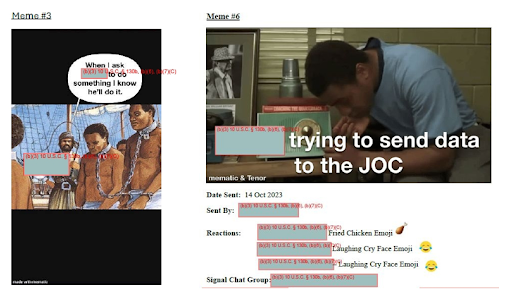
One racist meme sent to the SEAL in 2022 was described in the investigation as “Slave in Chains.” Another meme sent in 2022 was titled “Monkey Face” and depicted the SEAL in uniform with his face distorted to look like a monkey. A meme sent in 2023 compared him to the movie character Radio, a mentally disabled man played by Cuba Gooding Jr.
U.S. Navy / released via Freedom of Information Act request
The full results of the Navy’s investigation and the internal surveys have not been reported on until now. The After-Action Report, a national security blog on Substack, first reported on the memes, earlier this year.
The punishments ranged from reduction in rank and forfeiture of pay to administrative measures, like formal letters of instruction and counseling, according to the Navy spokesperson.
CBS News has learned that Rear Adm. Milton Sands, then the head of Naval Special Warfare Command, acted swiftly once the allegations surfaced in March. Sands has since been removed from his position by Defense Secretary Pete Hegseth. The reason for his removal is unknown.
Attorney William Brown of the Parlatore Law Group and a former Navy SEAL himself told CBS News in a phone interview that what happened at SEAL Team Four violates “everything the Teams stand for,” and he praised Rear Adm. Sands and other naval special warfare leaders for taking “unprecedented action” in this case.
“This was not a SEAL Team Four issue; it was a platoon-level leadership failure, but Sands took action and the system worked,” said Brown, who represented the SEAL pro bono.
Brown said Sands and other senior leaders inside the command moved to support the Black SEAL and to send a message to the wider naval special operations community that racist conduct would carry severe consequences. Brown lauded Sands for his leadership in the case, despite the fact that he has had public disagreements with the two-star admiral on other issues.
Sands has not responded to a request for comment.
The Navy launched an investigation into the memes and messages, originally shared in a private Signal group chat between 2021 and 2024, when they were raised in complaints filed by the Black SEAL in March.
The SEAL wrote in the harassment complaint that before joining his platoon, he had not experienced any racial discrimination and had “great mentors” while undergoing the notoriously grueling training to become a qualified SEAL, which takes Naval candidates roughly two years to complete.
But after he joined, “the racism I experienced…was persistent, targeted and deeply dehumanizing,” wrote the SEAL. “It wasn’t just an attack on me personally — it reflected a breakdown in the very discipline and integrity the Teams are supposed to uphold.”
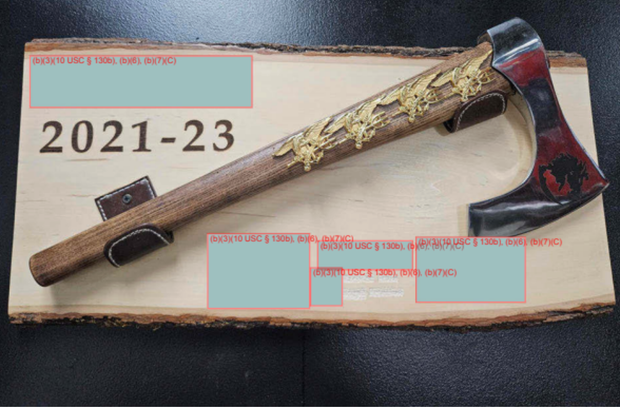
In the complaint, the Black Navy SEAL said his name was scratched off two plaques where it once appeared alongside others serving on SEAL Team Four. On one of the plaques, the names are etched into a piece of wood under a hatchet adorned with Navy SEAL Tridents, the physical pin that signifies a SEAL.
The SEAL described the removal of his name as “A final, disgraceful act to make it clear that I was not welcome,” and that it was “a direct and unmistakable act of hatred.”
U.S. Navy
Overall, the SEAL wrote of others’ behavior, “these were men who were supposed to be my brothers, but instead, they either participated in or enabled a culture of bigotry and silence.”
SEAL Team Four is based out of Naval Amphibious Base Little Creek in Virginia and falls under Naval Special Warfare Group Two, which oversees Team Four and three other SEAL Teams.
Each SEAL Team can have roughly 250 service members, including Navy SEALs and combat support personnel, according to the command climate surveys obtained by CBS News and former Navy SEALs.
The Black Navy SEAL, who declined to be interviewed, was in Delta platoon, a unit of roughly 16 to 20 SEALs. Prior to becoming a SEAL, he had earned a degree in global studies and was a trained pilot, according to the documents.
He filed the harassment complaints after his Trident, the physical pin that signifies a SEAL, was revoked after review boards found his performance was lacking. But records obtained by CBS News show he was a qualified sniper and a certified joint terminal attack controller or JTAC for short. JTACs fill a high-stress role – it requires extreme precision, since the controllers coordinate aircraft delivering bombs and missiles, sometimes near their position on the ground. A mistake can be deadly.
Brown, in refuting the SEAL’s substandard performance review, pointed out that SEAL leaders typically send their smartest service members to sniper and JTAC school.
After an investigation, the SEAL’s Trident was restored. Brown believes he’s the first Navy SEAL in history whose Trident was restored after it was revoked. The board that carried out the SEAL’s review will undergo reforms, Brown told CBS News.
Moreover, Brown said Rear Adm. Sands also called the SEAL to thank him for his service and extended his Navy tenure to enable him to get military medical treatment and moved him to a command that is closer to his family. The SEAL has since left the Navy.
A Naval Special Warfare spokesperson said the Navy had “completed accountability” regarding the SEAL’s case.
“Individuals accepted responsibility for their actions, reinforcing NSW’s commitment to accountability, transparency, and upholding the standard of the quiet professional,” the spokesperson said.
The SEAL’s superiors did not enable the chat content, according to the spokesperson, but they were counseled in front of their peers because the incident had occurred under their command. Brown, the SEAL’s attorney, said those counseled included the commanding officer, executive officer and command master chief of SEAL Team Four.
Brown told CBS News that he had previously served with the commanding officer of SEAL Team Four.
“He is not a racist man but he made a misjudgment in this case,” Brown told CBS News. “They will never command forces in NSW again.”
The leadership also held all-hands calls at various levels to address the misconduct within the group chat directly with the force, according to the spokesperson.
Some of the misconduct in the chat stemmed from “meme drop(s)” the members had periodically on Fridays “to make fun of things that happened each week,” according to one individual whom investigators found had contributed to a hostile environment because he did not stop the messages. Four of the six memes investigated were sent on a Friday, according to the investigation.
The investigated messages included one that read, “I dropped a hard R in front of a black student 3 weeks ago.” The author had a “pattern of behavior” using the word “n*****,” investigators found.
In the course of their review, military investigators also discovered some team members had referred to a fellow service member as “dragon lady” and mocked her Asian accent.
When asked by CBS News if there is any mandated racial sensitivity training, the spokesperson said there was not, adding that the command is committed to accountability. The investigations helped “identify shortcomings and implement corrective measures.”
CBS News obtained Defense Organizational Climate Surveys for SEAL Team Four through the Freedom of Information Act for the years 2018, 2022, 2023 and 2024. These surveys provide commanders with both statistical details and comments from their service members on a wide array of issues within their units.
Troops are not required to fill them out, and the responses are anonymous. But all Defense Department units are required to take them annually or whenever a new officer takes over a command of more than 50 people.
SEAL teams generally have limited numbers of troops representing racial and ethnic minorities. Nonetheless, the records obtained by CBS News show that service members have persistently reported racially harassing behavior. In 2024 for instance, 5 out of the 105 members of SEAL Team Four who took the survey reported it.
The figures were higher in 2022 when 18 out of the 105 members of SEAL Team Four reported experiencing racially harassing behaviors. The Team took two surveys in 2023 showing fluctuating but similar results.
Between 2022 and 2024, SEAL Team Four commanders writing to their direct superior underscored that they believe “diversity is key to organizational growth,” and that they “highly encourage inclusion of all personnel, regardless of ethnicity, background, rate, or otherwise.”
In a Nov. 2023 letter, Cmdr. Bryan Jennings, the commander of Navy SEAL TEAM Four at the time, wrote: “Racial and sexual harassing behaviors were 6%-7% negative, which is an overall low number, but any percentage in these categories is a weakness that should be addressed.”
Read the investigation into SEAL Team Four here and the Command Climate Surveys for SEAL Team Four here.