
▶ Watch Video: 2024 Eclipse: What to expect, from the awe-inspiring to the “very strange”
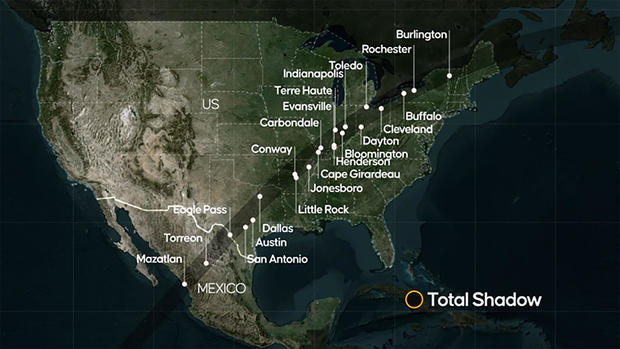
Monday’s total eclipse of the sun won’t be just any old eclipse; it’s being referred to as the Great American Eclipse, because it’s going through some very populated areas of the United States. Solar eclipses actually occur every 18 months or so, but during most of them the spectacle is “wasted” on empty ocean. But this time, the moon’s shadow will leave 32 million Americans in 15 states briefly in the dark.
Where is the best place to view the eclipse?
NASA/Getty Images
What exactly is a total eclipse?
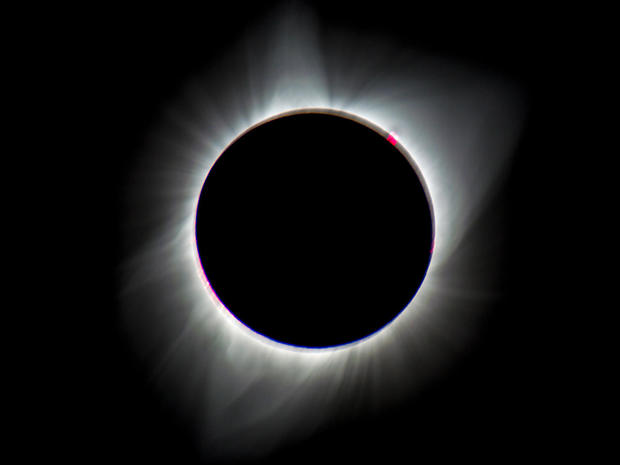
Astronomy author and educator Ed Ting says that in a solar eclipse, the moon passes exactly between your eyes and the sun, and casts its shadow on the Earth. That shadow is only about 100 miles wide, so you have to be in a specific place to witness the solar eclipse in totality.
It’s all the result of a freakish cosmic coincidence, when the moon and sun appear to be the exact same size in the sky. “The sun is 400 times bigger than the moon,” said Ting. “But by happy coincidence, it is also 400 times further away. So, from our perspective they are the same size.”
VW Pics/Universal Images Group via Getty Images
What can happen during a total solar eclipse?
But the thrill of an eclipse isn’t just about what’s overhead – it’s what happens all around you as the sky darkens. “The wind sometimes starts to pick up,” said Ting. “Animals get confused. The streetlights come on.”
But it’s not exactly like nighttime. “The sky takes on this sort of fish-scaly, shimmery quality, and you will freak out,” Ting said. “You can understand why the ancients ascribe such spiritual or religious significance to eclipses, because you will feel very strange. Half of the people who see an eclipse for the first time will cry.”
What preparations are being made?
If you live in the path of the eclipse, you may notice one more effect: A lot more traffic.
Cari White is the chairman of the Eclipse Oversight Committee for Jonesboro, Arkansas, where the moment of totality – complete blockage of the sun – will last 2 minutes and 17 seconds. And for that experience of totally, White said the town will briefly grow to twice its size: “One-hundred-sixty-thousand people might be in town for the eclipse, and we’re very excited about it,” she said. “Our police department, our fire department, city water and light, they’ve all been working for over a year to design a plan.”
And Jonesboro is not alone: “Everywhere, all over the country, [people] are doing exactly what I’ve been doing. It’s a big, big deal.”
- How Americans in the solar eclipse’s path of totality plan to celebrate the celestial event on April 8
- Here’s how one airline is planning to provide a total eclipse experience — from 30,000 feet in the air (“CBS Mornings”)
- Hotel prices soar as tourists flock to see solar eclipse
How to safely view the eclipse
Looking directly at the sun can permanently damage your vision, which is why you need eye protection. Cari White’s committee in Jonesboro ordered 75,000 pairs of special glasses. “We have been working for weeks to pass them out to all the schools, we’ve passed them out at all of the major businesses, the library, the city hall,” she said. “If you don’t have a pair of glasses and you live in Jonesboro, I don’t know how to help ya’.”
But here’s something about the glasses you might not know: According to Ting, “Once totality hits, you can take the glasses off. Because there’s not much light coming from the sun. Once the sun starts to come out again, you do need to remember to put your glasses back on!”
Cameras need protective filters, too. But Ting offers a classic piece of advice for would-be photographers: “See your first eclipse, photograph your second. I have seen this personally where there is an eclipse, and the person is not looking up; they’re fiddling with their camera. And then, before you know it, the eclipse is gone, you never saw it – and you didn’t get the picture.”
What about the weather?
Of course, all the precautions in the world won’t help you if the conditions aren’t right. Asked what she’ll do if the weather is bad on Monday, White said, “I guess I’ll cry. Don’t talk to me about the bad stuff.”
Fortunately, it’s mostly good stuff.
“When you consider that this truly is the Great American Eclipse, because it goes through the center of the United States, it just puts you in awe,” White said. “I just know that it’s gonna be wonderful. And I’m gonna take it all in, every second of my two minutes, I’m gonna take it in and enjoy.”
- Looking for the best places to see the April 8 solar eclipse in the totality path? You may have to dodge clouds
- Eclipse cloud cover forecasts and maps show where skies will clear up for April 8’s celestial show
For more info:
Story produced by Annie Iezzi. Editor: George Pozderec.