
Sullenberger: Boeing crashes ‘should never have happened’

▶ Watch Video: Captain “Sully” Sullenberger blasts Boeing and FAA in op-ed

Captain Chesley B. “Sully” Sullenberger III testified Wednesday before the House Subcommittee on Aviation. The hero pilot answered questions about the Boeing 737 Max 8, the type of aircraft involved in the deadly crashes of Lion Air Flight 610 last October and Ethiopian Airlines Flight 302 in March. 

“These crashes are demonstrable evidence that our current system of aircraft design and certification has failed us. These accidents should never have happened,” Sullenberger said in his prepared remarks, adding that he has 52 years of flying experience. “I know that we must consider all the human factors of these accidents, and how system design determines how many, and what kinds of, errors will be made and how consequential they will be.” 

“These two recent crashes happened in foreign countries, but if we do not address all of the important issues and factors they can and will happen here,” Sullenberger said.  
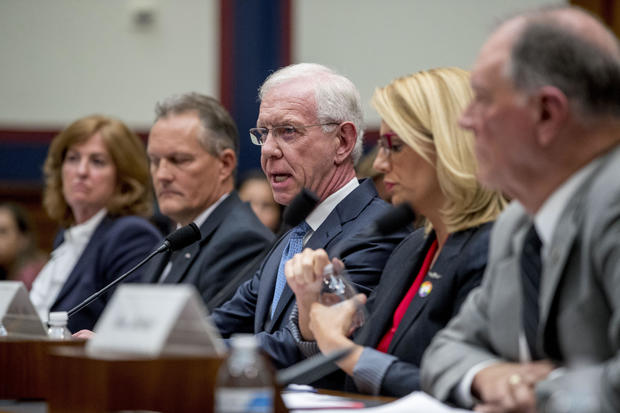
Congress Boeing Plane
Captain Chesley “Sully” Sullenberger speaks during a House Committee on Transportation and Infrastructure hearing on the status of the Boeing 737 MAX on Capitol Hill, June 19, 2019.

Andrew Harnik / AP

Sullenberger rose to worldwide fame on January 15, 2009, when he piloted U.S. Airways Flight 1549 to land safely in the Hudson River after it blew both engines in a bird strike after takeoff from New York’s LaGuardia Airport. All 155 people on board survived because of Sullenberger’s quick thinking and professional actions. It has been dubbed “The Miracle on the Hudson.” 

“I’m one of the relatively small group of people who have experienced such a sudden crisis — and lived to share what we learned about it,” he told House members on Wednesday. “I can tell you firsthand that the startle factor is real and it is huge — it interferes with one’s ability to quickly analyze the crisis and take effective action. Within seconds, these crews would have been fighting for their lives in the fight of their lives.” 

Sullenberger detailed how the failure of a single “angle of attack” sensor on the Boeing 737 Max 8 flights quickly caused “multiple instrument indication anomalies” and “false warnings,” as an automated flight-control system called MCAS overrode pilots’ commands.

He said his own experience in recent 737 Max simulator trainings demonstrated to him the unprecedented difficulties the Lion Air and Ethiopian Airline pilot crews encountered when trying to handle the malfunction.

“Prior to these accidents, I think it is unlikely that any U.S. pilots were confronted with this scenario in simulator training,” Sullenberger said. CBS News correspondent Kris Van Cleave reported last year that U.S. airline pilots were initially given just 56 minutes of training on an iPad about the differences between the new Boeing Max planes and the older 737s.

Others at the hearing agreed with Sullenberger and disputed the FAA’s previous insistence that pilots had been sufficiently trained how to use the MCAS system, as well as Boeing’s insinuation that international pilots did not “completely follow” instructions of how to prevent an MCAS malfunction. 

“Again, the failure was Boeing did not disclose the existence of MCAS to the pilot community around the word,” said Captain Daniel F. Carey, president of the Allied Pilots Association, who testified alongside Sullenberger.  “Therefore robust training was not conducted.” 

Boeing issued a statement in response to the hearing, saying:

“Safety is a shared priority and we are working closely with our industry partners to learn from these tragedies, answer their questions, and take steps to re-earn people’s trust and ensure accidents like these never happen again. Boeing continues to work with global regulators and our airline customers as they determine training requirements.”

In May, CBS News obtained audio from the American Airlines pilots’ union confronting Boeing about new features to the 737 Max that factored into the two deadly crashes

“They didn’t ever tell us the system existed,” Carey said Wednesday, referring to Boeing and MCAS. 

During the hearing, Sullenberger urged Congress to provide the Federal Aviation Administration (FAA) with sufficient funding to conduct necessary oversight. He also testified that the FAA must remain independent from political and economic influence, and asked for protection for whistleblowers.  

“We get what we measure. We get what we reward. And right now, in the important ways, the incentives are not aligned toward consistent public good sufficiently in all our organizations,” Sullenberger said of the aviation industry. 

Doctor convicted of attempted manslaughter of his wife wants a new trial, saying jurors may have been confused

(CNN) — Along the steep Pali Puka trail last spring, the verdant beauty of Oahu spilled out to the Pacific Ocean from the scenic path where Gerhardt and Arielle Konig stood. On that high ridge, they fought for their lives – emotionally, then physically – each later would testify.A trip intended to celebrate Arielle’s birthday – and maybe salvage their troubled marriage – ended with the couple, who share two young children, on the ground attacking each other. He bashed her in the face with a rock. She bit him and squeezed his testicles.Who started the melee became the question at the heart of an attempted second-degree murder charge filed against Gerhardt Konig.Prosecutors said the defendant wanted to kill his spouse and tried to push her off the cliff. But after an emotional, 10-day trial a year later that saw husband, wife and one of Gerhardt Konig’s children from a prior marriage on the stand, the jury found him guilty of the lesser charge of attempted manslaughter.At Konig’s request, a judge on Friday heard arguments on whether a new jury should hear the case because of what two jurors in news interviews revealed soon after issuing the verdict that could send Konig to prison for up to 20 years, along with concern one juror may have communicated about the case outside the jury room during deliberations.“Jury irregularities call into serious question the integrity of this verdict,” defense attorney Thomas Otake wrote in an appeal filed in May.At Friday’s hearing, Judge Paul Wong said the court would question jurors about any outside communications during deliberations before deciding whether to grant a new trial. The court will revisit the matter on September 11.“The court must ascertain the extent of the influence,” Wong said.Whether defendant intended to kill is at issueFinding insufficient evidence to convict Konig of attempted murder, the jury found him guilty of attempted manslaughter, with his actions – even if extremely dangerous – motivated by “extreme mental or emotional disturbance.”Ruling out an attempted murder charge was a relief to Konig’s legal team and left open the possibility Konig could be sentenced to probation, with no jail time at all.“We are thankful that they did not convict him of attempted murder, which would have been life in prison,” Otake told reporters shortly after the verdict was announced.Still, the defense attorney immediately promised an appeal based on unspecified concerns about the judge’s rulings during the trial. When his motion dropped a month later, however, it wasn’t the judge Otake took issue with:The request for a new trial was based on what jurors said after the verdict.“Somebody was definitely hurt; it was a bodily injury to the head that could result in serious bodily injury,” foreperson Makalapua Atkins told CNN affiliate East Idaho News about jurors’ state of mind in deliberations.“The intent to kill is improbable to us based on the evidence presented,” Atkins said in an interview after the verdict with True Crime AZ, adding, “The only people who know what happened on that cliff are the two that were involved.”But under Hawaii law, Konig’s defense team has argued, even a conviction for attempted manslaughter would require the jury to find the defendant was trying to kill the victim – and the foreperson said they didn’t.“The jury did not unanimously believe that Dr. Konig had an intent to kill his wife,” Atkins confirmed in a sworn statement to the defense attorney accompanying his appeal. Prosecutors also asked Atkins to sit down with them for an interview, but she declined, their response to the request for appeal states. CNN could not reach Atkins for comment.Another juror, identified publicly only as Juror #3, also said he had not been convinced Gerhardt Konig intended to take Arielle’s life that day.“I don’t know if he was trying to kill his wife, personally,” he told Honolulu TV station KHON in an on-camera interview. “I do know that it was the capacity to kill his wife, personally. That how I felt about it.”If jurors didn’t understand what was required for conviction, Konig’s attorneys argued, it opens the door to a new trial.“Conduct that could result in death or has the capacity to kill may be reckless, but it is not necessarily intentional, and Hawaiʻi does not recognize attempted reckless manslaughter,” Konig’s defense attorneys said, with the emphasis, in a court filing.Did the jury understand the law?“The jurors’ public remarks raise a serious concern that the verdict may rest upon findings inconsistent with the convicted offense,” Konig’s defense attorneys said in a motion for a new trial.The judge’s instructions – 33 in all – were a lot to digest. They laid out a menu of five possible charges – from second-degree attempted murder to third-degree assault – explaining the order in which they had to be considered and steps to evaluating each.“If and only if you unanimously find that all the elements of Attempted Murder in the Second Degree have been proven by the prosecution beyond a reasonable doubt, and you unanimously find that the defendant was not acting in Self-Defense, then you must consider the affirmative defense of Extreme Mental or Emotional Disturbance,” one instruction states.In their response to Konig’s request for a new trial, prosecutors did not try to rebut the claim jurors were confused, instead saying it doesn’t matter. The “internal thought process” of the jury, even when revealed voluntarily by jurors, should not be reconsidered by the court after a verdict, prosecutor Joel Garner stated.“Jurors can change their mind, but what matters is whether the verdict was unanimous at the time it was rendered,” the prosecution wrote. “In this case it was, even according to the on-the-record statements of the foreperson – and therefore a later declaration disagreeing with the verdicts is not a sufficient basis to grant a motion for a new trial.”Juror may have revealed their discussions during deliberationKonig’s defense also raises another concern about the jury: that one member may have been communicating about the case to an outsider while deliberations were still underway.“I’ve been texting with one of the juror’s (sic) and they’re going for count 3 attempted manslaughter,” says a message posted to the live chat of trial coverage by the Law&Crime Network.The comment was first spotted by someone – whose name is redacted in the court filing – and emailed to prosecutors, who alerted the judge.“What caught my attention is that this commenter specifically predicted the verdict – that Konig would be convicted of attempted manslaughter – before it was announced,” the person wrote in the email.Whether it was legitimate or a hoax has not been proven, but Konig’s defense attorneys say the fact that it correctly foreshadowed the verdict should give it credibility.“Although the full scope of any such communication remains unknown, these circumstances raise substantial concerns regarding the jury’s exposure to outside influence or extraneous information during deliberations,” the defense team wrote.Prosecutors say even if the comment was authentic, it doesn’t require a new trial unless there is proof that “external influence” swayed the decision of the juror.“A juror disclosing where the jury stands is certainly problematic, but on its own it does not indicate that the other party influenced that juror in any way,” Garner said in their court filing.Could a new trial backfire?If Konig, who is in jail pending his sentencing, is granted a new trial, it could come with a big risk: He could face the attempted murder charge again after beating it in his first trial.Otake is trying to make sure that doesn’t happen.“The jury did not convict Dr. Konig of attempted murder in the second degree,” the defense lawyer wrote, arguing the conviction on the lesser charge amounts to an attempted murder acquittal since the jury could not convict Konig of both.“Any retrial must therefore be limited to offenses consistent with the jury’s verdict and the constitutional protections against double jeopardy,” Otake added.The Department of the Prosecuting Attorney in Honolulu has not said whether it would try to pursue an attempted murder conviction again if a retrial is ordered.Either way, the legal fight between Gerhardt and Arielle Konig will continue, as their divorce is still pending.“The marriage,” Arielle Konig wrote in her divorce petition, “is irretrievably broken.”The-CNN-Wire™ & © 2026 Cable News Network, Inc., a Warner Bros. Discovery Company. All rights reserved.
Read Next Story