
‘Miracle on the Hudson’ pilot, Capt. ‘Sully,’ shares Alzheimer’s diagnosis

▶ Watch Video: Sully Sullenberger reflects on “Miracle on the Hudson” 15 years later

Capt. Chesley “Sully” Sullenberger, who famously landed a passenger jet on the Hudson River in 2009, shared Tuesday he has been diagnosed with Alzheimer’s disease. 

“It is early stage. For now, this means a name may not come easily to me, I forget a story I have recently told, or I don’t sleep as well, but I am in the beginning of this long journey,” he wrote in a post on social media. His statement was first shared with People magazine.

Alzheimer’s is a brain condition that gradually causes problems with memory and other skills. It is the most common cause of dementia. There is no cure. 

Sullenberger became a national hero when his quick thinking saved 155 people on board US Airways Flight 1549 on Jan. 15, 2009. Shortly after takeoff from New York’s LaGuardia Airport, both engines of the plane started to fail due to a bird strike. In less than four minutes, Sullenberger and his crew executed an emergency water landing in the Hudson River, after determining landing at an airport wasn’t feasible, according to a cockpit voice recorder transcript. All passengers and crew members were then evacuated from the plane and rescued by first responders.

The landing would become known as the “Miracle on the Hudson” and was portrayed in the 2016 film titled “Sully.”
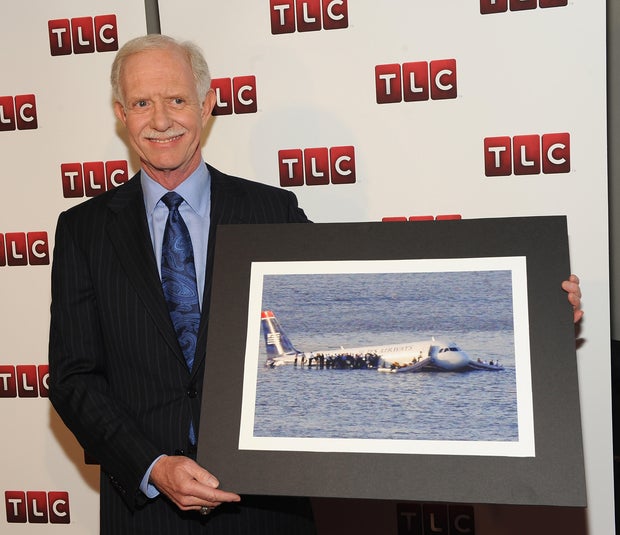
Chesley "Sully" Sullenberger
Chesley “Sully” Sullenberger, with a photo of the “Miracle on the Hudson” landing, at the premiere of “Brace for Impact” on Jan. 5, 2010 in New York City. 

Theo Wargo/WireImage/Getty Images

Sullenberger, who went on to serve for years as an on-air expert for CBS News, is an advocate for aviation safety.

Since his diagnosis, the retired pilot said he has learned how prevalent Alzheimer’s is. More than 7 million Americans are living with Alzheimer’s, according to the Alzheimer’s Association.

Sullenberger said he hopes that by sharing his diagnosis, others with the disease will also speak up.

“Over the years, when people would ask about the successful outcome of Flight 1549, I would say that ‘courage can be contagious,’ and on that day it helped everyone band together to get everyone off that airplane successfully,” he wrote. “Now we need that courage to battle this disease. I am now part of a larger community with many of you, and we will be courageous together.”

State board: Musk may have broken election law by offering $1M checks to voters

▶ Watch Video: Why Musk is pumping millions into a Wisconsin Supreme Court seat election The Wisconsin Elections Commission found that billionaire Elon Musk may have violated the state's election bribery law by offering $1 million checks to voters during a Wisconsin Supreme Court election that Musk's political action committee spent heavily in.The commission — which is made up of three Republicans and three Democrats — voted 5-1 last Thursday to refer two complaints filed by voters against Musk to the Brown County District Attorney's office, commission Communications Director Emilee Miklas told CBS News.A motion approved by the committee found "probable cause" that Musk violated a state law that makes it a crime to offer a person "anything of value" to induce them to vote.It is unclear whether Brown County District Attorney David Lasee — the top prosecutor in the county that covers Green Bay — plans to pursue charges.CBS News has reached out to Lasee and Musk for comment.The legal complaint revolves around Musk's controversial practice of offering cash giveaways to certain voters who sign his political group's petitions — a practice that started when Musk backed President Trump's 2024 campaign and continued during Wisconsin's April 2025 judicial election.In Wisconsin, Musk's America PAC awarded $1 million checks early last year to three voters who signed a petition against "activist judges." In that race, Musk and his group had spent millions backing GOP-endorsed Judge Brad Schimel's campaign for a seat on the state Supreme Court, though Schimel lost to Democratic-endorsed Judge Susan Crawford.At the time, Wisconsin Attorney General Josh Kaul, a Democrat, sued to stop Musk from making the payments, accusing him of violating state law by offering people money to vote. Musk's lawyers argued the billionaire was exercising his right to free speech. The state's highest court ultimately declined to take up the issue, and at a rally several days before the election, Musk handed out giant novelty checks to a pair of voters who were dubbed spokespeople for his political action committee.Elon Musk gives a $1 million check made to the order of Nicholas Jacobs during a town hall in Green Bay, Wisconsin on March 30, 2025. ROBIN LEGRAND/AFP via Getty Images
Read Next Story