
WWII explosives detonate in France amid wildfires: ‘Sound of war’

▶ Watch Video: Wildfires threaten France’s historic Bordeaux wine region

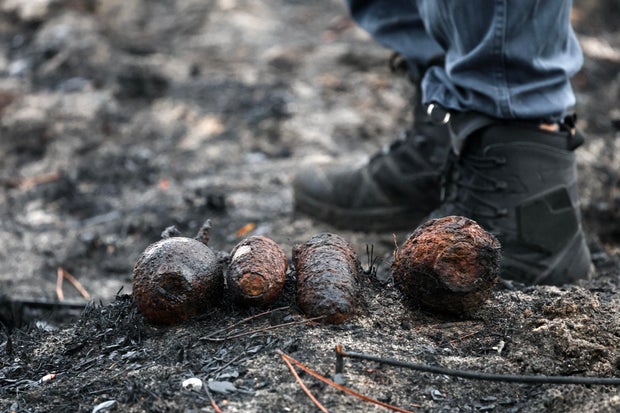
A huge forest fire near Bordeaux in southwestern France has revealed World War II shells in the village of Le Porge, where all residents returned to their homes on Monday after days of demining operations.

Around 400 shells and pieces of ammunition have been recovered in the area where over 180 homes were destroyed by flames, according to local authorities.

During the fire, blasts were heard, initially mistaken for exploding gas cylinders, but they may have been these shells, according to fire commander Thomas Mimiague.

According to BBC News, more than 100 explosions were heard on the second night of the fire, and Mayor Martial Zaninetti told French news outlet France Info the blasts were similar to “the sound of war.”
TOPSHOT-FRANCE-HISTORY-WWII-SHELL-WILDFIRES
Shells from World War II in Le Porge, France, on Aug. 3, 2026, after the discovery of projectiles in the town.

ROMAIN PERROCHEAU/AFP via Getty Images

“There were ammunition depots buried in land within our municipality, but we didn’t know it, and they exploded,” Zaninetti told France Info.

Zaninetti said there was “even one that went through a house.”

The munitions, both German and French, consist mainly of mortar shells, along with some high-explosive anti-tank shells.

“We don’t really know why they’re there; we think they were just abandoned,” Mimiague said.

Numerous fires have broken out in France since the start of the summer, particularly in the Bordeaux region, where the most serious blaze since 1949 has now been brought under control after burning more than 99,000 acres in about 10 days, without reaching the major wine estates of the region.

Munitions from the war have surfaced in France before. Last year, trains were brought to a halt around Paris following the discovery of an unexploded bomb dating back to World War II near tracks serving the French capital’s busy Gare du Nord station. In 2012, about 1,000 people were evacuated in Marseille so officials could remove a 1-ton German bomb from the war.

Organización cristiana afirma que un misionero de EE.UU. secuestrado en Níger fue liberado tras nueve meses de cautiverio

Kevin Rideout, un misionero estadounidense que estuvo cautivo en Níger durante nueve meses, fue liberado y entregado a funcionarios de Estados Unidos, informó el viernes la organización misionera para la que trabajaba.“Estamos agradecidos de confirmar que nuestro buen amigo y hermano en Cristo, Kevin Rideout, fue liberado después de más de nueve meses en cautiverio”, dijo a CNN Phil Bauman, director internacional de SIM.“Kevin goza de buena salud y está bajo el cuidado de funcionarios de Estados Unidos”, señala el comunicado, que agrega que Rideout pronto se reunirá con su familia.Rideout fue secuestrado afuera de su casa en la capital, Niamey, el 21 de octubre de 2025, según SIM, una organización misionera cristiana con sede en Charlotte que afirma trabajar en más de 70 países.Tres hombres no identificados lo secuestraron y posteriormente se dirigieron hacia la región occidental de Tillaberi, donde operan militantes islamistas, informó en ese momento la agencia de noticias Reuters, citando a un diplomático no identificado.Al día siguiente del secuestro, la Embajada de Estados Unidos en Níger advirtió sobre una “mayor preocupación por la amenaza de secuestro” y aumentó los requisitos de seguridad para el personal de la Embajada.Según The New York Times, que informó primero sobre su liberación, Rideout estaba bajo custodia del FBI y gozaba de buena salud, según imágenes que demostraban que estaba vivo, de acuerdo con un funcionario de Estados Unidos no identificado.El FBI se negó a hacer comentarios cuando CNN se puso en contacto con la agencia.No estaba claro cómo ni cuándo fue liberado, ni qué grupo lo mantenía cautivo al final de su cautiverio, informó The New York Times, que agregó que es posible que haya sido trasladado recientemente.Níger ha sufrido un aumento de los ataques de grupos militantes vinculados con Al Qaeda y el autodenominado Estado Islámico, particularmente en la región de la triple frontera con Malí y Burkina Faso, y a lo largo de su frontera sur con Nigeria.En mayo, las fuerzas de Estados Unidos y Nigeria falleció al comandante de alto rango de ISIS, Abu-Bilal al-Minuki.CNN se puso en contacto con la Casa Blanca, el Departamento de Estado y el Pentágono para solicitar comentarios.The-CNN-Wire™ & © 2026 Cable News Network, Inc., a Warner Bros. Discovery Company. All rights reserved.
Read Next Story