
USPS makes new rules for mail-in ballots, but they are less restrictive than Trump’s demands

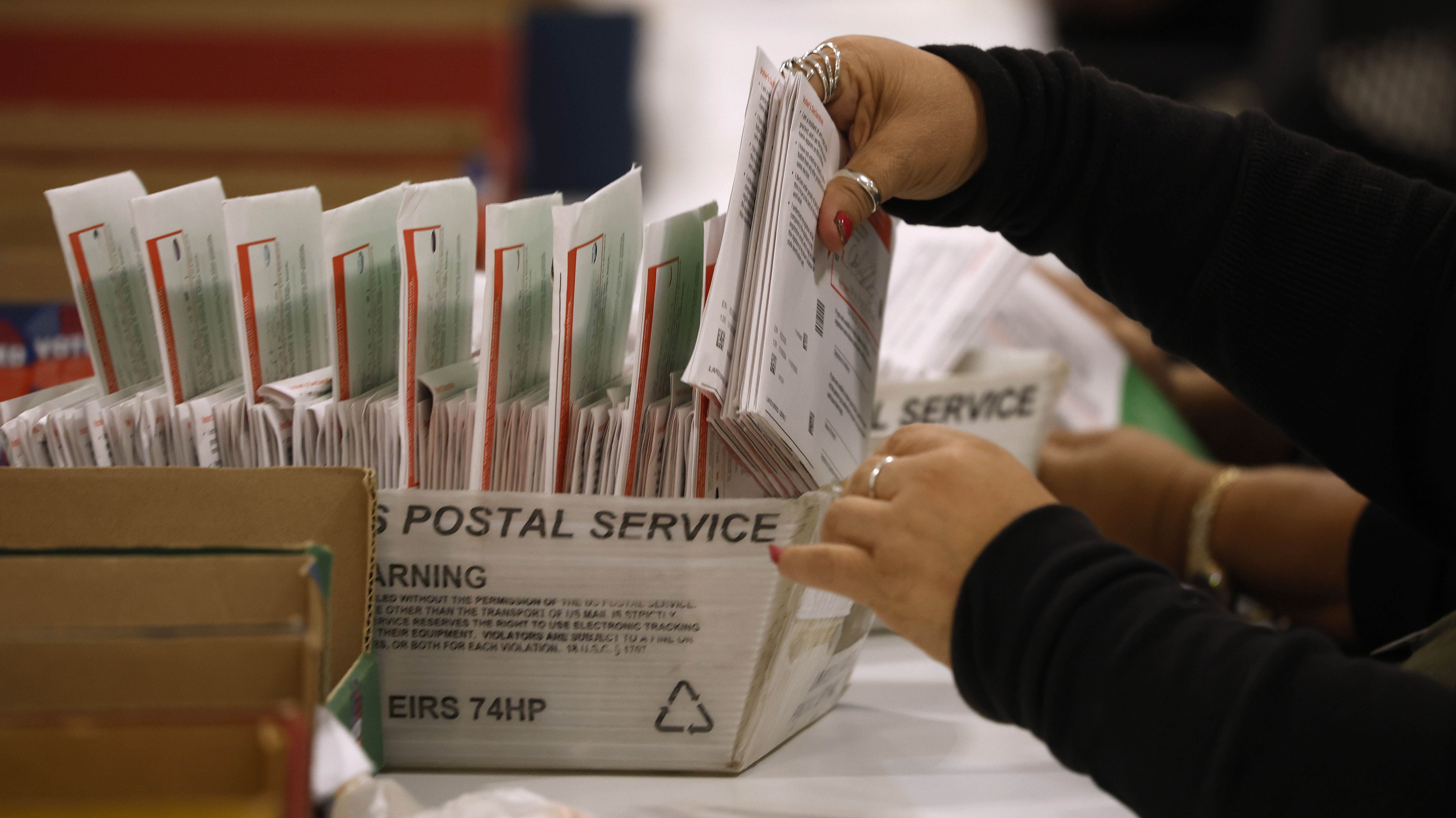
An election worker processes mail-in ballots for the California state primary election at the Los Angeles County Ballot Processing Center on June 5, 2026, in City of Industry, California. (Justin Sullivan/Getty Images)

(WASHINGTON) — The United States Postal Service (USPS) has released a new rule adding verification requirements to all mail-in ballots, falling short of President Donald Trump’s expectations but providing additional scrutiny.

These changes will not go into effect unless the Supreme Court lifts an injunction imposed by a lower court. If given the go-ahead, the postal service said the changes would occur immediately.

Under the proposed change, states would be required to collect and report basic voter information, such as a voter’s name and home address, attached to a unique barcode on every mail-in ballot distributed. Currently, there is no standardized requirement or method for states to track this information, instead letting each state independently decide how its mail-in voting system operates. 

State election authorities would then be required to input this information into a “federal ballot mail portal” before the ballot is accepted into the mail stream.

The USPS said it would not deliver ballots to any state not in compliance with these changes.

The move comes after months of attempts by the Trump administration to collect voter information in the name of election integrity. Some experts are concerned that consolidation of that information into federal hands undermines the Constitution’s system of state-run elections.

“If the administration can determine who is American enough to register to vote, who can prove it sufficiently, then they would have a lot of power to shape the electorate,” said Jonathan Diaz, director of voting advocacy for the bipartisan nonprofit Campaign Legal Center.

The new requirements fall short of Trump’s demands — his March executive order on mail-in ballots would have established statewide voter citizenship lists from Social Security or immigration databases, established uniform ballots, and had the USPS “coordinate with the USPS Office of Inspector General and the Department of Justice for investigation of suspected unlawful use of the mail involving Federal election materials.”

Most of these demands are included but watered down in the USPS’ final rule, ultimately creating a system that would track eligible voters by name and address, but keep citizenship largely out of it.

“No other voter information, such as birthdate, social security number, or other voter registration details, will be uploaded to the Portal,” the USPS said. “The Postal Service will not play any role in determining voter eligibility, maintaining voter rolls, or counting ballots.”

This rule is not a mail-in ballot ban, nor does it include the military, disability, illness, and travel exceptions requested by the president.

Trump’s appeal to the Supreme Court over his executive order directing USPS to make these rules remains pending.

On Monday morning, the Trump administration notified the Supreme Court of the USPS rule finalization, saying it merely imposes “modest envelope design requirements” on states that wish to use U.S. mail to distribute ballots. 

The government insists that the rules fall short of “restricting” mail-in voting and leave out many of the president’s demands. 

“USPS will not perform any verification of voter eligibility or the like,” Solicitor General John Sauer told the court. The USPS will “not refuse to transmit ballots from individuals who were not on the state-provided list.” 

The rule does say data collected “will help to facilitate enforcement of federal law.”

“It will provide federal law enforcement with a list of individuals to whom states planned to mail a ballot (and who may potentially use the mail to vote), along with the associated barcode data,” the USPS said.

The rule comes alongside months of gridlock for the SAVE America Act, the GOP’s signature piece of election reform that would require photo ID and proof of citizenship to vote.

“To Vote a person must show PHOTO VOTER I.D., PROOF OF CITIZENSHIP, AND THAT THERE WILL BE NO MORE CROOKED, CORRUPT, & DESTABILIZING MAIL-IN BALLOTS (EXCEPTIONS for Military, Disabled, Illness, and Travel!),” the president wrote on social media. “THE SAVE AMERICA ACT’S non-passage is CRAZY, and a serious threat to any politician who votes against it!”

The president has long demanded the bill make it through Congress, even calling on the termination of the Senate filibuster to make it easier to pass, though Democrats and some Republican lawmakers say the rules would disenfranchise too many American voters. The White House did not immediately respond to a request for comment. 

“Alaska’s 20-year struggle to implement REAL ID demonstrates just how incredibly difficult the enforcement of federal mandates can be and how unlikely it is that the SAVE America Act could be effectively implemented on an expedited basis,” Alaska Republican Sen. Lisa Murkowski said in a statement.

“Free and fair elections are the cornerstone of our democracy. As doubt is cast on their legitimacy and public trust erodes, we would do well to avoid partisan reforms that sound good on paper but may work very differently in the real world,” she added.

The USPS said it received “more than 200,000 comments” on the change and recognized concerns in its rule Friday.

“While the Postal Service acknowledges the range of disagreement on this point, the incidence of voter fraud does not impact the proposed rule’s legal grounding,” the USPS said. “Such enhanced visibility will help identify potential issues that would have otherwise gone undetected; at the very least, it will provide increased assurance that any potential issues are more capable of being effectively identified and investigated.”

The USPS said the rule will be officially published on Aug. 26. A U.S. appeals court upheld the district judge’s injunction in July, keeping any changes to mail-in ballots on hold while litigation continues.

ABC News’ Devin Dwyer contributed to this report.

Copyright © 2026, ABC Audio. All rights reserved.

“Debemos apoyarlo”: Gianni Infantino se aferra al poder en la FIFA y el exfutbolista Samuel Eto’o quiere que se quede

En las últimas semanas, parecía inevitable que Gianni Infantino se viera obligado a dimitir como presidente de la FIFA.La situación se le complicaba y la creciente ola de críticas tras su fallido intento de aprobar a toda prisa su controvertida propuesta FIFA Forward Enterprise (FFE) resultaba abrumadora.Sin embargo, a pesar de los constantes llamamientos a su dimisión, Infantino se aferra al poder, con las elecciones presidenciales de la FIFA a la vuelta de la esquina en marzo.Si bien algunos no quieren esperar tanto para tener la oportunidad de derrocar a Infantino, el actual presidente de la FIFA cuenta con cierto apoyo entre tantos detractores.Uno de ellos es el presidente de la Federación Camerunesa de Fútbol (Fecafoot), Samuel Eto’o, quien recientemente declaró a CNN Sports en una entrevista exclusiva que Infantino no ha hecho nada malo y, de hecho, pidió que se revisara el controvertido plan que originó esta turbulenta situación.Eto’o fue en su día uno de los mejores jugadores del mundo, anotando innumerables goles y ganando importantes trofeos con clubes como el Barcelona, ​​el Inter de Milán, el Chelsea y el Real Madrid.Fue elegido presidente de la Fecafoot en 2021 y desde entonces se ha dedicado a impulsar el fútbol camerunés y africano en general.“No creo que el presidente Gianni Infantino haya hecho nada malo”, declaró Eto’o a CNN Sports al ser preguntado sobre la actuación del presidente de la FIFA respecto al plan de la FFE.“Creo que todo esto se debe a que se acercan las elecciones, y Gianni Infantino se presenta como candidato. Todo esto ha sucedido porque se acercan las elecciones, eso es todo”.La voz de Eto’o será un alivio para Infantino, quien ha sido duramente criticado por numerosas confederaciones. La UEFA, organismo rector del fútbol europeo, ha amenazado con boicotear futuros torneos, mientras que la Concacaf (Confederación de Fútbol de Norteamérica, Centroamérica y el Caribe) y la AFC (Confederación Asiática de Fútbol) han exigido un cambio de liderazgo.El próximo Mundial Femenino Sub20, que se celebrará en septiembre, podría ser el siguiente punto de conflicto, ya que las selecciones de la UEFA podrían no participar. Esto significaría que seis de las selecciones clasificadas no jugarían, incluida Polonia, la anfitriona.La Confederación Africana de Fútbol (CAF) ha sido una de las pocas que ha apoyado a Infantino, aunque persisten las dudas sobre qué naciones individuales respaldan realmente la postura de su federación.Camerún parece estar muy alineado, e Infantino incluso mencionó a Eto’o en una publicación de agradecimiento en Instagram la semana pasada.“El presidente Gianni Infantino ha cambiado el fútbol”, añadió Eto’o, instando a las demás naciones africanas a apoyar al presidente de la FIFA.“Ha brindado oportunidades a naciones que antes no las tenían para participar en el torneo más hermoso, la Copa del Mundo. Ha permitido que naciones más pequeñas obtengan un lugar en estas competiciones”.“Ha ayudado a nuestro continente. Ha ayudado a nuestras federaciones a desarrollarse mucho más rápido, y debemos reconocerlo. Debemos aceptar y reconocer lo que ha hecho, y debemos apoyarlo por todo lo que ha hecho hasta ahora”.Eto’o declaró a CNN Sports que el plan propuesto habría ayudado a distribuir la riqueza de manera más justa, permitiendo que las naciones más pequeñas compitieran con las más grandes del mundo al contar con mejores instalaciones y recursos. Dijo que habría ayudado a selecciones como la de Camerún a atraer a los mejores jugadores del mundo, como Kylian Mbappé, quien nació en Francia pero tiene ascendencia camerunesa por parte de su padre.“Hay federaciones en otros continentes que se encuentran en la misma situación que nosotros, que tienen más o menos el mismo nivel financiero para desarrollar el fútbol que tanto amamos”. Queremos ver a los (Lionel) Messi, queremos ver a los Mbappé, pero me gustaría ver a Mbappé jugar para Camerún.La FIFA ya se disculpó por algunas de sus acciones y descartó la propuesta de la FFE. También respaldó a Infantino después de una reunión de crisis en Marruecos a principios de mes.La narrativa de la FIFA ahora es que los informes erróneos de los medios sacaron de contexto los planes propuestos, y eso es algo de lo que se hace eco Eto’o, quien todavía piensa que fue una buena idea y espera que pueda debatirse si Infantino es reelegido el próximo año.“Las naciones más grandes ocuparon el espacio mediático. Dieron su punto de vista, y el presidente Gianni Infantino quería mantener unida a la familia del fútbol y decidió retirar el proyecto”, dijo.“Sigo convencido de que para nosotros, como africanos, este proyecto era algo que podría haber sido increíble. Habría restablecido el equilibrio de poder en el fútbol para garantizar que nuestro talento no desaparezca y termine jugando para otras naciones”.“Al fin y al cabo, quienes han hablado del proyecto y han dado su opinión no han leído bien de qué se trata y, en algunos casos, lo han mirado desde su posición dominante”.Y añadió: “Quiero ver a todos mis colegas, a todos los presidentes, releer el proyecto. Después de la reelección del presidente Infantino, tendremos la fuerza para pedir que este proyecto se vuelva a poner sobre la mesa de discusión”.“Sigo convencido de que, si hay una votación democrática, este proyecto se aprobará porque es bueno para la mayoría”.Eto’o no es la única persona que apoya a Infantino en lo que se ha convertido en un panorama cada vez más fracturado.El apoyo de la CAF podría ser crucial, pero también existe la simpatía de otras partes del mundo.La Conmebol de Sudamérica elogió a la FIFA por descartar su controvertido plan, pero no llegó a pedir la renuncia de Infantino. La Asociación Argentina también ha dado todo su apoyo al asediado líder.También cuenta con el apoyo de México (miembro de la Concacaf) y de los miembros de la AFC Qatar, Indonesia y Filipinas, lo que demuestra cómo algunas asociaciones nacionales de fútbol se están alejando de la postura de sus confederaciones.Se trata de una cuestión de números: ¿cuáles de las 211 federaciones nacionales apoyan o se oponen a la permanencia de Infantino?Para algunos críticos, las elecciones del próximo año son muy esperadas, aunque aún no está claro quién desafiaría a Infantino. Los aspirantes deben presentarse antes del 18 de noviembre.Pero podría haber otra forma de destituir al presidente anticipadamente.Si el 20 % de las 211 naciones miembro de la FIFA presentaran una solicitud formal por escrito, se convocaría un congreso extraordinario, según los estatutos de la FIFA. Se podría entonces lanzar una moción de censura contra Infantino, dando a todos los miembros la oportunidad de decidir su futuro, aunque CNN Sports no encontró directrices oficiales sobre este posible proceso.Por ahora, el presidente de la FIFA permanece en el cargo. Y a pesar de las innumerables críticas que surgen a diario, hay quienes creen que el presidente puede, de alguna manera, mantenerse en el puesto.The-CNN-Wire™ & © 2026 Cable News Network, Inc., a Warner Bros. Discovery Company. All rights reserved.
Read Next Story