
US-UK ‘special relationship’ can survive spats with Trump, ex-British PM says

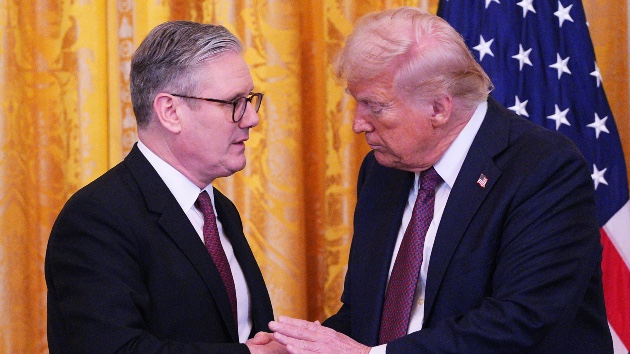
UK Prime Minister Keir Starmer and U.S. President Donald Trump shake hands at a joint press conference in the East Room at the White House on February 27, 2025 in Washington, DC (Photo by Carl Court – Pool/Getty Images)

(LONDON) — As Britain prepares for yet another prime ministerial change, a former holder of the office — Theresa May, who led the country from 2016 to 2019 — urged the country’s next leader to focus on shared U.S.-U.K. interests, rather than falling prey to potential personal or political clashes with President Donald Trump.

The U.K. Parliament is expected to anoint the Labour Party’s Andy Burnham as prime minister later this month. Burnham will become the seventh leader to take the reins of the country in 10 years, a reflection of the political and economic turbulence that has beset the country since the Brexit vote in 2016.

Burnham will replace current Prime Minister Keir Starmer, who last month said he would vacate his post following a collapse in support among Labour members of parliament, exacerbated by disastrous local election results in May. Starmer delivered Labour a historic majority in parliament in the 2024 general election, but saw his authority and approval rapidly deteriorate.

Like his predecessors, Burnham will need to juggle domestic discord while navigating a raft of foreign policy demands — among them the cultivation of the so-called “special relationship” between the U.K. and the U.S., which during President Donald Trump’s two terms in the White House has been subject to strategic, ideological and economic headwinds.

Trump has already described Burnham — who until recently was serving as the mayor of Greater Manchester — as “extremely liberal.” During Starmer’s time in office, the president has been scathing toward the prime minister’s policies in areas including energy, immigration, crime and foreign policy.
May, whose time in office overlapped with Trump’s first term, told ABC News last week that institutional transatlantic relationships and shared interests can help Starmer’s successors ease possible interpersonal tensions.

“Keir Starmer, actually, on the foreign policy field, by and large, played a good hand,” May told ABC News on the sidelines of the Chatham House think tank’s conference in London. The outgoing prime minister has been broadly praised for his deft handling of the transatlantic relationship, which included hosting a state visit for Trump to the U.K. in 2025.

Of the special relationship, May said, “We talk about it perhaps slightly more than the U.S. does. But that relationship is built on a whole set of different levels of relationships. So, it’s not just about the prime minister and the president. It’s also about our security relationships, our defense relationships … It’s not just about the two people at the top.”

The same is true of the U.K.’s own political issues, May said, as the nation prepares for the coronation of its next prime minister. “It’s not about individuals. Politics today generally across the globe has become more about individuals and personalities and I think that’s problematic,” she said.

“What matters to people is not the personality at the top. What matters to the people is what they’re doing, what their policies are,” May said.

The recent joint U.S.-Israeli war with Iran has again prompted Trump to strike out at America’s European allies, who refused to join the campaign in support of Washington though expressed willingness to aid security and minesweeping missions in the Strait of Hormuz once the conflict is over.

The U.K. was among the American allies who refusal to assist the U.S. against Iran “greatly disappointed me,” Trump said in March. Starmer’s response in particular, the president said, was “very disappointing.”

Asked whether the Iran war would prove to be a long-lasting blot on U.K.-U.S. relations, May said she was hesitant to comment as the conflict “is not finished.”

Still, she — like many other current and former European leaders — noted that European nations have previously shown their “commitment to the United States,” not least in rallying to the U.S. side after the 9/11 attacks; the only time in NATO history that an ally invoked the Article 5 collective defense clause.

When asked about Trump’s repeated suggestions that the U.S. should be less involved in European security, May replied, “There have been other times when there’s been more of that sense of isolationism,” specifically noting the later American entry into the Second World War in support of the U.K. and its allies.

“But I think, again, the interests that we have together are what combines us,” May said.

Copyright © 2026, ABC Audio. All rights reserved.

A Qing Dynasty vase 200 years ahead of its time

Hong Kong (CNN) — There’s a plucky little Qing Dynasty artifact that at first glance looks out of place among China’s many Forbidden City treasures. Instead of the ornate porcelain and cloisonné enameling often associated with imperial vases, this one is made of blown glass. With its swirling red, white and blue ribbons and emerald green base and mouth, it evokes a spinning barbershop pole; an item which could slot straight into a 1960s living room.Standing at just over eight inches, the curiously contemporary-looking object bears the reign mark of the Qianlong Emperor. Such Chinese characters were inscribed or stamped on most of the hundreds of thousands of works made during the Chinese monarch’s rule in the 18th century.Qianlong, one of history’s greatest and most prolific collectors, had opulent taste and seemingly bottomless funds. “He loved the profusion of colors, and textures, and all kinds of fine things,” said Daisy Wang, Deputy Director and Chief Curator at the Hong Kong Palace Museum, which until this August, exhibited the vase on loan from the Beijing Palace Museum.“He always thought, ‘more is more,’” she added, and under his six-decade rule, art production flourished.The vase, which may appear simple compared to decorative porcelain counterparts (where “little white space would be left”), might have surprised the emperor, said Marco Almeida, a Senior Vice President at Christie’s Asia Pacific and the auction house’s Head of Chinese Ceramics and Works of Art.China at that time had taken the likes of ceramics and lacquerware to the next level, but Europe was still ahead in its glass-making technologies, despite the Chinese making the material since the Western Zhou period more than 2,000 years earlier.Whereas other glass vases were small, plain, and monochromatic, “suddenly, you have this vase with multiple colors, and a style of decoration that was alien,” he said. “I think the emperor must have been quite taken by it and quite pleased.”The object also reveals how cosmopolitan the Qianlong court was, which, like the Mughal court in India, welcomed artisans from all corners of China and the rest of the world, according to Wang.“Putting myself in Qianlong’s shoes, he would consider the vase to be really beautiful, different and novel. That was the value,” she said.It is also incredibly rare. At the Beijing Palace Museum, there are over 300,000 pieces of porcelain in a collection that spans thousands of years of Chinese history, and only a “handful” of glass vases, added Wang.The curator said the vase was likely made either by a European missionary or with technologies and ingredients introduced by missionaries who wound up working in the imperial workshops, or “zaobanchu.” (During the Kangxi emperor’s reign in the Qing Dynasty, German Jesuit missionary Kilian Stumpf began overseeing glass production).The zaobanchu, located in the Forbidden City complex and around the country, had dozens of departments specializing in paintings, textiles, wood carving, materials and more — every minute aspect required to create elaborate pieces.Fashioning the vase, according to the Hong Kong Palace Museum, was akin to pulling candy. Artisans would have pulled hot colored glass into thin tubes, gluing pieces onto the vase’s body, working quickly to roll it as it was heated and cooled again and again as its swirled pattern took shape.Almedia said that while the technique used to make the vase was European, and similar to the “latticino” method used in Venetian glassmaking, the “sensuous” shape was Chinese as of course, was the reign mark. “It’s the perfect, and clear-cut marriage of what is Chinese and what is Western.” The Christie’s specialist said it would be difficult to ascribe its value, but he called the artifact, “borderline priceless.”Wang, who is curating a forthcoming exhibition on imperial workshops at the Hong Kong Palace Museum in September, described Qianlong as a “micromanager in today’s company culture.”He would meticulously document objects, and often gave specific instructions on their design, proportion and size. The zaobanchu during Qianlong’s reign comprised nearly one thousand artisans, who worked out of fear to serve the demands of the insatiable emperor who would sometimes dole out severe punishments, like taking away a year’s salary. “He looked at every step in detail and really dwelt on them as well.”The vase has a “twin brother,” according to Wang, who explained that often objects were created in pairs and in even, lucky numbers. In Beijing Palace Museum’s collection, there’s another one with imperceptible differences — at least to the naked eye, except that it’s a hair taller.And some 5,000 miles away, at Bristol Museum & Art Gallery in the UK, there’s yet another version — this time elongated and olive-shaped, with its threads of color more spaced apart.Kate Newnham, the museum’s Senior Curator of Visual Arts, speculates that the vases were likely created around the same time and scientific analysis “might reveal they are from the glass of similar recipes, perhaps even from the same batch.”She added there’s no evidence, so far, supporting that Qianlong personally commissioned the vase sitting in the Bristol collection. But it’s clear he took a “close interest” in output from the glass atelier. The curator said imperial archives from 1753 include the emperor’s instructions to make a few more “threaded-glass” pitchers after seeing some presented by a French Jesuit craftsman.For such novelty pieces, there would always be more than one version of an object for the emperor to choose from, Almeida explained. “They would want to experiment and see what else they could do with it.”The-CNN-Wire™ & © 2026 Cable News Network, Inc., a Warner Bros. Discovery Company. All rights reserved.
Read Next Story