
Tuesday primaries: Crowley projected to defeat democratic socialist Hong in Wisconsin

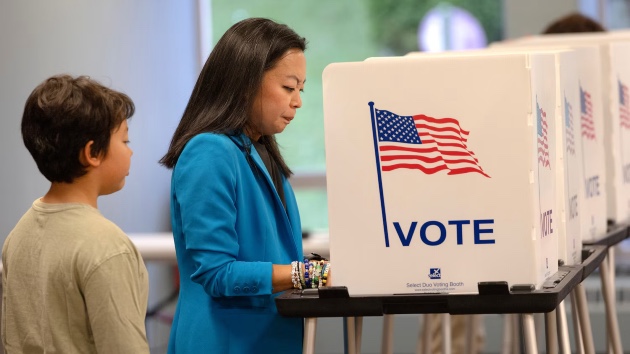
With her son George by her side, Democratic Wisconsin Gubernatorial candidate Francesca Hong votes in the primary election on Aug. 11, 2026, in Madison, Wisconsin. (Scott Olson/Getty Images)

(WASHINGTON) — Voters in six states on Tuesday decided which candidates will face off in November in House and Senate races that could determine whether the balance of power will shift in the next Congress.

Milwaukee County Executive David Crowley, a centrist Democrat, narrowly won the Democratic primary in Wisconsin in a major upset in the race for governor, the Associated Press projects. He defeated Wisconsin assemblywoman Francesca Hong, a democratic socialist, in what became a high-stakes test for progressives who pinned their hopes on winning a major party nomination in a crucial battleground state.

And in Connecticut, 14-term Rep. John Larson became the seventh House Democrat incumbent to lose a primary during this election cycle.

Here’s a look at Tuesday’s primaries:

Wisconsin

Republican and Democratic candidates in Wisconsin are vying to win the first open gubernatorial seat since 2010, replacing Democratic Gov. Tony Evers, who announced last year that he wouldn’t run for reelection.

There are also primaries in both parties that could have an impact on which controls the House next year.

Live Wisconsin primary results

Connecticut

Incumbent Democratic Rep. John Larson will lose the Democratic primary for his 1st Congressional District seat to challenger Luke Bronin, the former mayor of Hartford, ABC News projects. Larson has held his seat since 1999. Larson is the seventh incumbent House Democrat to lose in primaries this year.

And Gov. Ned Lamont, who was elected in 2018, will fend off a primary challenge from Josh Elliott, ABC News projects. He’ll face Republican Ryan Fazio in November. 

Live Connecticut primary results

Minnesota

Sen. Amy Klobuchar will win the Democratic governor primary, ABC News projects, in the race to replace Democratic Gov. Tim Walz, who is retiring. She will face state House Speaker Lisa Demuth, who ABC projects will win the Republican governor’s primary, in November.

ABC News also projects Lt. Gov. Peggy Flanagan will win the Democratic primary in the race to replace Democratic Sen. Tina Smith, who is also retiring. She’ll face former NFL sideline reporter Michelle Tafoya, who ABC projects will win the Republican primary for Senate.

Minnesota also voted in primaries for several House races that could help determine the balance of power in Congress.

Live Minnesota primary results

South Carolina

Darline Graham, the sister of the late Sen. Lindsey Graham who was appointed to fill the remainder of her brother’s term, will face Rep. Ralph Norman in an Aug. 25 runoff to replace Lindsey Graham on the November ballot, ABC News projects.

Lindsey Graham’s death in July sparked a rapid-fire campaign season. Eight other candidates besides Graham and Norman were running for the seat.

Live South Carolina special Senate primary results

Vermont

Economist Amanda Janoo will win the Democratic primary for governor, ABC News projects, and will face incumbent Republican Gov. Phil Scott in the general election in November.

Live Vermont primary results

Alabama

In Alabama, some voters decided several House races following the Supreme Court decision that limited portions of the Voting Rights Act and led several states in the South to take part in mid-decade redistricting.

Primaries were held in May, but Republican Gov. Kay Ivey pushed back those in the 1st, 2nd, 6th and 7th districts that were impacted by redistricting after the Supreme Court decision.

Copyright © 2026, ABC Audio. All rights reserved.

This photojournalist was sentenced to 15 years in an Iranian prison. She refuses to be silenced

(CNN) — “Don’t forget me.” This is the desperate plea of Iranian photojournalist Yalda Moaiery, who has spent more than two decades documenting life under the Iranian regime, including most recently the bloody crackdown on protests in January, the war with the United States, and a new campaign of repression currently underway.Moaiery, whose stories and photographs have appeared around the world, has now herself become a target and was sentenced to 15 years in prison earlier this month by an Iranian court with “activities in furtherance of the interest of the Zionist regime against national security.” She hopes to appeal the decision.Even as she prepares for the alarming prospect of years inside Iran’s notorious prison system, Moaiery told me she will continue to bear witness as long as she can. “I’m not willing to work as a person in that framework of propaganda,” she said. “This is the main problem, but all of my interviews, all of my photos…all, all the things that I did as a photojournalist…is like crime for them, and these are all of my charges, including talking with you.”I first interviewed Moaiery for CNN in February following anti-government protests which had spread across more than 100 cities, driven by anger over Iran’s economic turmoil and the government’s crackdown.She provided a rare eyewitness account from inside Iran, even as the regime attempted to block communications with the outside world. Through a choppy internet connection, she told me the scale of the protests had been unlike anything she had ever seen.“I’ve never seen such a crowd in these 25 years that I’m working as a photojournalist,” she said at the time. “It was incredible. A huge number of people, hundred [of] thousands of people, were on the street and groups of people like family members, all family members even the children, the babies, the elderly, everyone were there.”But as the government cracked down on the demonstrations, killing thousands according to estimates by human rights groups, Moaiery told me the people’s hope had disappeared.“Terrible – one the saddest time in our history,” she said at the time. “I’m 44 years old. I’ve never experienced such a feeling in my life. I’ve never been such a hopeless person in my life. And all the people that I’m talking to them, people in the streets…my friends everyone. People are so hopeless, so sad. And this is the main question that they are asking each other…what can we do?”After the US and Israel launched war on Iran in February, I spoke to Moaiery again. Though the government continued to block internet access, she managed to communicate that many Iranians she spoke to were hoping the conflict might bring down the regime.“People are supporting the war,” she said. “I have to be honest…people want the war to be continued because they tried many peaceful ways to change this regime.”Six months later, however, as the war drags on with no end in sight and economic and political pressure intensifies, I asked Moaiery if that initial hope for change remained. “No, not at all,” she said this week. “During the war…I knew many people that they were willing that this war continue, but it’s really changed these days and people are not thinking like this.”“Most of them [are] thinking about the economic situation,” she continued. “People cannot afford the very basic needs…the real war is here. The real war is the economy right now.”More broadly, she told me she and many people she interviewed believe the war has made the regime stronger. “Stronger, unfortunately,” she said. “We are facing…the worst version of the Islamic Republic that I haven’t seen….I am the child of the Islamic Republic. I was born some years just after the regime took the power, but I’ve never seen such a thing in my life.”“The very new version of the Islamic Republic is much more angry, much more tough,” she said.Moaiery was experiencing that toughness even as we spoke. She said that hours before our latest interview, Iranian authorities threatened to raid her home if she spoke to the international media again.“They just [threatened] me hours before that if you talk again with someone – of course they didn’t mention your name – but if you talk to someone about this case, we are coming to your home again and they’re [going to] raid your home again and we’re [going to] take your cell phones,” she told me.Yet, once again showing her now familiar courage and resolve, she insisted, “I do not care. I mean, of course I’m scared of the things that’s [going to] happen. Fifteen years is a lifetime, but… this is the risk that I was accepting in my whole life to tell the truth, to show the truth, to be an independent journalist, and photojournalist.”“I’m not giv[ing] up. I do not have any regrets,” she added.We at CNN took the charges against Moaiery very seriously. Prior to our most recent interview, I asked her if she was worried that speaking to me would make her situation worse. She said, on the contrary, she believed “it will help definitely,” adding, “We have to have this interview.”Moaiery’s view is not uncommon. Others imprisoned by the Iranian regime, including journalists Jason Rezaian and Roxana Saberi and businessman Siamak Namazi, have said that public attention to their cases, including coverage and interviews in the international media, helped apply pressure to eventually win their release.That remains her hope as she now faces the daunting prospect of a lengthy imprisonment.“As a journalist, as an independent journalist, we do not have any kind of weapon,” she told me. “We have only the media and truth, and this is the thing that I always try to keep and I think when I inform the people about what is happening in my country, what is happening about me or my case.”“It will help to the other journalists all around the world who are living under the authoritarian…regime[s],”she continued. “I think it’s like a global solution for all of us, and of course it will help.”It was then that she added those powerful words –– “Don’t forget me” –– to which I responded, “We won’t forget you.”The-CNN-Wire™ & © 2026 Cable News Network, Inc., a Warner Bros. Discovery Company. All rights reserved.
Read Next Story