
Trump appeals to Supreme Court to allow White House ballroom construction to continue

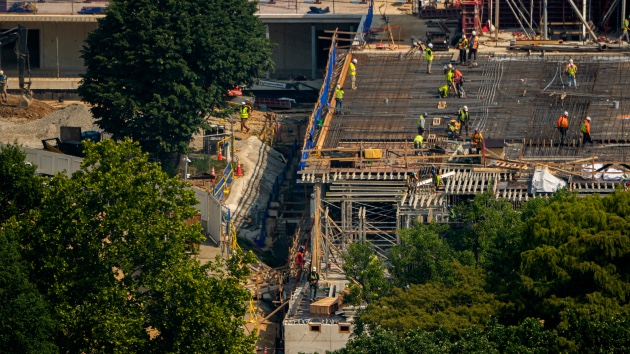
Construction continues on the East Wing ballroom at the White House on Aug. 10, 2026, in Washington, D.C. (Andrew Harnik/Getty Images)

(WASHINGTON) — The Trump administration is asking the Supreme Court to allow construction of President Donald Trump’s White House ballroom to continue after a lower court put it on pause.

The administration on Friday asked the high court for an emergency stay of the injunction, which would halt substantial portions of the above-ground construction of the White House East Wing and ballroom while litigation plays out over its legality.

The injunction is set to take effect on Aug. 21 unless the Supreme Court acts.

The district court order would still allow below-ground construction or any other measures necessary to protect national security and the president’s safety.

Solicitor General John Sauer called the injunction “extraordinary and unlawful,” arguing that it would put the security of the president and his family at risk and override the advice of the nation’s top military, intelligence and law enforcement officials. 

“If allowed to go into effect, the injunction would wrongfully install a single district judge as sole arbiter of what further construction is ‘strictly necessary’ to protect the safety of the President, his family, staff members, and visitors to the White House, including foreign dignitaries, and presidents and prime ministers of other countries,” Sauer wrote. 

The district court concluded that Trump lacks the authority to overhaul the White House without congressional approval. A divided federal appeals court upheld the ruling earlier this month. 

In his appeal to the justices to intervene, Sauer suggested halting construction would directly put the life of the president at risk, citing six “recent assassination attempts,” including “the threat of a missile attack against Air Force One on July 8.”

“The President of the United States of America is not a tenant, but rather the sole, elected head of the Executive Branch, and Congress has authorized him to renovate, secure, and protect the White House and its grounds, as other Presidents have been allowed to do, without exception,” he wrote. 

The government argued that it is likely to win on appeal in the case, insisting that the National Trust for Historic Preservation lacks standing to bring the lawsuit and that federal law has long allowed presidents to undertake the “care, maintenance, repair, alteration, refurbishment, and improvement … of the Executive Residence at the White House.” 

The Supreme Court is expected to seek a response from the National Trust for Historic Preservation sometime in the next week before rendering a decision on the stay. 

Sauer indicated that the administration also plans to ask the Supreme Court to take the case up for expedited oral argument and decision on the merits. 

Separately, the administration’s filing appeared to provide new details about the state of the construction operation. 

The government asserts that it is “on time” and “under budget” and that “zero taxpayer dollars are needed or required.” 

Though there is no mention of the White House’s $1 billion funding request to Congress for White House hardening and enhancements for evolving threats and technology, which have been widely seen by lawmakers as related to Trump’s ballroom.

Senate Democrats on Wednesday formally asked the Government Accountability Office (GAO) to conduct an audit of the project and its funding.

“The scale of this project, the destruction of historic architecture, the opaque and unorthodox combination of public funds with private funding sources, and the absence of standard federal review processes raise serious concerns about transparency, accountability, and stewardship of this national landmark,” the lawmakers wrote.

Sauer claimed in Friday’s filing that the project is 65% complete and that $200 million has been spent or committed to date. 

He says a 250-person crew is working 20 hours a day, 7 days a week. The structure is said to be 5 stories deep and 70-feet above ground across 50,000 square feet. 

The administration’s filing also includes sworn declarations from some of the most senior officials in the government, including from the secretary of state, the chairman of the Joint Chiefs of Staff, and the heads of the FBI and Secret Service, in an effort to dramatically lay out the national security justifications for the ballroom.

One White House official also said in a declaration that the construction is simply too far along for the project to be safely stopped.

“[I]f work is stopped in line with the district court’s injunction, it will be a disaster,” wrote Joshua Fisher, the White House director of management and administration.  “Quite frankly, if the building were tragically ordered to be taken down, or even altered, by the court, there would be no way to do so.”

Fisher says the concrete-and-steel superstructure is now “beyond the point of no return,” adding that the freestanding walls “cannot be left as-is without being tied together with the designed structural steel.”

Copyright © 2026, ABC Audio. All rights reserved.

Trump pide a la Corte Suprema que le permita construir el salón de baile por motivos de seguridad nacional

El presidente Donald Trump le pidió a la Corte Suprema que le permitiera construir el salón de baile en la Casa Blanca, argumentando amenazas previas contra su vida, necesidades de seguridad nacional y valores arquitectónicos.La solicitud de emergencia presentada el viernes llega después de que tribunales inferiores fallaran reiteradamente que Trump necesitaba la aprobación del Congreso antes de seguir adelante con el proyecto de US$ 400 millones. La presentación también incluye nuevas representaciones del salón de baile que muestran cambios de estilo, incluida la incorporación de al menos dos grandes sellos presidenciales dorados en el exterior del edificio.La última reprimenda se produjo la semana pasada, cuando un tribunal de apelaciones en Washington dijo que el presidente no tenía autoridad para impulsar unilateralmente el salón de baile planeado y le ordenó detener las obras en el lugar donde se encontraba el antiguo Ala Este hasta que los legisladores dieran su aprobación. Sin embargo, el tribunal suspendió durante 14 días la aplicación de su decisión para dar a Trump tiempo de apelar ante los jueces.El secretario general del Departamento de Justicia, John Sauer, argumentó en la presentación ante la Corte Suprema que la construcción en el Ala Este era “absolutamente necesaria” para la seguridad del presidente, y señaló los intentos contra la vida de Trump en los últimos años.“El presidente de Estados Unidos no es un inquilino, sino el único jefe electo del Poder Ejecutivo, y el Congreso le ha autorizado a renovar, asegurar y proteger la Casa Blanca y sus terrenos, como se ha permitido hacer a otros presidentes, sin excepción”, escribió Sauer. “La orden judicial es un exceso de autoridad judicial que va más allá de la jurisdicción adecuada de los tribunales federales”.Es la primera vez que uno de los proyectos impulsados personalmente por Trump llega ante la Corte Suprema. En los últimos meses, tribunales inferiores que han examinado una larga lista de casos que cuestionan sus planes para transformar Washington han visto con escepticismo sus argumentos para defender su enfoque o han emitido fallos que han frustrado sus iniciativas.En el caso del salón de baile, el Tribunal de Apelaciones del Circuito de Washington estuvo de acuerdo el 7 de agosto con el fallo de un juez federal que ordenó a Trump detener las obras de las partes del salón de baile que están por encima del nivel del suelo. Ambas decisiones permitieron que continuara la construcción de un búnker altamente sofisticado debajo del salón de baile.“La decisión de construir o no un enorme salón de baile corresponde al Congreso y no es un asunto que el Poder Ejecutivo pueda resolver por sí mismo”, dijo el Circuito de Washington en su fallo de 2-1.El caso fue presentado el año pasado por el National Trust for Historic Preservation, la principal organización del país dedicada a la preservación histórica.“El National Trust ha demostrado de manera convincente que el Congreso no ha cedido al Poder Ejecutivo una autoridad sin restricciones para rediseñar, remodelar y reconstruir de manera drástica la Casa Blanca —la Casa del Pueblo— para adaptarla a los deseos de un presidente en particular”, concluyó el tribunal de apelaciones.El grupo de preservación tiene hasta el mediodía del martes para responder a la petición de Trump ante el máximo tribunal.El Gobierno de Trump argumentó el viernes que la excepción que hicieron los tribunales inferiores para permitir que continuara la construcción del búnker de seguridad no era suficiente y dijo que la orden “amenaza la seguridad y protección del presidente”.“Toda la estructura del salón de baile está diseñada para proteger la instalación militar que se encuentra debajo”, escribió Sauer. “Detener el proyecto retrasará esta construcción vital, lo que hará que este presidente —objetivo de reiterados intentos de asesinato— esté mucho menos seguro y pondrá en riesgo la seguridad de futuros presidentes”.La construcción del salón de baile por encima del nivel del suelo comenzó en primavera y ha avanzado considerablemente. Las imágenes publicadas por Trump a principios de agosto muestran varios niveles de columnas de concreto y barras de refuerzo metálicas en medio de una cantidad considerable de equipos de construcción, incluida una grúa torre.El presidente ha participado personalmente en los detalles del salón de baile, desde los planos hasta la selección del mármol. El proyecto tiene un tamaño estimado de aproximadamente 89.000 pies cuadrados (8.268 metros cuadrados), según el arquitecto principal, Shalom Baranes. En comparación, la estructura principal de la Casa Blanca, la Mansión Ejecutiva, tiene apenas 55.000 pies cuadrados (5.110 metros cuadrados).Trump ha sostenido que el proyecto no está sujeto a ningún tipo de supervisión y que debería poder continuar con las obras sin un escrutinio significativo.El Gobierno dijo el viernes que “el Congreso otorgó al presidente la facultad de realizar ‘modificaciones’ y ‘mejoras’ en la Casa Blanca ‘según determine el presidente’”.Trump ha dicho que el proyecto estará terminado en el verano de 2028, un calendario acelerado que permitiría completarlo meses antes de que deje el cargo.Su Gobierno argumentó ante la Corte Suprema que congelar la construcción en esta etapa “crearía un verdadero circuito de obstáculos para el Servicio Secreto y pondría aún más en peligro la seguridad”.“La superestructura de concreto y acero, parcialmente terminada y de 70 pies de altura, ‘no puede quedar prácticamente abandonada en este momento’ sin sufrir enormes retrasos que comprometerían fundamentalmente la integridad de todo lo que se ha construido hasta ahora”, dijo Sauer. Agregó que también existiría un “importante riesgo de seguridad” si la estructura quedara con una estabilidad o resistencia inadecuadas para soportar por sí sola el viento y cargas pesadas.Las nuevas representaciones del salón de baile entregadas a la Corte Suprema incluyen nuevos detalles, entre ellos la incorporación de al menos dos grandes sellos presidenciales dorados.Una fuente familiarizada con el proceso de aprobación de edificios históricos en Washington dijo que esto debería hacer que el proyecto tenga que presentarse ante la Comisión de Bellas Artes y la Comisión Nacional de Planificación de la Capital, las agencias federales que supervisan la planificación de espacios federales en Washington.“El exterior de la Casa Blanca ha representado durante mucho tiempo una estética sobria de sencillez republicana, no una exhibición opulenta”, dijo la fuente. “La incorporación de los grandes y llamativos sellos dorados choca con esa tradición”.La presentación del viernes también dijo que el diseño del salón de baile se inspiró en la Corte Suprema “y, en particular, en sus magníficas columnas corintias, consideradas el orden de columnas de mayor categoría en la arquitectura”.Las columnas, elaboradas con “piedra caliza de Indiana de la más alta calidad” que fue enviada a Italia, “están siendo talladas por algunos de los mejores artistas del mundo”, dijo Sauer.“La entrega y la instalación comenzarán próximamente”, añadió.Esta historia fue actualizada con información adicional.The-CNN-Wire™ & © 2026 Cable News Network, Inc., a Warner Bros. Discovery Company. All rights reserved.
Read Next Story