▶ Watch Video: Tales from Gay Talese
“The Kingdom and the Power,” Gay Talese’s 1969 book, recounted power plays and family feuds at The New York Times, where he rose from copyboy to reporter. A work of non-fiction that read like a well-observed novel, it was his first bestseller – one that took Talese six years to write. “I’ve always been a very slow writer,” he said.
“Most journalists are restless voyeurs who see the warts on the world, the imperfections in people and places. The sane scene that is much of life, the great portion of the planet unmarked by madness, does not lure them like riots and raids, crumbling countries, and sinking ships, bankers banished to Rio and burning Buddhist nuns – gloom is their game, the spectacle their passion, normality their nemesis.”
From “The Kingdom and the Power”
“I want the reader to have a picture in mind, as I have myself,” Talese said.
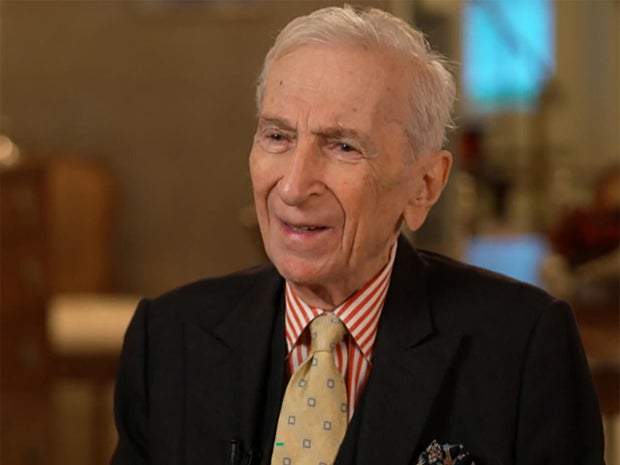
Gay Talese is a legend among writers and reporters. His career, both celebrated and, at times, controversial, spans some 70 years. Recently, the New York Public Library acquired his professional and personal archive.
CBS News
The first piece he ever wrote in The New York Times was about The New York Times, specifically the lit-up sign that broadcast headlines in five-foot-high letters. That sign, which revolved around the Times building, was a fixture in Times Square during the early 20th century. Hardly anyone thought about who changed the lightbulbs. “There used to be a guy on the fourth floor of that building who would write in a machine that would put the bulbs around the building that made the headlines,” Talese said.
Electrician James J. Torpey got his name in the paper. Talese didn’t. But, he’d found his calling. “I wanted to be the lamplighter for those people who were in the dark,” Talese said. “That was my main ambition. I wanted to write about people and make them known enough to have to have an obituary written about them, ’cause they were known.”
Robert Boynton, a professor at the Arthur L. Carter Journalism Institute at New York University, called Talese “the most curious person I’ve ever met. He was on his way somewhere once, and some guy was doing construction outside, and he started interviewing him.”
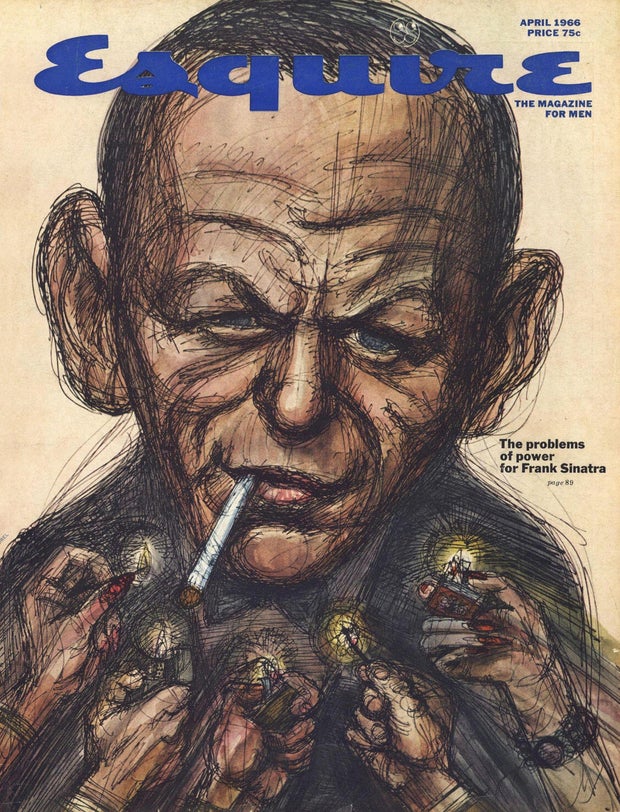
By 1965, magazines were fat with advertising, and populated by great storytellers. Esquire, under the editor Harold Hayes, was a beacon for writers like Norman Mailer, Tom Wolfe, and Talese.
“I had a contract, one year,” Talee recalled. “Hayes said, ‘You could write three pieces on your people.’ And, I had to write about Frank.”
Esquire
His resulting 1966 article, “Frank Sinatra Has a Cold,” is one of the most famous magazine stories ever. “You had to be impressed with Sinatra,” Talese said. “I’m not fawning on people. I keep my reserves. But I was respectful of Sinatra.”
But Talese was in trouble: Frank Sinatra would not speak to him. To get himself out of trouble, Talese did something that’s still talked about, and still taught, in journalism schools: he wrote around the story. Talese spent 33 days interviewing more than 100 people who surrounded Sinatra. The result read more like a short story than a typical celebrity profile, and Talese became known as a leading practitioner of what was called “New Journalism.”
“Sinatra with a cold is Picasso without paint, Ferrari without fuel—only worse. For the common cold robs Sinatra of that uninsurable jewel, his voice, cutting into the core of his confidence, and it affects not only his own psyche but also seems to cause a kind of psychosomatic nasal drip within dozens of people who work for him, drink with him, love him, depend on him for their own welfare and stability. A Sinatra with a cold can, in a small way, send vibrations through the entertainment industry and beyond as surely as a president of the United States, suddenly sick, can shake the national economy.”
From “Frank Sinatra Has a Cold”
Boynton said, “Talese really takes this sort of cinematic approach, which did not exist before in the very sort of flat, corporate writing of, say, Time or Newsweek that really was dominant in that time.”
But Talese said he didn’t know “Frank Sinatra Has a Cold” would resonate as it did. “I didn’t care about the Sinatra piece,” he said. “And I have written many good pieces.” From “Mr. Bad News” (about Alden Whitman, the obituary writer at The New York Times), to profiles of aging sports figures, like Joe DiMaggio, Floyd Patterson, and Joe Louis.
His profile of Louis, the boxer, starts with him not talking to Talese, but talking to his wife. It’s an example of what Talese calls “the art of hanging around. I hope I win their confidence to allow me to accompany them on what they do.”
“Hi, sweetheart!” Joe Louis called to his wife, spotting her waiting for him at the Los Angeles airport.
She smiled, walked toward him, and was about to stretch up on her toes and kiss him—but suddenly stopped.
“Joe,” she said, “where’s your tie?”
“‘Aw, sweetie,” he said, shrugging, “I stayed out all night in New York and didn’t have time—”
“‘All night!” she cut in. “When you’re out here all you do is sleep, sleep, sleep.”
“‘Sweetie,” Joe Louis said, with a tired grin, “I’m an ole man.”
“‘Yes,” she agreed, “but when you go to New York you try to be young again.”
From “Joe Louis: The King as a Middle-aged Man”
Boynton says he encourages his students to be (the word he uses is) Talesian. “That means going the extra mile in your reporting, being creative about the kinds of things you’re gonna look into, taking extra time, showing up early, staying late,” he said.
And dressing up. To Talese, appearances matter: “I once wrote a whole book about the Verrazzano Bridge builders (“The Bridge”). I went up in the scaffolding wearing a hard hat, and a suit and a tie.”
While researching his book “Thy Neighbor’s Wife,” about nudists and brothels, he sometimes chose to dress down. “In 1972, I’m living in California. I’m living in a world of pornographers and nudist fornicators.”
And he wasn’t just chronicling that world; to some extent he became part of that world. “When I was with the Mafia, I was hanging out with crooks and murderers and gangsters. To hang around with nudists, you can’t be there with your press card. I couldn’t hang around the press box and write that story.”
He has been married to Nan Talese, one of publishing’s most admired editors, for 67 years. “I had two children [when I wrote ‘Thy Neighbor’s Wife’], and a wife that was in the public eye. She was embarrassed, likely. She should have been embarrassed. And I was sort of embarrassed, too. But I wanted the story. There’s something about me (and a lot of journalists), they care a lot about the story, and they’re willing to take the rap to get the story.”
It turns out, Nan has been the story all along. “I have a longstanding relationship with a book called ‘A Non-Fiction Marriage,’ it’s about my marriage, my marriage to a woman of great achievement,” he said. But the long-promised book is still not finished. “We’re not done – our marriage is not done yet,” he said.
Gay Talese won’t be pushed. Although not long after we talked to him, he revealed that he is battling Parkinson’s disease.
Now 94, he shared his thinking about writing: “I should be, at least, as good as my last best work.”
Does that suggest that, maybe, his best book is yet to come?
“We always hope that’s true!” he replied.
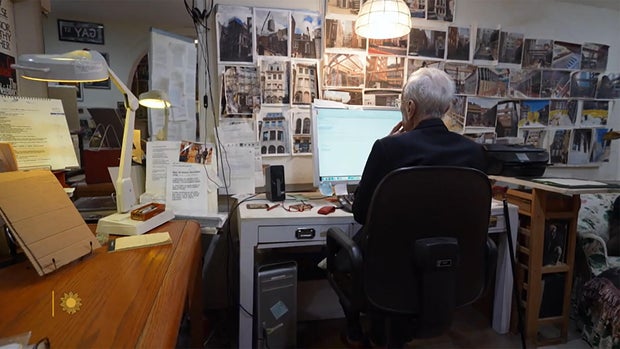
For most of his career, Talese has worked in an office in the basement of his brownstone, on New York’s Upper East Side. There, there is no sunlight, no phone, no outside distractions. He’s surrounded by photos and every note he’s ever taken on every story – meticulously saved memories of a job well done.
CBS News
“When I die,” he said. “I want to have everything I wrote not embarrass me in my afterlife. I think I’ve done that. I will die with the satisfaction that I did my best at all times.”
For more info:
- Gay Talese (Official site)
- “A Town Without Time: Gay Talese’s New York – The Master Journalist’s Greatest Reporting on the City’s Eccentric Characters from the 1950s to Today” by Gay Talese (Mariner Books Classics), in Hardcover, Trade Paperback, eBook and Audio formats, available via Amazon, Barnes & Noble and Bookshop.org
- Robert Boynton, journalism professor, New York University
Story produced by Mary Raffalli. Editors: Mike Levine, Lauren Barnello
See also:
- From 2006: Writer Tom Wolfe on journalism and voyeurism (“Sunday Morning”)
- From 2007: Norman Mailer: A pugilistic literary lion remembered (“Sunday Morning”)
- From 2001: The Mailers: Norman and Norris (“Sunday Morning”)