Some Haitian immigrants in Ohio told to report to ICE and given ankle monitors

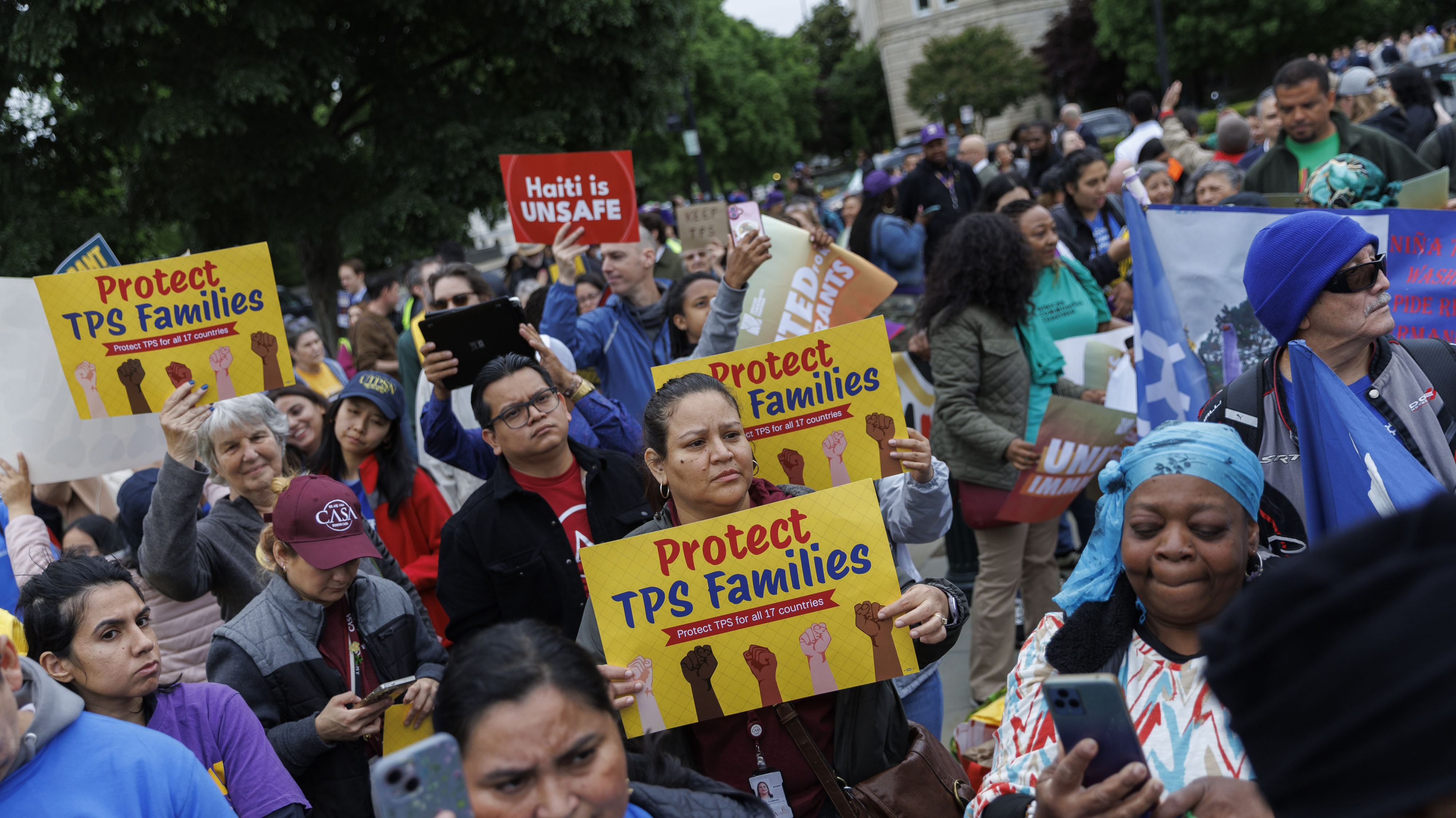
Demonstrators chant and hold signs outside U.S. Supreme Court on April 29, 2026, in Washington, DC. The court heard arguments challenging DHS’s termination of Temporary Protected Status for asylum seekers. (Photo by Tom Brenner/Getty Images)

(NEW YORK) — Hundreds of Haitian immigrants in Ohio who had Temporary Protected Status have been summoned by the Department of Homeland Security for in-person “check-ins” with the agency, where some have been fitted with ankle monitors, immigration advocates tell ABC News.

The move from the government comes after the U.S. Supreme Court ruled in June that the Trump administration could end TPS for about 350,000 Haitians, as part of the administration’s ongoing immigration crackdown.

Steve Foster, the immigration policy coordinator for the Institute for Justice and Democracy in Haiti, said “Haitians with TPS, regardless of whether they have a pending asylum claim, have gotten a ‘DHS Call-In Letter’ to appear at ICE offices in person.”

Some have been given ankle monitors and future court dates, Foster said.

Viles Dorsainvil, executive director of a Haitian support group in Springfield, Ohio, confirmed the government’s effort to call Haitians in Ohio with TPS into ICE offices and fit some of them with ankle monitors.

“We are just helping these folks to go to this appointment, and when they get there, they interview them and eventually put [an] ankle monitor on them,” Dorsainvil said.

TPS status, established by the 1952 Immigration and Nationality Act, provides work authorization and protection from deportation if a foreign country is deemed by the government to be unsafe because of armed conflict, natural disaster, or “extraordinary and temporary conditions.”

In a statement, a spokesperson for the Department of Homeland Security said, “Temporary Protected Status is exactly that — temporary. For too long, TPS has been allowed to function as a de facto amnesty program despite Congress never intending it to be permanent.”

“What we would say now is it’s closing time, which means you don’t have to go home, but you can’t stay here,” the statement said.

Dorsainvil said that some TPS holders have lost their work permits, while others who have pending asylum cases still have valid work authorization.

“There is so much anxiety, and they are fearful, and they are uncertain when it comes to what they should do next,” he said.

Copyright © 2026, ABC Audio. All rights reserved.
Bill Gates proposes major limits on AI development

(CNN) — Microsoft co-founder Bill Gates argued on Wednesday that artificial intelligence needs significant limits or else the harm to humans will outweigh any potential good.“AI will either be the greatest equalizer ever invented, or the worst source of injustice,” he said in a 6,000-word essay, entitled “The turbulent AI era is here. The choices we make now are critical.”Gates isn’t the first tech leader to raise concerns about rapid advancements in AI. But his essay adds to growing worries about the actions of some AI models and potential job losses, even as the AI companies and Wall Street press full speed ahead on the technology.Gates became one of the richest people on the planet as a key player during last century’s personal computer revolution. However, he wrote that he believes the next technology revolution – AI – will be far more disruptive to society.“Even under the best circumstances, the transition to this new AI era will be one of the most turbulent times in human history,” he said, adding that “I don’t see evidence that leaders, experts, and communities are confronting the challenges adequately. There is no plan to ease the entry into the AI era.”AI can provide great benefits in field like agriculture and medicine, he argued, such as breakthroughs in preventing and treating diseases.But he also noted that the transition carries big risks, like widespread unemployment, harming the educational and social development of children, or making it easier for criminals and bad actors – or AI itself – to cause deliberate harm.“As the models become more powerful, they could begin to act against our interests and we could lose control,” he warned.These significant risks must be controlled quickly, Gates said.“If someone had a credible plan for slowing down AI advances globally, I would likely support it,” he wrote. “However, I don’t think that’s going to happen. The geopolitical and economic incentives are pushing too hard to go full speed ahead.”In an interview with CNN’s Anderson Cooper that will air on Wednesday evening, Gates said AI models have gotten dramatically more powerful at a rate faster than he expected.“They’re now capable of causing cyberattack risk, bioterrorism risk, psychosocial risk,” he said. “I have to say I’m kind of shocked that the exact criteria that we review these models with, and the actions we take to minimize the harms, are really completely missing.”In his essay, Gates proposed taxing AI or robots the way you would pay a human employee’s payroll tax in order to slow the shift away from using human labor. He also wants to set aside some work to be done by humans only.“My message to leaders is: You have a chance to act now, before unemployment rises sharply, communities are hurting, and public trust has eroded,” he said. “You can make sure AI benefits everyone. And you can work with other governments to meet this national and global challenge.”The-CNN-Wire™ & © 2026 Cable News Network, Inc., a Warner Bros. Discovery Company. All rights reserved.
Read Next Story