
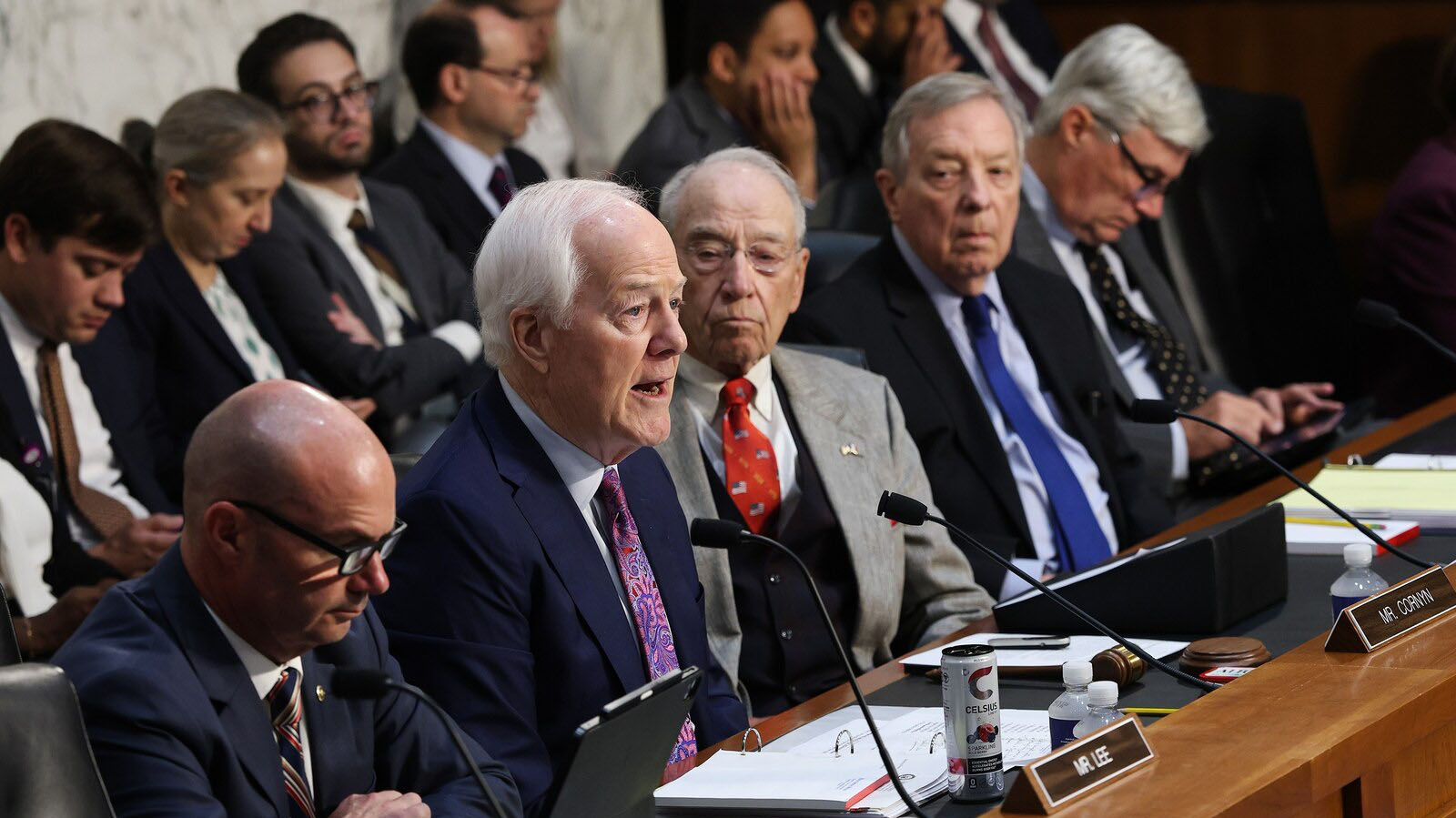
Senate Judiciary Committee advances Todd Blanche’s nomination for attorney general

Sen. John Cornyn speaks as members of the Senate Judiciary Committee gather to vote on the nomination of Todd Blanche to be U.S. Attorney General on Capitol Hill, Aug. 4, 2026, in Washington. (Win McNamee/Getty Images)

(WASHINGTON) — The Senate Judiciary Committee on Tuesday voted to advance acting Attorney General Todd Blanche’s nomination to permanently lead the Department of Justice.

Blanche advanced in a 12-10 party line vote. All Republicans voted in favor of him, while all Democrats voted against. 

Republican Sens. John Cornyn and Thom Tillis ultimately supported Blanche after securing an agreement that clarified the scope of President Donald Trump’s IRS immunity deal and formally rescinded the administration’s so-called $1.8 billion “Anti-Weaponization Fund.”

Despite the fact that the agreement reached has no language preventing the resurrection of the controversial fund under a different name or method, Cornyn said the DOJ has been “consistent” about their assertions that the fund is dead. 

“And of course, I expect them to live up to that in any future litigation,” Cornyn said in remarks on the Senate panel ahead of the vote.

Tillis also said the agreement reached with Blanche satisfies his concerns. 

“I believe that we have addressed the concerns that I have. The first one I called the ‘payout pot for punks.’ I’ve never liked this 1776 fund. It made no sense to me, and I thought it was an insult to the police officers and the people that defended us on January the 6th. It’s done. It’s been rescinded, and I am satisfied,” Tillis said.

Tillis said that both sides on the aisle “have a problem” when it comes to malicious prosecution. He said he hopes to see a “bending of the curve of this absurdity” when Blanche is confirmed.

Ahead of the vote, Senate Judiciary Committee Chairman Chuck Grassley thanked Cornyn and Tillis for their work securing the agreement. He said many senators shared their concerns.

“Formally rescinding the fund and clarifying the scope of release of claims has put this issue to bed once and for all,” Grassley said.

Democratic Sen. Chris Coons took a different view on the so-called “Anti-Weaponization Fund” than his Republican colleagues, arguing that Blanche’s willingness to go along with its creation in the first place should disqualify him from the attorney general job. 

“In my view, we never should have gotten to this place. As acting attorney general, when asked by the president to do something plainly unethical and corrupt, Mr. Blanche should have simply said no. He did not do that, and I pressed him in his confirmation hearing whether he even tried to talk President Trump out of this widely rejected plan, and he refused to answer,” Coons said.

During the hearing, Blanche responded to Coons’ questions, saying he was not simply a “yes-man” in giving Trump counsel. 

“I will say that President Trump trusts me to give him counsel. Counsel does not mean I’m a ‘yes-man.’ And that’s true in my case, like it should be in any attorneys general case,” Blanche said during his confirmation hearing.

Several Democrats on the panel raised a number of concerns about Blanche.

“Today I think is a sad and embarrassing day for this committee, as it looks like, on a party line vote, we are going to advance out of this committee probably the most discreditable person ever to seek the office of attorney general of the United States,” Democratic Sen. Sheldon Whitehouse said.

Democratic Sen. Cory Booker, in a lengthy speech, warned that the country was in “dangerous waters” with Blanche.

“This man is not our lawyer. He is not America’s lawyer. He is about to become Trump’s sword against his adversaries and shield against any scrutiny,” Booker said.

What’s next for Blanche’s nomination? 

Blanche’s nomination is now ready for consideration on the Senate floor.

Unless there is an agreement to speed things along, the soonest the Senate can take a procedural vote on Blanche’s nomination is Friday. That would set up a final confirmation vote sometime on Saturday.

Though Tillis and Cornyn were the most closely watched Republican votes on the Senate Judiciary Committee, there remains other GOP senators who have raised concerns about Blanche.

With Republican Sen. Mitch McConnell still absent from Congress, Blanche will ultimately only be able to lose the support of two Republicans when his nomination comes up for a vote on the Senate floor.

Copyright © 2026, ABC Audio. All rights reserved.

What Shall I Do With My Boy?

Click here for updates on this story    August 4, 2026 (Houston Style Magazine) -- In 1836, four white apprentices beat Frederick Douglass nearly blind in a Baltimore shipyard.He named them years later. Ned North. Ned Hays. Bill Stewart. Tom Humphreys. One came at him with a brick. One swung a handspike into his head. Fifty white carpenters watched. None said stop.They said the Black caulkers were "eating the bread which should be eaten by American freemen." Douglass saw past that. The white man, he wrote, "is robbed by the slave system of the just results of his labor." The men who owned that system taught poor whites to fight poor Blacks. It kept them both poor.He escaped to New Bedford, a trained caulker in a free town of Quakers and abolitionists. A shipowner tried to hire him. Every white man on the vessel threatened to walk. He shoveled coal instead.Still no bench for him.In 1853 he asked Harriet Beecher Stowe to help him build a school where Black boys could learn a trade. There were fathers, he said, "whose minds are tossed by day and by night with the anxious enquiry, 'what shall I do with my boys?'"The school was never built. The question never went away.Ask it again now. Manufacturing jobs peaked in June 1979 and fell for forty years. In the 1950s, 98 of every 100 American men in their prime worked or looked for work. Today it is 89. Black men lived this first.Then we told every child that college was the only road. Georgetown researchers project only 42 percent of jobs will require a degree by 2031. We closed the shop classes and called it progress. The old track had sorted Black and brown children into dead ends. We did not fix the sorting. We tore out the ladder and left the wall.Now hear what we tell the boys. The Pentagon studied who could enlist. Seventy-seven percent of Americans aged 17 to 24 cannot qualify. Too heavy. A record. A pill. A test.Three out of four, told they are not wanted. Then the Army did something quiet. In 2022 it opened a course at Fort Jackson for the ones who failed the standards. It taught them until they met them. About 95 percent passed.Chaz Andrews had wanted to serve since he was 19. He failed the entrance test more than ten times. He was 29 when the course got him through. Nothing was wrong with Chaz Andrews.Hugh Price saw this coming. He helped start the National Guard Youth Challenge Program, which lifts dropouts' earnings 20 percent. The military, the former Urban League president wrote, "figured out long ago how to nurture the potential of aimless young people."He did not want to militarize childhood. He wanted the method. High expectations for everyone. A mentor who knows your name. A refusal to sort children into the ones worth teaching and the ones worth writing off.Charlie Rangel asked the other half. He came home to Harlem from Korea with a Purple Heart and pushed for universal national service. "If we are going to send our children to war," he wrote, "the governing principle must be shared sacrifice."Rangel answered who serves. Price answered how people are made.Maryland is testing both. Republican Larry Hogan dropped the degree requirement for most state jobs, and hiring without degrees rose 41 percent in four months. Democrat Wes Moore built the first statewide service year in America.That is real. So is this. Congress has not reauthorized the National Apprenticeship Act since 1937.Further along than we were. Nowhere near done.My father ran a Head Start center in San Diego in the late sixties. What surprised him was who objected. Not only men who hated Black children. Also, comfortable people who did not want anybody's poor children given a head start, white ones included.We would rather sort children than teach them.Douglass asked what he should do with his boys. We still owe him an answer.Ten years after Los Angeles burned, I stood backstage waiting to speak. Jack Kemp was at the lectern, pounding it. Our kids, he shouted. Our kids. Our kids.An elder from South Central asked me where he was from. Upstate New York, I said.Then whose kids is he talking about?All of them, ma'am. They are all American children.The notion stunned her. It should not stun anyone. It still does.A country is not a nation until it claims them all.photo Ben Jealous is a professor of practice at the University of Pennsylvania and former president and CEO of the NAACP. Please note: This story was provided to CNN Wire by an affiliate and does not contain original CNN reporting. This content carries a strict local market embargo. If you share the same market as the contributor of this article, you may not use it on any platform.Kierra LeeKIELEESTYLE@GMAIL.COM4096658446
Read Next Story