
Ebola deaths surpass 1,500 in DRC as outbreak continues to spread

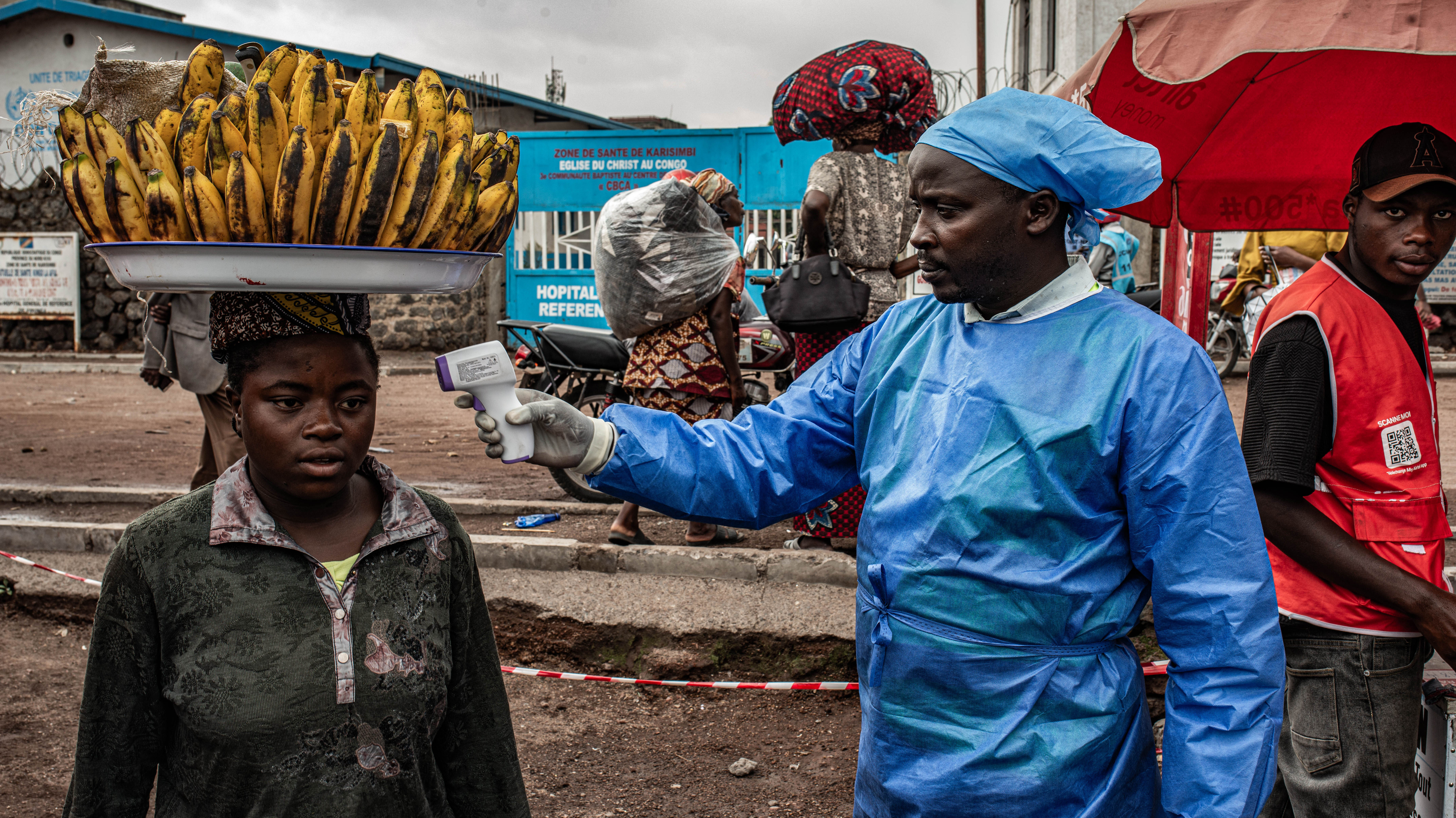
A health worker takes a woman’s temperature as part of Ebola screening efforts on June 24, 2026, in Goma, Democratic Republic of Congo. (Photo by Daniel Buuma/Getty Images)

(NEW YORK) — More than 1,500 people have died from Ebola as an outbreak continues to spread in the eastern Democratic Republic of the Congo, according to government figures released on Thursday.

As of Tuesday, at least 3,442 cases and 1,521 deaths had been recorded, with 797 people hospitalized or in isolation, Congo’s Ministry of Health said.

Health officials said the contact tracing rate stands at 78.3%, which is below the 90-95% that the World Health Organization says needed to contain the outbreak.

The outbreak was first detected in the DRC’s northeastern province of Ituri, with cases officially confirmed by the health ministry on May 15.

It marks the 17th outbreak of Ebola virus disease in the DRC, which is Africa’s second-largest country and its fourth-most populous nation. The country had a population of about 105 million as of 2023, according to the WHO.

The majority of cases have been detected in Bunia, the capital of the Ituri province, with cases also recorded in the provinces of North Kivu, South Kivu, Haut-Uele and Tshopo, health officials noted.

Aid organizations have said that community mistrust, insecurity due to armed conflict, and gaps in healthcare have hindered response and containment efforts.

Mercy Corps, an aid organization responding to the outbreak, said in a press release this week that teams are finding it “increasingly difficult to reach communities safely, consistently, and early enough.”

Onesphore Bangenza, Ebola response team leader in Bunia for Mercy Corps, said that in 10 weeks, there have been about as many cases recorded as there were during the 2018-2020 outbreak, which is “alarming and should stop us in our tracks.”

“There is no doubt that the virus is moving faster than we can contain it,” Bangenza said in a statement. “We have seen a real improvement in people’s understanding of Ebola over the past month, but those gains are fragile. When basic healthcare is unavailable, insecurity interrupts humanitarian assistance, or essential prevention infrastructure.”

A doctor working on the Ebola response in the DRC told ABC News on Thursday that basic supplies for safe and dignified burials are running short in some areas. He asked to remain anonymous.

“People are crying because they don’t even have the materials needed to bury the bodies,” the doctor said.

Additionally, there aren’t enough people to perform the contact tracing needed to get the outbreak under control, according to the doctor.

“You cannot investigate, you cannot do contact tracing with so few epidemiologists. Two epidemiologists per hospital is the minimum, but it is nowhere near enough to respond to an outbreak of this scale,” he said. “The response needs more than money. It needs people, equipment and community engagement. All the partners need to work together.”

Meanwhile, in neighboring Uganda, health officials declared the Ebola outbreak over earlier this week. The majority of the 20 cases reported in Uganda were travel-related, according to the country’s health ministry.

Dr. Jean Kaseya, the head of Africa Centres for Disease Control and Prevention, wrote in a post on X on Thursday that he was joining Uganda’s Minister of Health for a media briefing following the declaration of the end of the Ebola outbreak.

“This milestone reflects the commitment and dedication of health workers, communities, national authorities and partners who worked tirelessly to detect, contain and overcome this outbreak,” he wrote. “I commend the leadership of Uganda and all those who contributed to this response, including the teams from Africa CDC, WHO and partners who supported efforts on the ground.”

Copyright © 2026, ABC Audio. All rights reserved.

Trump tries to push Sen. Darline Graham across the finish line over some Republicans’ objections

(CNN) — Fresh off the losses of three candidates he endorsed in Republican primaries, President Donald Trump faces a much higher-profile test of his political power in South Carolina.Trump is set to hold a rally Friday night in Myrtle Beach with Sen. Darline Graham, whom he endorsed for her late brother’s Senate seat and whose campaign was shaken by a recent debate when she couldn’t answer a question about Taiwan and the South China Sea because she was “not that informed about national security.”Both Trump and Graham are at a crucial moment. Some stalwart supporters of the president are openly rejecting his pick in Tuesday’s Republican primary runoff, despite a strong effort by the White House that included Trump calling old rivals to push them to endorse her.A defeat in South Carolina would further call into question the second-term president’s ability to keep his party ranks in line.“The entire world is laughing at South Carolina right now and laughing at Darline Graham Nordone,” said former state Rep. Adam Morgan, a Norman supporter, using the full name for Graham that some of her critics like to invoke to distinguish her from Sen. Lindsey Graham. Morgan added that Darline Graham’s debate flub had to be a “serious gut check” for Trump and his political team.As of Thursday, Trump was showing no signs of backing away from his exclusive support for Darline Graham or making a double endorsement like he did in the South Carolina governor’s runoff after his first pick didn’t win the primary.“President Trump’s endorsement is the most powerful endorsement in the history of American politics,” White House spokeswoman Allison Schuster said in a statement. “Anyone claiming otherwise is a complete and utter fool.”How the White House ramped up its backing of GrahamTrump moved quickly to consolidate GOP support behind Graham after she finished first in the August 11 primary but did not get enough of the vote to avoid a runoff. Trump called at least two of her opponents that night – Rep. Russell Fry and former Gov. Mark Sanford – and asked them to endorse her, according to sources familiar with the calls.The results were mixed.Fry was not ready to immediately back Graham and waited until three days later, after at least one other call from Trump, to do so. They talked about Trump possibly coming to South Carolina to stump for Graham in the runoff, and Fry suggested a place in his district, the Myrtle Beach area, as a good location.Sanford, who also ran a long-shot campaign against Trump in the 2020 presidential primary, remains neutral in the runoff, while one of his sons, Landon Sanford, backed Norman. A representative for Mark Sanford did not respond to a request for comment.Businessman Mark Lynch, who ran against Lindsey Graham in the June primary, told CNN he did not get a call from Trump though he has spoken to Trump allies. He endorsed Norman within hours after losing the primary.“South Carolinians do not want ‘Queen Darline’ appointed as their senator by D.C. special interests and Democrat PACs,” Lynch said in a statement to CNN.Graham’s campaign did not respond to a request for comment for this story. But she shrugged off the debate flub while speaking with reporters afterward, saying South Carolinians are “worried about their pocketbooks more than they’re worried about the South China Sea.”During a campaign event Wednesday in Florence, an audience member asked if she had any concerns about “credibility” in the Senate in light of the debate answer.“Is national security important? Absolutely,” she said. “Can I learn? I’m smart. Yes, I’ll learn. I’ll become informed. Everybody has a first day on the job. President Trump, was he a politician? Has he done a good job? Yes, he has.”Yet even some Graham supporters cringed at the moment, which came when a moderator, journalist Greta Van Susteren, asked Graham if Taiwan and the South China Sea were “national security issues for the United States.” Struggling to answer, Graham voiced general support for the military and added national security is “not my thing.”A Republican lawmaker who endorsed Graham after she made the runoff called her debate performance “eyebrow-raising” and said it “didn’t inspire confidence.”“I’m a little surprised she didn’t have a better pivot than ‘I don’t know about that’. She won’t make that mistake again, that’s for sure. I would think she’ll be able to learn more during the rest of this term,” the lawmaker said. “She had decent answers about domestic issues.”A GOP source told CNN Graham’s team was downplaying the gaffe to donors and Republicans who’d endorsed her, echoing the candidate and telling them that “people struggling with affordability aren’t concerned about the South China Sea.”Dorchester County GOP Chairman CJ Westfall, a Graham critic, noted his group texts with state Republicans started lighting up when Graham gave that answer.“The people who were watching that are the hardcore Republicans,” said Westfall. “And a special runoff? Those voters are the most hardcore of the hardcore.”Critics of Graham are piling onThe debate moment appeared to be a turning point for Republicans who had previously been holding back on airing reservations about her candidacy.Former South Carolina Gov. Nikki Haley, a longtime Norman ally who ran against Trump in 2024, said on X that Lindsey Graham was “well informed” about national security and it is “not something you inherit.” Kevin Roberts, head of the Heritage Foundation and a strong Trump ally, called Darline Graham’s answer “embarrassing and inexcusable.”“Can we just stop this ridiculous experiment in nepotism now???” former Trump adviser Steve Cortes wrote on X.Graham’s critics also noted that she said during the debate that South Carolina has a population of 50 million people when it is actually about a tenth of that size. Rep. Nancy Mace, a Norman supporter, highlighted Graham’s error on social media and said, “I can’t even right now with this Senate race.”Beyond the national security question, the debate signaled that the race had entered a new, more contentious phase. Graham seized several opportunities to attack Norman, including in a closing statement that was particularly animated.“Fact is, I’ve done more in 20 days than you have done in 20 years,” Graham told Norman, a five-term congressman.Norman largely shrugged off her jabs as part of “silly season,” but his allies are sharpening their rhetoric against her. A pro-Norman super PAC, Palmetto First PAC, is running a TV ad that says Graham “inherited” the seat and asks, “What if Darline Graham had any other last name?”The cast of outside groups backing Graham has only grown in the runoff. The latest entrants include two super PACs aligned with artificial intelligence industry and a third group focused on clean energy, Invest in Tomorrow Coalition PAC, that recently helped unseat Rep. Andy Ogles, a Tennessee Republican, in his primary.Norman has sought to make up for the overwhelming outside funding backing Graham by self-funding his campaign. He loaned his campaign $1.3 million on Monday, according to a campaign finance filing, adding to the $400,000 he put into his campaign last week.As for endorsements, Fry is not the only big name in South Carolina politics that has coalesced behind Graham since the primary. She has also picked up endorsements from Sen. Tim Scott and Lt. Gov. Pamela Evette. Evette was Trump’s initial choice in the primary for governor but lost to Attorney General Alan Wilson in the runoff.Graham has also garnered endorsements from some anti-abortion groups as intra-party critics question have highlighted her friendship with — and two past small political donations to – a former GOP state lawmaker who fought the state’s near-total abortion ban. One of the organizations, the Susan B. Anthony List, followed Trump’s lead and backed Graham even though Norman has an “A+” rating on its legislative scorecard.“I have gotten to know Darline Graham and I am confident she is 100% committed to advocating for unborn children and their mothers in the U.S. Senate,” Marjorie Dannenfelser, president of SBA Pro-Life America, said in a statement.Dannenfelser visited South Carolina on Thursday to campaign with Graham, as did the second highest-ranking Republican in the Senate, Majority Whip John Barrasso.Norman has gained some interesting, if lower-profile, endorsements in the runoff. Among them is the Republican Party in Lexington County, Graham’s home county and where she got the most votes in the primary.Mark Weber, the chairman of the Lexington County GOP, said he moved to South Carolina from California in 1989 and has come to appreciate that the state “truly believes in state’s rights and local control.”“While I am a Trump support[er] and Lexington and SC is Trump Country,” Weber said in a text message, “SC voters don’t want anyone to twist our arms or tell us how to vote.”The-CNN-Wire™ & © 2026 Cable News Network, Inc., a Warner Bros. Discovery Company. All rights reserved.
Read Next Story