
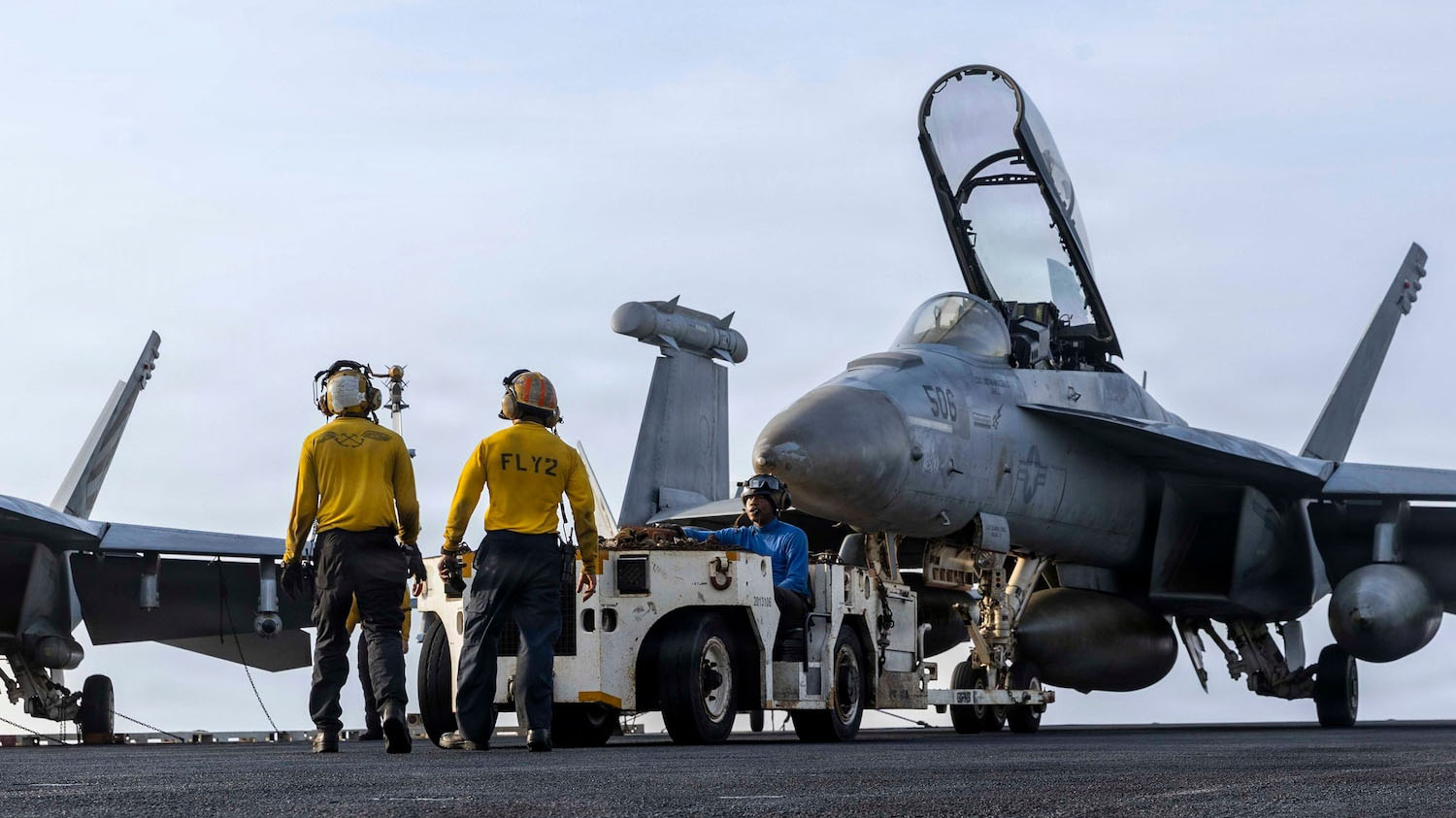
(WASHINGTON) — The top Democrat on the Senate Armed Services Committee sent a letter to Defense Secretary Pete Hegseth and acting Navy Secretary Hung Cao on Wednesday demanding more information about the extended deployment of the USS Abraham Lincoln amid the war with Iran and raising further questions about the Navy’s ability to preserve service members’ well-being while sustaining its current “operational tempo.”
In his letter, Sen. Richard Blumenthal noted the Lincoln has been deployed for more than 250 days and has gone more than 200 days without a port call.
“There have been widespread reports of shortages of basic supplies, water contamination, plumbing issues, deteriorating mental health, deck safety concerns, and disruptions in the mail system, which have caused many care packages en route to the ship to be lost in transit for months,” Blumenthal wrote. “These reports warrant immediate attention, but they also raise a broader question: whether the Navy can sustain the operational tempo now being demanded of its carrier force, particularly as this Administration repeatedly commits U.S. forces to conflicts of its own choosing and increasingly relies on aircraft carriers to sustain those operations.”
His letter comes amid reports that the sailors are exhausted and, according to Military Times, one family member alleges a sailor attempted to go overboard from the USS Abraham Lincoln.
A U.S. official confirmed to ABC News that a sailor went overboard last month from the Lincoln and was quickly recovered. The incident is under investigation, the official said.
Hegseth on Thursday pushed back on reports of a sailor going overboard from the Lincoln and accounts of sailors struggling through an unusually long deployment have been “completely misrepresented.”
“We make sure every ship, every crew, every captain has everything we can provide them at every single moment,” Hegseth told Newsmax. “Some deployments are longer than others, and I have more respect and gratitude for those sailors than anybody.”
A Navy official told ABC News in a statement that the Lincoln has not seen an uptick in mental health issues and has “not identified an increase in reported suicidal ideation or suicide attempts aboard the ship.”
But it acknowledged sailors are strained.
“We know that extended deployments place a significant strain on our service members and their families, and we are grateful for the resilience and sacrifices they make in support of our nation’s security,” the statement said.
A U.S. official told ABC News on Thursday that the Navy’s data shows its not uncommon for suicidal ideation to occur on deployed ships and that typically the rates are higher at the start of a deployment. The official said the data shows the Lincoln is following that trend and so far there have been no deaths or suicides since the it departed from San Diego last November.
The 5,000 sailors aboard the carrier have access to mental health assistance as well as chaplains, according to the official.
The ship was slated for a normal six-month deployment to the Pacific but has been extended on an unusually long nine-month deployment due to the war with Iran, where it was redirected earlier this year. It’s not clear when it will be allowed home and is currently serving in North Arabian Sea.
Cao told Lincoln families during a town hall last week that another carrier will eventually swap out with the Lincoln, though he did not provide a timeline.
A U.S. official told ABC News on Thursday that the aircraft carrier USS George Washington, which is homeported in Japan, will replace the Lincoln as part of a long-planned rotation of ships.
Blumenthal notes in his letter that the Lincoln is not an isolated case, highlighting the prolonged deployment of the aircraft carrier USS Gerald Ford earlier this year.
“Recent carrier deployments have repeatedly stretched beyond their originally anticipated durations, suggesting that extended deployments may be becoming a feature rather than an exception of the Navy’s force-generation model,” Blumenthal wrote.
Blumenthal wrote that Lincoln’s extended deployment is especially concerning because of the war.
“The Administration has yet to adequately explain the objectives, end state, or anticipated duration of those operations. If the Administration intends to maintain a prolonged military campaign or an elevated carrier presence in the region, it must explain how it intends to ensure today’s operational requirements do not create tomorrow’s readiness crisis,” Blumenthal wrote.
The letter requests responses from Hegseth and Cao about the Navy’s plan for sustaining carrier strike groups in the Middle East for the next 12 to 24 months, about who authorized extensions of the Lincoln’s deployments and when, and about what military objective the Lincoln’s extended deployment is aimed at achieving.
Blumenthal also requests an accounting of the “habitability, supply and quality-of-life problems” aboard the Lincoln, and he asks for further information on what metrics the Navy is using to address “fatigue, morale, mental health and crew readiness.”
Blumenthal is not the only Democrat to weigh in.
Sen. Chris Coons, the top Democrat on the Senate Defense Appropriations subcommittee, told CNN on Thursday that reports of a sailor jumping from the ship are “another reminder of how the president and his team, while asking for a huge increase in defense spending for all sorts of exotic new undertakings like the Trump-class battleship or Golden Dome missile defense system, are not making the investments in the daily lives and the care and the support of our sailors and soldiers, airmen and marines that they deserve.”
Coons said this is an example of how the U.S. has “pushed our Navy to the limit.”
White House spokeswoman Olivia Wales said in a statement to ABC News, “President Trump and Secretary Hegseth are committed to ensuring that the brave American patriots serving our country in uniform are equipped with the resources necessary to counter any threat to the United States.” Coons said he is only aware of media reports about the Lincoln and has not been briefed on it.
Coons blamed “unscheduled, unplanned deployments to the Southern Caribbean and the Eastern Pacific for repeated strikes against Venezuela and alleged drug boats, long deployments into the Middle East” and the “now six month war against Iran and deployments around the world because of increasing threats” for straining the Navy.
Democrats earlier this year blocked the Senate from proceeding with consideration of the National Defense Authorization Act, a massive, must-pass defense bill that authorizes pay raises for the troops and funding for the military, due to their objection to the administration’s actions in Iran that Congress has not authorized.
A number Democrats in Congress have posted concerns about the Lincoln. Sen Ruben Gallego called for the Navy to allow a bipartisan congressional delegation to visit the Lincoln and investigate.
Sen. Mary Kelly wrote that “long deployments are hard” but that “they are a lot harder when the mission isn’t well defined and there is no end in sight.”
Copyright © 2026, ABC Audio. All rights reserved.