
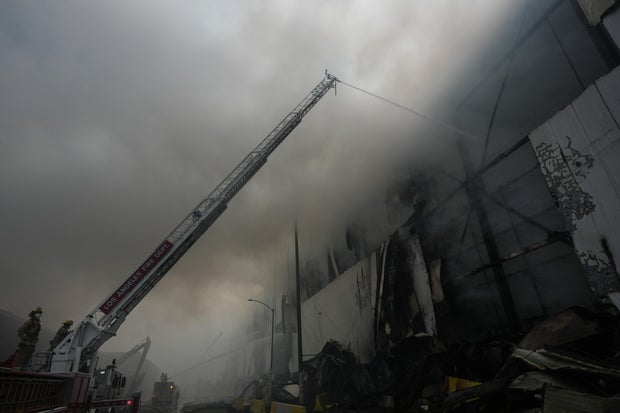
The massive food warehouse fire that blanketed parts of Los Angeles in smoke in June was not an isolated event, but one in a long run of fires at properties tied to one of the world’s largest cold storage companies, a CBS News investigation has found.
Federal records show that in the past decade there have been at least 63 fires of varying severity at properties run by Lineage, a company that operates temperature-controlled warehouses around the globe. The firm said it was aware of 34 fires at its various warehouses, including one in Finley, Washington, that burned for nearly two months.
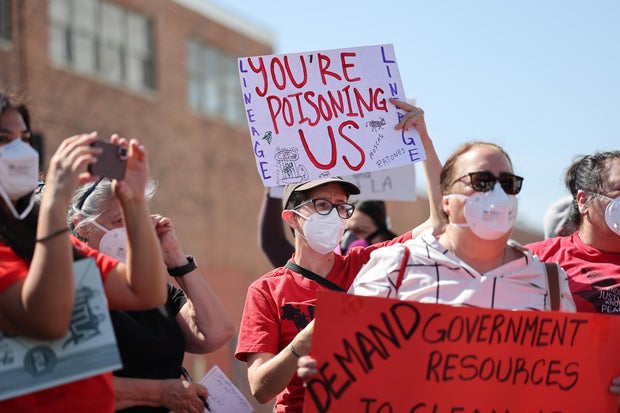
The company’s safety record has been under renewed scrutiny since the massive June 17 fire at a food storage warehouse in the Boyle Heights neighborhood of LA, where residents say they are still dealing with lingering odors, pests, and uncertainty about what pollutants they may have been exposed to.
“I feel that leadership at all levels — from Lineage to the city, to the state, even the federal government — has failed us,” one resident said during a contentious community town hall last month.
Lineage was leasing and operating the Boyle Heights warehouse that burned, which was owned by Chill Build LLC.
In a statement to CBS News, Lineage said that the company is working around the clock on odor control, pest control and the removal of food waste, and that it expects conditions to improve as the cleanup effort progresses.
Several Boyle Heights residents have since filed lawsuits against Lineage and other defendants — including Chill Build LLC, rooftop solar companies and contractors — alleging they failed to safely operate and maintain the facility, resulting in a preventable fire that exposed nearby residents to toxic smoke and hazardous pollutants.
AP Photo/Jae C. Hong
Chill Build told news outlet The LA Local that it spent millions of dollars on the fire response, but that Lineage is “responsible for all aspects of maintaining and repairing the facility” and “in charge of the recovery efforts.”
Lineage told CBS News that they believe the fire began on the roof while a contractor working for Altus Power, the owner of the rooftop solar array, was performing work on the system. Altus Power said that the cause of the fire and resulting damage has not yet been determined and that they would be responsive to authorities as they continue their investigation.
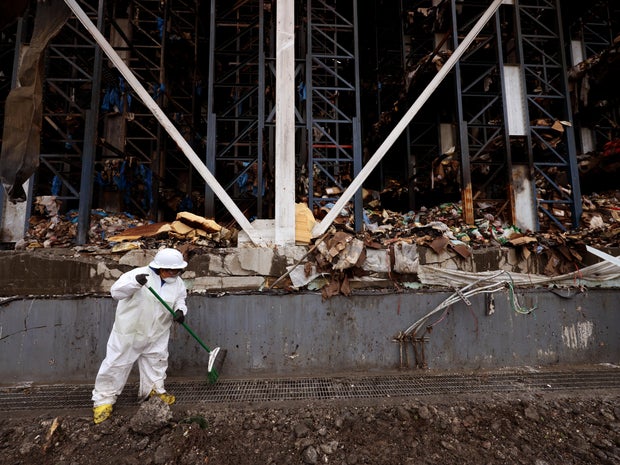
The June 17 fire quickly became one of the largest industrial fires in recent Los Angeles history, burning for more than a week and leaving behind an estimated 85 million pounds of spoiled food. Environmental health experts say the incident raises concerns that extend well beyond the lingering smell.
“When a fire burns right across the street from businesses and homes, it’s up there among significant industrial disasters in urban areas,” said Dr. Jill Johnston, an environmental health scientist at the University of California, Irvine. “It really adds to a burden that already exists around air toxics and health impacts.”
Lineage operates more than 500 temperature-controlled warehouses worldwide and says on its website that safety is its “number one value,” describing it as part of the company’s DNA.
But the Boyle Heights fire is not an isolated incident.
Genaro Molina/Los Angeles Times
A CBS News investigation identified at least 63 fires in and around Lineage facilities since 2016 involving the company’s buildings, vehicles or trash on its sites. The company acknowledged 34 building fires — including fires in Finley, Washington; Pasadena, Texas; Everett, Massachusetts; and a previous fire at the same Boyle Heights warehouse in 2024.
The figures come from a national database that about 70% of U.S. fire departments report to, listing all the fires they responded to each year.
Residents in Finley filed a class action lawsuit in April alleging pollution from the blaze contaminated surrounding air and water and contributed to illnesses and two deaths. Lineage says it “vigorously disputes” the lawsuit’s characterization of its safety record.
Government records also show Lineage has faced repeated enforcement actions since 2014, with regulators assessing more than $4.5 million in penalties for alleged workplace safety and environmental violations, including incidents involving hazardous chemical releases, according to government watchdog data collected by the group Good Jobs First, which tracks industrial incidents.
In January 2020, one worker died following an ammonia leak at a Lineage warehouse in Statesville, North Carolina. That incident was among several cited by federal and state regulators in enforcement actions involving Lineage facilities.
Experts say cold storage warehouses present unique risks because many rely on anhydrous ammonia refrigeration systems.
“What they use for cooling are very toxic chemicals,” Johnston said. “They can explode. If something goes wrong, these facilities have the potential to release massive amounts of toxic chemicals.”
Allen J. Schaben / Los Angeles Times via Getty Images
Lineage said that it is continuously monitoring air quality and sharing air-monitoring data with both local regulators and the public, and that it removed ammonia from the Boyle Heights warehouse shortly after the fire began. In a previous statement to CBS News, they said that “no measurable ammonia had been detected in the community at any time since the fire started.”
But Johnston pointed to air data from July showing ammonia levels were over 10 times higher near the warehouse than in other L.A. neighborhoods a month after the blaze was extinguished — though well below levels considered dangerous by authorities.
The Environmental Protection Agency wrote to Lineage on July 31 demanding information on the company’s safety compliance and any releases of hazardous chemicals during the fire.
Unlike many industrial facilities located far from neighborhoods, cold storage warehouses are often built close to homes, schools and businesses to speed up food distribution. In Boyle Heights, some residents live less than one block from the warehouse.
“I think what we’re seeing is really an unprecedented challenge, at least here, in both understanding and containing all the toxins that are still inside,” Johnston said.
Lineage told CBS News that it has consistently supported the community throughout the emergency response and subsequent cleanup and recovery effort. It said its workplace safety performance “outperformed the industry average.”
It added that it will “always strive for excellence” when it comes to safety, and that it has “a team of over 200 dedicated engineering, maintenance, safety, and compliance personnel focused on meeting that standard.”