
▶ Watch Video: Nanny testifies in Lindsay Clancy murder trial
On Day 7 of testimony in the Lindsay Clancy murder trial, the last nanny hired by the family testified that the Duxbury, Massachusetts, mother was “a wonderful mom who loved her kids.”
Clancy is charged with first-degree murder in the deaths of her three children: 5-year-old Cora, 3-year-old Dawson and 8-month-old Callan. She’s admitted to killing them in the basement of their home on Jan. 24, 2023.
Testimony ended for the day at noon. It resumes Thursday at 9 a.m. in Plymouth Superior Court.
Clancy family nanny testifies at trial
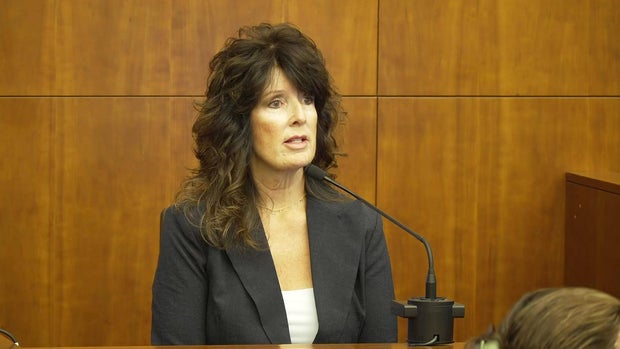
The prosecution’s 45th witness was Elaine Rossi, the Clancy family’s former nanny.
Rossi, from Kingston, said she had worked as a nanny for 15 years. She said she got the job with the Clancy family by responding to a Facebook posting from Lindsay in July 2022.
CBS Boston
Rossi worked with the family from September 2022 through early December 2022. It was understood that her primary role would be to take care of baby Callan once Clancy went back to work in November.
She said she would primarily communicate with the family via text message and notes left by Lindsay Clancy. Rossi worked three days a week from 8:30 a.m. to 1:30 p.m. and also did food preparation, light housekeeping and laundry for the family.
Rossi said she came to find out that Lindsay Clancy was dealing with mental health struggles.
“She shared with me that she was suffering from postpartum,” Rossi said.
She said she saw prescription bottles around the house, and Clancy told her she was not going to nurse Callan anymore because she was about to start a new medication.
But Rossi said she had no concerns about Clancy’s interactions with the children.
“None at all, she was a wonderful mom,” Rossi said.
She described the children in glowing terms.
“[Callan] was the happiest, sweetest, easiest baby,” Rossi said. “He was just a love.”
Lindsay Clancy cried during the nanny’s testimony, her shoulders shaking.
During cross-examination, defense attorney Kevin Reddington asked Rossi what she told Massachusetts State Police about Lindsay Clancy.
“I observed a wonderful mom who loved her kids,” Rossi said. “She was very concerned about their safety. She was very concerned with Callan’s eating and sleeping. She was a wonderful mother.”
Reddington asked Rossi if she remembered telling police, “I love my Lindsay.”
“Do I love Lindsay?” Rossi responded. “I did love Lindsay, yes.”
Drugs in Clancy’s system not at “suicidal level,” witness says
Forensic toxicologist Dr. Justin Brower described the amount of drugs detected in Lindsay Clancy’s system as consistent with a therapeutic level — not a “suicidal level.”
“Usually people take handfuls of pills when they’re trying to harm themselves and take their own life,” Dr. Brower said. “This was not consistent with that.”
Reddington asked Dr. Brower if he agreed that “the numbers alone do not tell the tale of what happened to a particular individual.”
“Correct, they do not tell the entire story,” the witness said.
Judge calls for break in Lindsay Clancy trial
As a forensic toxicologist was testifying about drugs found in Lindsay Clancy’s blood, Judge William Sullivan abruptly called for a break at about 10:12 a.m.
It’s not clear what led to the interruption. The break lasted for about 20 minutes.
Physician assistant treated Lindsay Clancy’s cuts
The first prosecution witness called Wednesday was Eitan Negri, who was working as a physician assistant at Brigham & Women’s Hospital in 2023.
He said he treated Clancy in Boston after the murders and testified that she had multiple lacerations on her wrists and “superficial” lacerations on her neck. Prosecutors have been arguing that Clancy wasn’t trying to die by suicide when she cut herself after the murders.
“Did you observe any active bleeding?” prosecutor Shanan Buckingham asked.
“No,” Negri said.
During cross-examination, Reddington had Negri confirm that Clancy was “critically ill” when he treated her and noted that Clancy had a cut that was 3.5 centimeters deep.
What’s happened in the Lindsay Clancy case?
Prosecutors argue that Clancy made a calculated decision to commit the murders and then faked a suicide attempt. The defense says she was overmedicated and experienced an extreme episode of postpartum psychosis.
Tuesday’s court proceedings focused mostly on evidence collected from the Duxbury home. Jurors were shown prescription pills that Clancy was taking at the time.
Clancy also spoke to the judge briefly to confirm that the defense and the prosecution agree on certain facts in the case. The defense wants the focus to be on why the killings happened, not who did it.
On Monday, the prosecution and defense both read aloud diary entries Lindsay Clancy made in the months leading up to the killings.
Prosecutors are expected to soon call to the stand psychiatrists who treated Clancy before the murders.
Clancy faces life in prison without a chance at parole if convicted. If she’s found not criminally responsible for the deaths of her children, she will be sent to a state mental health facility in Massachusetts.
If you or someone you know is in emotional distress or a suicidal crisis, you can reach the 988 Suicide & Crisis Lifeline by calling or texting 988. You can also chat with the 988 Suicide & Crisis Lifeline here.
For more information about mental healthcare resources and support, The National Alliance on Mental Illness HelpLine can be reached Monday through Friday, 10 a.m.–10 p.m. ET, at 1-800-950-NAMI (6264) or email info@nami.org.