
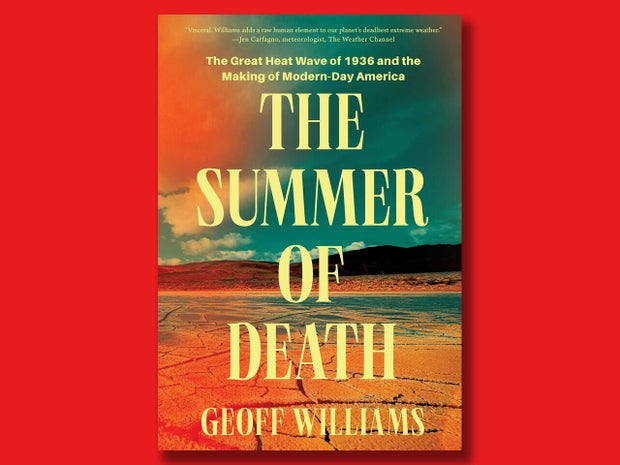
Book excerpt: Modesty on the line in ‘The Summer of Death’

summer-of-death-cover-pegasus-1280.jpg

Pegasus

We may receive an affiliate commission from anything you buy from this article.

In 1936, America suffered a devasting heat wave that resulted in five thousand deaths. But not all civic responses to the health emergency were reasonable.

In “The Summer of Death: The Great Heat Wave of 1936 and the Making of Modern-Day America” (published by Pegasus Books), author Geoff Williams recounts the actions taken in one Kentucky city with regard to the heat – namely, setting out to arrest women whose warm-weather attire was considered too revealing.

Read the excerpt below, and don’t miss Mo Rocca’s interview with Geoff Williams on “CBS Sunday Morning” August 16! 


Prefer to listen? Audible has a 30-day free trial available right now.


Kentucky

A group of guys patrolled the streets, seeking teenage girls and women dressed in shorts and halter tops on the streets of Covington. These men weren’t being creeps per se. A woman police officer named Elizabeth Cohran requested that her colleagues keep an eye out for any girls or women wearing any clothing that was deemed too revealing.

Miss Cohran was a product of her time, and the girls she was trying to look out for were a product of theirs. Cohran was a rarity in 1936 — a female police officer, known then as a police matron. The unmarried former nurse handled situations that the city government believed needed a woman’s delicate touch. For instance, if the authorities were looking for a teenage runaway girl, Cohran would get involved. If a young woman was pregnant and needed to find a home for her baby, Cohran was on the job. If a woman was the victim of abuse, you’d call Miss Cohran.

She did a lot of good in Covington, but this summer, she arguably went too far. She wanted any girl over the age of ten cited for indecent exposure if they were caught outside wearing scanty outfits, such as shorts.

“The heat of the past few days has brought them out,” Cohran told a reporter. “Now, I think the shorts and halters are perfectly lovely in the right place. The streets, however, are no place for them.”

She had been on a crusade against hot-weather garments since late the previous year. Not everyone in the area agreed with how Cohran saw things.

“I don’t think that under the law, shorts and halters would be defined as contributing to indecent exposure. They seem to have become an accepted custom,” said John Ames, acting secretary director of Cincinnati, in an interview.

Still, Cohran may have had a point, if you look at it from the viewpoint of a woman born in 1891. Maybe she encountered a lot of male deviants who couldn’t handle women wearing skimpy clothing. Cohran was living in an age in which masculinity and youth were prized (she shaved four years from her age when she applied to the police force). She probably believed she was saving young women from predators by ensuring they were well clothed.

Excerpted from “The Summer of Death: The Great Heat Wave of 1936 and the Making of Modern Day America” by Geoff Williams. Published by Pegasus Books, June 2026. Reprinted by permission. 


Get the book here:

“The Summer of Death” by Geoff Williams

Buy locally from Bookshop.org


For more info:

Inside ‘the Pool’: Fugitive arrested in alleged cross-border car trade scheme

▶ Watch Video: On the ground look from Eagle Pass, Texas, as illegal border crossings remain historically low Along the Texas-Mexico border, it's known as "the Pool." And this week, federal authorities say they caught one of the men accused of helping run it.Every year, drivers known as transmigrantes transport used cars bought in the United States through Mexico to be resold in Central America. Federal prosecutors say a group of South Texas businessmen found a way to monopolize the industry that took those cars across the border — fixing the fees, pooling their revenues and squeezing businesses that refused to comply. At the center of the scheme, authorities say, was Carlos Martinez, a Mission, Texas, businessman known as "Cuate" who controlled the transmigrante forwarding agency near the Los Indios border crossing in Texas' Rio Grande Valley. Prosecutors allege Martinez — the son-in-law of a former notorious Gulf Cartel leader — helped turn a cluster of supposedly competing businesses into a tightly controlled network of fixed prices, shared revenue, cash payments and intimidation. He pleaded guilty to federal charges and was sentenced to prison time.Working alongside him, prosecutors allege, was Rigoberto Brown, a dual U.S.-Mexican citizen who served in managerial roles on Martinez's behalf, helping him pull off the alleged scheme. Brown was charged in November 2022 with conspiring to fix prices and divide the market and with conspiring to monopolize the transmigrante forwarding business. Then he disappeared.For nearly four years, authorities say, Brown lived as a fugitive in Mexico. This week, they caught him near McAllen, Texas. He is set to be arraigned Friday in federal court in Houston. An alleged price-fixing 'empresa'For years, much of the traffic moved by transmigrantes was funneled through one place.Before March 2021, Mexican regulations required commerce to enter Mexico through the Los Indios Port of Entry in South Texas, according to the federal indictment. That created a concentrated industry around the crossing, where forwarding agencies helped drivers handle the customs paperwork and other requirements needed to get their vehicles into Mexico.Thousands of vehicles moved through the system, generating millions of dollars a year in forwarding agency revenue, according to prosecutors. Federal authorities allege a group of operators found a way to control it.Beginning as early as 2011, prosecutors say, forwarding agencies agreed on prices instead of competing for customers, choosing to inflate prices and divide the market among themselves.Participating businesses allegedly collected their revenues centrally and divided the money according to agreed-upon percentages. Prosecutors say the operation was so organized, participants used charts and spreadsheets to keep track of the arrangement and communicated about prices and revenues throughout meetings and in calls, texts and exchanges on social media and messaging applications.Some participants referred to the collective enterprise as the "empresa" — Spanish for "the company" — according to the indictment. But prosecutors say controlling prices was only one part of the operation.Vehicles carrying secondhand cars and other goods line up in Los Indios, Texas, as they prepare to go through Mexico on Dec. 19, 2006. Many of the transmigrantes come from as far as Washington, New York and California. AP/Valley Morning Star, Gabe Hernandez
Read Next Story