
Arson suspect in Spokane wildfire had prior manslaughter conviction

▶ Watch Video: Arson suspect arrested as Spokane fires ravage buildings, force tens of thousands to evacuate

A 37-year-old man was arrested Monday for allegedly starting the largest of the three devastating Spokane, Washington-area wildfires that are leaving some residents with nothing.

Aaron Farinacci, a Spokane resident who has a prior manslaughter conviction, was booked on suspicion of first degree arson in connection with the Old Trails Fire and was being held on $1 million bond, the Spokane County Sheriff’s Office said.

Authorities began investigating Farinacci after a witness saw him kneeling near grass where the fire began, Spokane County Sheriff John Nowels told a press conference late Monday.

“We believe it was matches or a lighter. When he was detained … he was found to be in possession of some waterproof matches and a butane lighter,” the sheriff said, adding that Farinacci was only arrested in connection with the Old Trails Fire.

With some 67,000 people under evacuation orders amid the three blazes, hundreds could be coming home to total losses.

“All of our memories are gone,” said Anna Andreachi, a Spokane resident whose home was lost in the blaze. “My dad just died, and all of his stuff was still in there, too.” 

More than 700 buildings in the Spokane area have been destroyed, and another 400 have yet to be assessed, officials said Monday. 

“It’s a nightmare situation,” Washington Gov. Bob Ferguson said. “This is likely the worst natural disaster in Spokane history.”

Nowels confirmed Tuesday that there have been no fatalities from the fires so far, and everyone who had been reported missing in the area has been located.
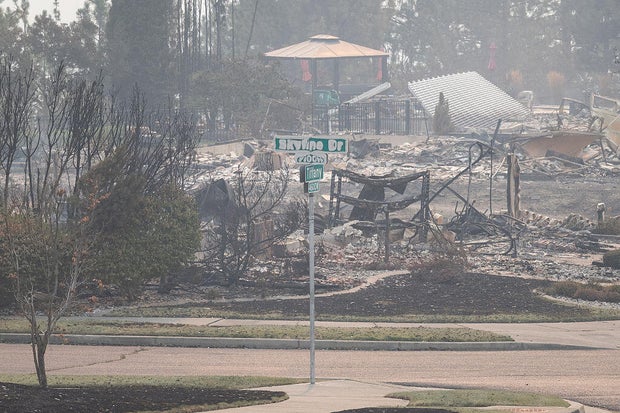
US-ENVIRONMENT-WILDFIRE
A partially melted street sign sits in front of a burned out residential home in the Balboa neighborhood of Spokane, Washington, on August 2, 2026.

Erick Doxey / AFP via Getty Images

Joe Cvancara and his family managed to save their home by digging a fire line. But his neighbor’s home and at least eight others in the area were destroyed. 

Cvancara said he’s grateful but that it feels like “almost survivor’s guilt, in a way. Like, wow. So we’re going to open our home to our neighbors. I know it’s going to take a long time to rebuild.”

The fires began Saturday, when extreme drought, bone-dry brush, high heat and wicked winds combined to create a dangerous environment for fires to spread quickly. Firefighters went door to door trying to save as many homes as they could, but were soon overwhelmed.   

The Old Trails Fire and the Fairview Fire are both still burning, but the main focus for firefighters on Sunday and Monday was the Autumn Lane Fire.

The heat and wind that initially fueled the fires had died down by the beginning of the week, but the dangerous conditions are expected to return by Wednesday.

Daniel Ramey, a spokesperson for the California Interagency Incident Management Team 7, which is taking part in the firefighting efforts, told CBS News that the next few days could be critical for firefighting efforts.

“It looks like Wednesday into Friday we’re going to be seeing a heat trend up to the 90s, so it’s really time for us to put in the work … on this fire up north and continue the efforts with getting the communities back into their homes as soon as possible below us,” he said.
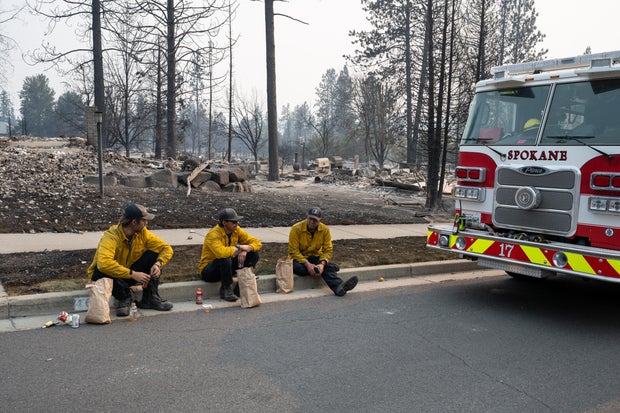
TOPSHOT-US-ENVIRONMENT-WILDFIRE
Three members of the Spokane Fire Department sit on a curb in front of burned down homes in the Balboa neighborhood of Spokane, Washington, on August 2, 2026. 

Erick Doxey / AFP via Getty Images

Ramey said that while the three fires aren’t particularly big compared to other notable wildfires, the issue is that they have occurred in what’s known as the wildland-urban interface — areas where human structures sit on the edge or within the wilderness.

“There’s always a chance when you live next to trees and grass and the beautiful nature that you’re going to have a potential for fire like we saw,” he said. “We didn’t have rain for the whole month of July in this area, so everything was extremely dry. Everything was susceptible to those new starts, like we saw.”

For the Pacific Northwest, this has been one of the worst fire seasons in three decades. At least 16 major fires are burning in Washington state. In Utah, a fire has burned nearly 70,000 acres after doubling in size Monday. The Big Rock Fire in southeastern Idaho has burned more than 2,500 acres and forced evacuations.

Ramey warns things could get worse, with California still relatively quiet so far but firefighting resources already stretched thin.
Fact check: How Tim Scott and a Republican attack ad misleadingly snipped key context from El-Sayed’s ‘dangerous’ speech

(CNN) — The leader of Senate Republicans’ campaign arm, Sen. Tim Scott, said in a Sunday interview on CNN that people should believe something Democratic Senate candidate Abdul El-Sayed supposedly said about himself. But Scott took El-Sayed’s quote out of context. So did an attack ad released last week by the group Scott chairs.The National Republican Senatorial Committee’s online ad has generated attention and criticism for using the full legal name of El-Sayed, a Muslim former public health official who is running in Michigan against Republican former congressman Mike Rogers. But the ad is also notable for how, like Scott, it uses a misleadingly snipped “dangerous” comment to bolster its case that El-Sayed is a radical.How Scott and the NRSC ad portrayed El-Sayed’s wordsIn the CNN interview on Sunday, Scott claimed of El-Sayed: “He says he’s the most dangerous candidate you can find. He’s right. We should trust his words, not ours.” The 30-second ad features a one-second video clip of El-Sayed shouting, “I’m pretty damn dangerous” – immediately before turning to an attack on El-Sayed’s stance toward the Muslim Brotherhood in Egypt in the early 2010s.What El-Sayed actually said, in fullThe full video of El-Sayed’s remarks, at a July 25 campaign event during the Democratic primary he won, shows he was arguing that he is an ally to struggling Americans and merely “dangerous” to a list of corporate and political interests he claimed are “rigging our policies against us.” The NRSC ad and Scott’s remark on CNN didn’t acknowledge that the “dangerous” identifier was directed at specific targets, nor that El-Sayed was rejecting the notion that he is broadly “dangerous” to Americans.Here’s the full context.El-Sayed said his critics “always use this word around me: dangerous,” then added sarcastically, to some audience laughter, “I always wonder, like, why would you call someone like me dangerous? It’s not like people who look like me have ever been called dangerous. It’s not like you’re falling into a well-worn groove that’s been around for 25 years calling people who look like me with names like mine dangerous. I know that’s not what you’re doing, right?”He continued: “I’ll just say this. Go ask a child who needed a pair of glasses in Detroit if I’m dangerous. Go ask the folks who could not breathe because of smokestacks spewing out sulfur dioxide if I’m dangerous. Go ask the parents of kids who are going to schools that were leaded if I’m dangerous. Go ask the people flooded in medical debt if I’m dangerous. I think what they’ll tell you is: He’s the best friend you might have if you want government to work for you. I’ll tell you what: If you’re AIPAC, I’m pretty damn dangerous. If you’re Big Pharma, I’m dangerous. If you’re Big Tech and want to put a data center in your backyard, I’m dangerous. If you’re a big bank that wants to collude against us, I am dangerous. If you’re a monopolist who wants to raise our prices, I’m dangerous. If you’re Chuck Schumer, I’m pretty damn dangerous. And I think it’s about damn time we had Democrats who are willing to be dangerous for all the people rigging our policies against us.”Even the RNC previously provided significantly more contextIn a social media post on the day of El-Sayed’s speech, the Republican National Committee posted a 15-second clip of El-Sayed saying: “If you’re a big bank that wants to collude against us, I am dangerous. If you’re a monopolist who wants to raise our prices, I’m dangerous. If you’re Chuck Schumer, I’m pretty damn dangerous.”That’s not El-Sayed’s entire monologue, of course, but it’s a fair edit – clearly demonstrating that El-Sayed was not generally admitting he’s a “dangerous” man but rather identifying himself as “dangerous” to big businesses supposedly hurting the public and to Schumer, the Democratic Senate leader the party’s left has long criticized.The NRSC, meanwhile, posted a clip that day showing El-Sayed saying: “If you’re Chuck Schumer, I’m pretty damn dangerous.” Even that four-second clip was fairer than the one-second, zero-context version of the “dangerous” quote the NRSC used in the ad.Asked by CNN this week whether the ad did not take El-Sayed’s “dangerous” comment significantly out of context, NRSC spokesperson Joanna Rodriguez said in an email, “As you mentioned, yes, Abdul El-Sayed did in fact say he was dangerous.” Rodriguez went on to list some El-Sayed remarks she argued were examples of dangerous campaign rhetoric from him and to repeat the attacks from the 30-second ad.Republicans are entitled to argue that El-Sayed is dangerous and has said dangerous things. But Scott purported to be quoting El-Sayed’s own words, and he didn’t fairly convey those words. The ad didn’t either.The-CNN-Wire™ & © 2026 Cable News Network, Inc., a Warner Bros. Discovery Company. All rights reserved.
Read Next Story